Skip to content
Briefings are running a touch slower this week while we rebuild the foundations.See roadmap
Iran Conflict 2026
21APR

Tankers self-impose Hormuz blockade

1 min read
10:51UTC

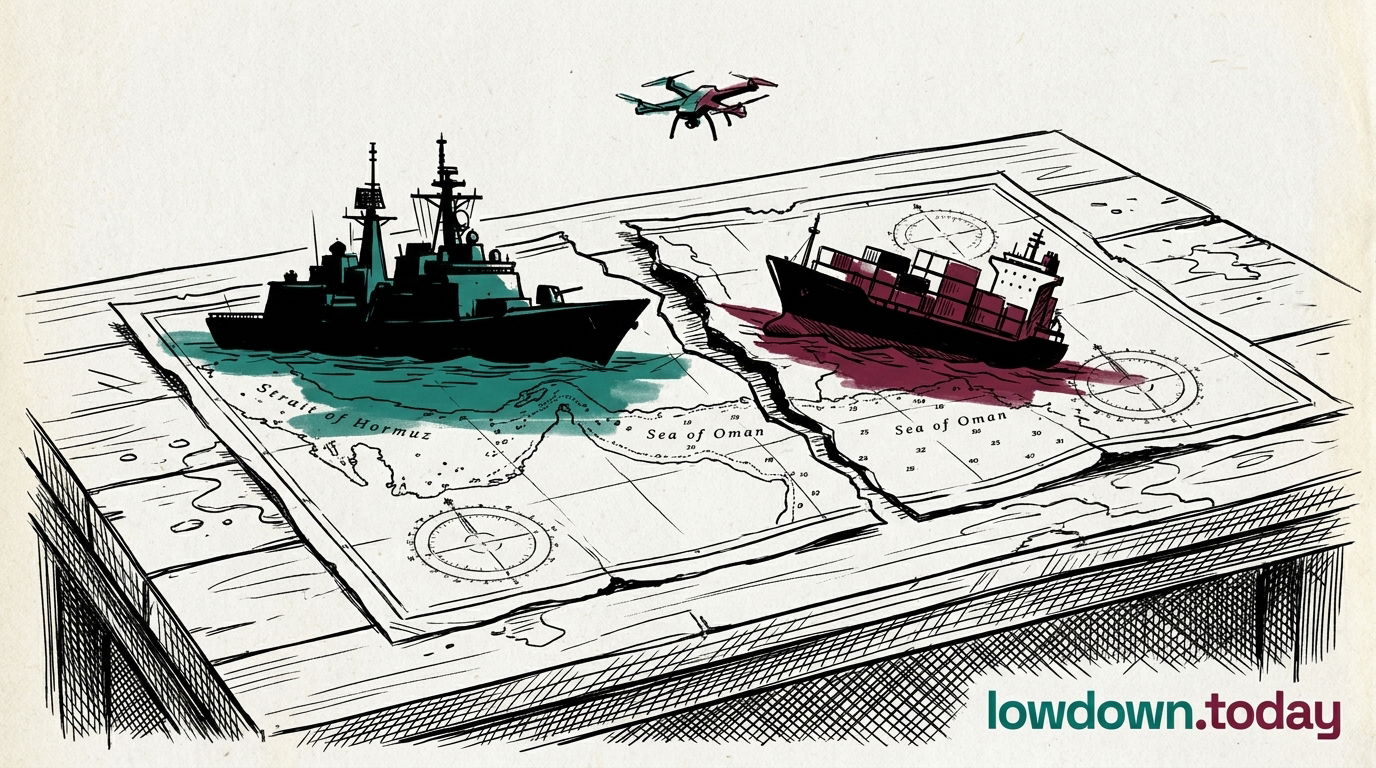
Oil tankers began voluntarily avoiding the Strait of Hormuz following the 28 February 2026 strikes on Iran, achieving a partial chokepoint effect through commercial risk calculation rather than Iranian military interdiction.

ConflictDeveloping
Key takeaway

Commercial tanker avoidance of Hormuz achieves partial supply disruption without requiring Iranian military action, and will reverse rapidly once a credible de-escalation signal appears.

Voluntary avoidance of Hormuz by tanker operators achieves, in functional terms, some of the same supply-disruption effects as an Iranian blockade — without requiring Iran to take the naval action that would have constituted a direct casus belli for further US military response.

Approximately 20 million barrels per day transited Hormuz in 2025 — around 20% of global oil supply and 30% of global liquefied natural gas. Voluntary tanker avoidance does not halt all transit, but it reduces throughput and drives insurance premiums on vessels that do proceed to prohibitive levels. Lloyd's of London and other marine war-risk insurers will reclassify the Gulf as a war-risk zone within hours of the strikes, adding several hundred percentage points to insurance costs and making many voyages commercially unviable even if the physical route remains open.

The difference between voluntary avoidance and a formal Iranian blockade is reversibility. Commercial tanker operators are risk-averse but economically rational: if the military situation stabilises or a credible de-escalation signal emerges, traffic will resume within days. A formal Iranian blockade would require negotiated lifting and military verification, potentially taking weeks or months. Voluntary avoidance is therefore a more moderate and more reversible disruption than the worst-case scenario — which is precisely why markets are pricing $80–100 rather than $150–200.

What could happen next?
  • Meaning

    Short term · Assessed
  • Meaning

    Short term · Assessed
  • Meaning

    Short term · Assessed
First Reported In

Update #2 · Five cities struck on opening night

CNN· 28 Feb 2026
Read original
Causes and effects
This Event
Tankers self-impose Hormuz blockade
Tanker avoidance of Hormuz, through which approximately 20% of global oil transits, creates immediate supply disruption risks and freight cost spikes.
Different Perspectives
Israel
Israel
The IDF struck a Lebanese army unit on 6 June, killing a colonel, and privately told Moscow that shelling near Bushehr was accidental, per Putin's SPIEF disclosure. Israel is advancing in Lebanon past an unenforced ceasefire text while maintaining a back-channel to Russia on nuclear-site deconfliction.
Lebanon
Lebanon
President Aoun told CNN on 5 June that Iran uses Lebanon as a bargaining chip and urged Hezbollah toward diplomacy; on 6 June an IDF strike killed a Lebanese army colonel on the Khardali-Nabatieh road. The Lebanese state is publicly rejecting Iranian tutelage while the army sustains casualties from Israeli fire and the Washington framework remains unenforced.
Bahrain
Bahrain
Bahrain's US Fifth Fleet headquarters was among the targets in the 5-6 June two-country salvo; its PAC-3 magazine stands at 87 per cent depletion with an 18-month resupply gap and no comparable arms sale has been announced. The state is defending a critical US regional command on a thinning interceptor stock.
Kuwait
Kuwait
Kuwait received a $1.98bn US counter-drone sale approval on the same day IRGC missiles targeted its bases; it expelled two Iranian diplomats on 4 June and filed a formal protest. The arms approval gives Kuwait a future capability but leaves a 6-18 month delivery gap that the salvo tempo is already pressing.
Russia
Russia
Putin reaffirmed Russia's offer to hold Iran's 440.9 kg HEU at SPIEF on 6 June, said Russia is not arming Iran, and disclosed that both the US and Israel privately told Moscow that shelling near Bushehr was accidental. The restatement casts Moscow as the only remaining mediator both sides call, a position serving Russian interests whatever the nuclear file produces.
Iran
Iran
The IRGC, per Iranian state media, fired seven ballistic missiles at US bases in Kuwait and Bahrain, the largest two-country salvo of the war, and framed the launches as lawful retaliation; Foreign Minister Araghchi rejected Aoun's bargaining-chip accusation and Velayati warned Beirut against diplomatic naivety. Tehran has sent no HEU counter-proposal since Araghchi confirmed no progress on 4 June.