Skip to content
Briefings are running a touch slower this week while we rebuild the foundations.See roadmap
Iran Conflict 2026
15APR

CENTCOM intercept tally pauses at 33

2 min read
09:40UTC

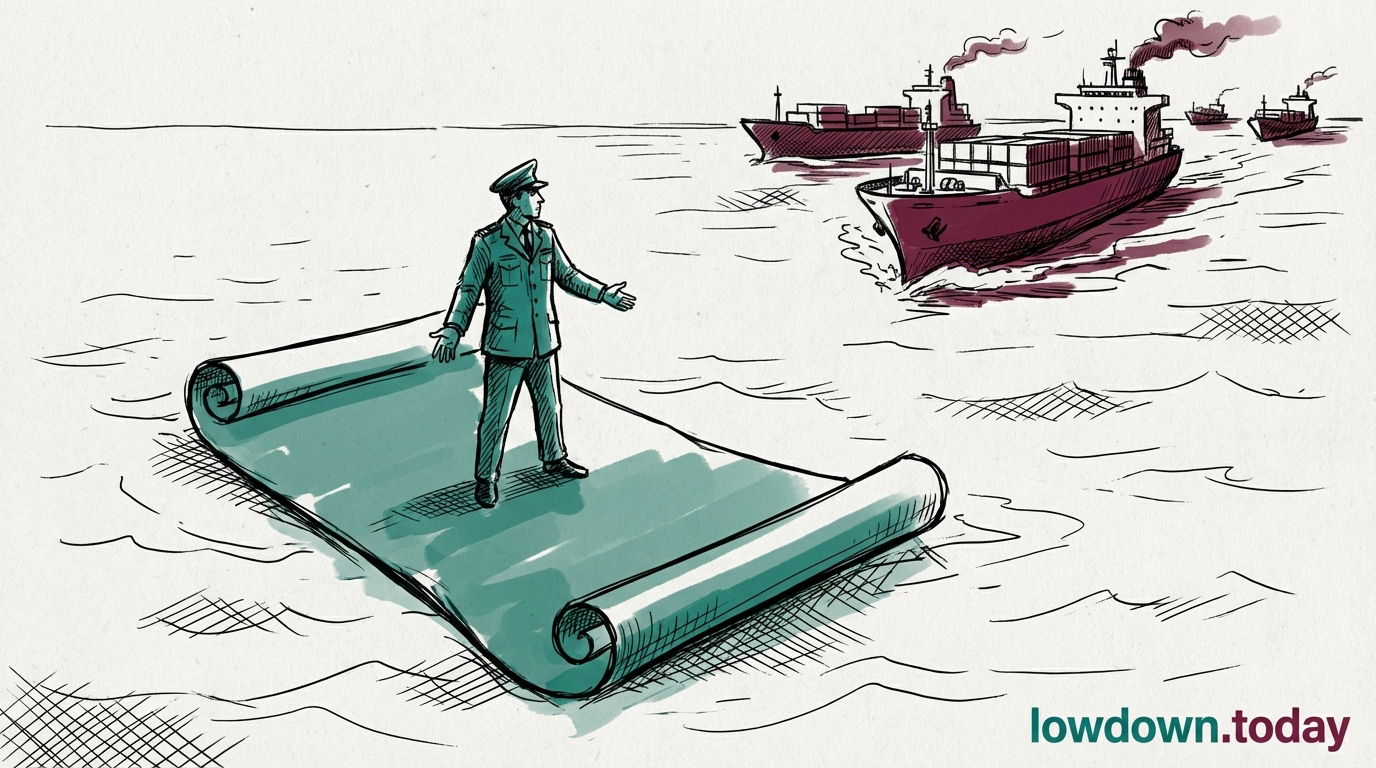
CENTCOM's vessel-redirection count held at 33 for a second straight day on Saturday 25 April, the first such pause since the Hormuz blockade began.

ConflictDeveloping
Key takeaway

CENTCOM intercepts pause at 33 the day after the IRGC ends its self-restraint declaration.

CENTCOM's cumulative count of vessels redirected under the Hormuz blockade held at 33 ships through Saturday 25 April, the first two-day pause since enforcement began . The pace had been climbing in step-twos and threes since early April; the flatline is the first quantitative signal that the intercept curve has either stopped finding fresh targets or that CENTCOM has tightened its definition of what counts. CENTCOM is the United States Central Command, the combatant command running the Hormuz enforcement.

The pause sits inside a verbal escalation on the Iranian side. The Islamic Revolutionary Guard Corps declaration on Friday 24 April that its "self-restraint is over" was a public lifting of the constraint that had governed IRGC small-craft behaviour through the indefinite ceasefire. Two trajectories now run alongside each other: an enforcement count that has stopped rising and a threat posture that has verbally escalated.

The likeliest mechanical explanation is that the population of ships approaching the strait under insured-tonnage rules has collapsed. The dark-fleet baseline means the only remaining Hormuz transits run without insurance and often without AIS, narrowing the candidate pool CENTCOM can credibly intercept. A static count against an invisible denominator does not measure deterrence; it measures the absence of legal traffic.

Deep Analysis

In plain English

Since the blockade started, the US military has been redirecting ships away from Iranian ports or seizing some outright. The count hit 33 on 25 April and then stopped rising for two days in a row, which is unusual. At the same time, Iran's Revolutionary Guard publicly announced it was no longer holding back from attacking US bases in countries that host American troops. These two things together suggest the enforcement operation is running low on ships to stop, partly because insured commercial shipping has already left the area, and partly because the only ships still using the strait are the unlicensed dark-fleet tankers that are harder to intercept under existing US rules.

What could happen next?
  • Meaning

    A static intercept count while IRGC declares end of self-restraint is the worst combination for insurance-market repricing: neither deterrence nor de-escalation has occurred, and P&I clubs have no signal to reinstate cover.

    Short term · Assessed
  • Meaning

    If CENTCOM's intercept count remains flat while IRGC fast-attack activity increases, the enforcement operation transitions from coercive to custodial, managing a closed strait rather than reopening it.

    Short term · Assessed
  • Meaning

    The plateau removes CENTCOM's ability to demonstrate forward progress to congressional critics asking whether the blockade is working.

    Short term · Assessed
First Reported In

Update #80 · Three carriers, zero instruments

Army Recognition / The War Zone· 26 Apr 2026
Read original
Different Perspectives
Qatar
Qatar
Qatar holds approximately $12 billion in frozen Iranian assets that Tehran named as the precondition for any Hormuz reopening sequence; with Oman sidelined and no agreed HEU custodian, the asset-routing architecture that any deal requires has no operational channel and no neutral financial intermediary to run it through.
Hengaw and Iranian civilian population
Iranians face an internet capped at 40 per cent by hardware their president cannot dismantle, field killings that leave no court record, and judicial executions running in parallel; Hengaw, based in Norway, is the primary remaining monitor of a repression system the IRGC is deliberately moving beyond auditable records. The real toll is higher than any single monitor's count.
China
China
China supplied deep-packet-inspection hardware that caps Iran's internet at 40 per cent and enables an instant on-demand blackout, and was barred by Trump as a potential HEU custodian on 27 May. Beijing gains from Iran's continued non-alignment with the West while the DPI sale extends Chinese surveillance-technology exports as a geopolitical instrument.
Pakistan
Pakistan
Foreign Minister Ishaq Dar met Rubio in Washington on 29 May, formally inheriting the role of sole active mediator after Oman's forced withdrawal. Pakistan lacks Oman's banking infrastructure for frozen-asset routing and carries its own regional stakes, making it a less structurally neutral broker for the Qatar-held $12 billion sequencing.
Kuwait
Kuwait
Kuwait invoked Article 51 of the UN Charter after absorbing an Iranian ballistic-missile strike on Ali Al Salem Air Base on 28 May, becoming the first Gulf state to make a formal individual self-defence claim in the war. The invocation creates a legal record enabling a future bilateral defence-pact activation without yet triggering it.
Oman
Oman
Oman denied any Hormuz toll plan within hours of Bessent's 28 May threat, absorbing a sanctions warning from the country it has brokered for since 1981. The rapid capitulation preserved the channel formally, but Tehran now knows Washington will threaten its own mediator, which changes Muscat's calculus on how far it can lean into any joint-management architecture.