Skip to content
You can now search across every topic, entity and event.What's new
Iran Conflict 2026
23AUG

Sea drones push into the Black Sea

2 min read
19:02UTC

Ukraine's maritime drone campaign left the Sea of Azov overnight on 15 July under the name Operation MoLoChKa, hitting 20 vessels in a single night.

ConflictDeveloping
Key takeaway

Shadow-fleet anonymity defeats sanctions enforcement and leaves those same ships with nobody to defend them.

Ukraine's maritime drone campaign moved out of the Sea of Azov and into the Black Sea overnight on 15 July, under the name Operation "MoLoChKa", striking 20 vessels in one night: 17 oil tankers, two gas tankers and a tugboat 1. Two of the named targets, the Louise 1 and the Banda, were running dark on AIS, the automatic identification system merchant ships are required to broadcast, while carrying Russian crude in breach of the price cap set by the G7 group of industrial democracies and the EU. An SBU Sea Baby uncrewed boat had hit the tanker Blue near Yalta a week earlier, on 8 July. The Unmanned Systems Forces struck twelve more vessels on 17 July, taking the 6 to 17 July total to 159 shadow-fleet vessels across both seas 2.

Eleven days before the expansion, the same campaign was a chokepoint tactic confined to the Azov, where it cut tracked traffic by 55% . The Azov is shallow, narrow and effectively closed; the Black Sea is neither, and holding vessels at risk across it demands range and endurance the Azov operations never had to demonstrate.

The G7 and EU price cap runs on insurance certificates and port-entry checks, and a tanker that switches off its transponder, reflags through a shell registry and transfers cargo ship-to-ship outside territorial waters encounters none of them. Sea drones do not need to establish ownership before they arrive. The harder a vessel works at being untraceable, the fewer parties can be identified to protect it, and opaque ownership stops being cover and starts being exposure.


Deep Analysis

In plain English

Ukraine has been using naval drones to attack tankers that carry Russian oil while avoiding Western sanctions. This campaign expanded from the smaller Sea of Azov into the much larger Black Sea overnight on 15 July, under the name Operation MoLoChKa, hitting 20 vessels in a single night. Twelve more were struck two days later, taking the running total to 159 ships hit between 6 and 17 July. The tankers being targeted are part of what is often called Russia's "shadow fleet": ageing ships that turn off their tracking signals and use flags of convenience to keep moving Russian oil to buyers despite the price cap Western governments have imposed. By hitting them directly, Ukraine is making that trade physically dangerous rather than only illegal on paper.

First Reported In

Update #24 · Fedorov sacked as the front stands still

Militarnyi· 19 Jul 2026
Read original
Causes and effects
Different Perspectives
Hizballah
Hizballah
Has not commented on the US Treasury's 20 August designation of ten people, including named couriers, over a cash network Treasury says moved money to it from the IRGC-Qods Force. ACLED recorded a sharp rise in attacks around it the same day.
Kuwait
Kuwait
Kuwait's Chief of the General Staff, Lieutenant General Khaled al-Shriaan, co-chaired the 16th US-Kuwait Joint Military Commission at the Pentagon on 21 August. Kuwait has not published what was agreed; only a summary of the meeting's existence and attendees is sourced.
Qatar
Qatar
Has not commented publicly on the $4.5bn KC-46A tanker Foreign Military Sale notification the State Department approved on 20 August. The notification opens a sale process; Doha has not confirmed whether it will proceed to a signed transfer.
Mohammad Bagher Ghalibaf
Told a Baghdad business meeting on 20 August that Iran will not endure a hungry population regardless of its military strength, against 87.9% point-to-point inflation and 128.1% food inflation for Tir. His fellow Majlis Economic Committee member Samsami separately warned a petrol price rise would ignite unrest.
US Navy
US Navy
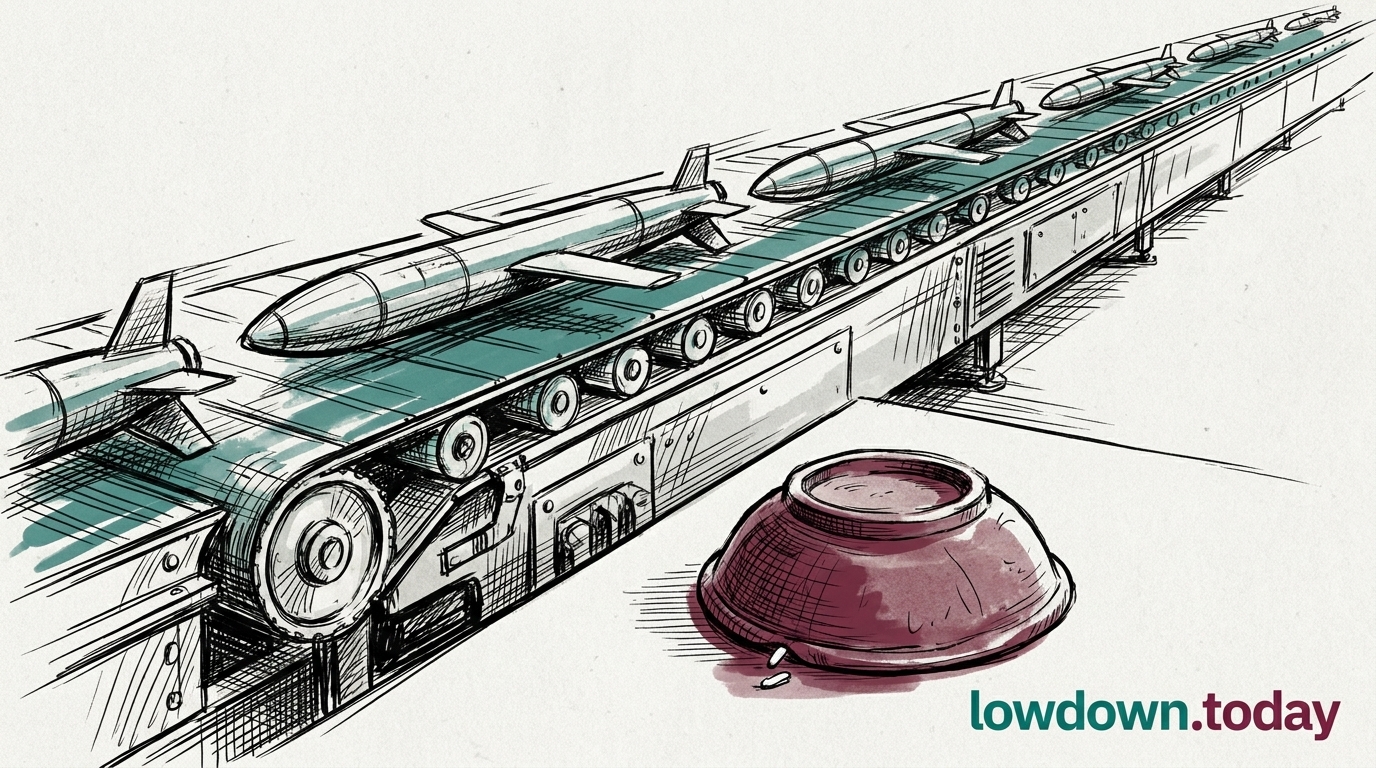
Signed a $22.9bn, seven-year contract with Raytheon on 17 August to raise Tomahawk output from about 60 a year to more than 1,000. The Acting Navy Secretary, quoted via an X post, framed it as the "Arsenal of Freedom" initiative; it replaces the 850 missiles fired by 1 April in about ten months at the new rate.
UK Maritime Trade Operations
UKMTO logged six armed men boarding a tanker 136 nautical miles east of Al Mukalla on 20 August and redirecting it toward Somalia. A vessel steered toward the Somali coast reads as an attempted seizure, a distinct hazard from the stand-off strikes the same lane has seen before.



