Skip to content
You can now search across every topic, entity and event.What's new
Iran Conflict 2026
23AUG

Germany flips to hard net injection

3 min read
19:02UTC

Germany pushed 1,207.5 GWh/day into storage on 27 June with zero withdrawal, its hardest net injection of the season, lifting national fill to 41.21% with no state mandate behind it.

ConflictDeveloping
Key takeaway

Cheap gas at EUR 40-44 let Germany fill caverns and run power plants at once, no mandate needed.

Germany pushed 1,207.5 GWh/day into storage on 27 June with zero withdrawal, the hardest net injection its anchor estate has run all season 1. The next gas day held at 1,136.6 GWh/day. National fill climbed from 39.9% on 25 June to 41.21% on 28 June, a 1.3-point gain in three days with no state mandate behind it 2.

Germany holds the largest gas storage estate in the European Union, so when it draws down through a refill season the whole bloc's trajectory sags. Through April and May, with TTF (the Dutch Title Transfer Facility benchmark) at EUR 47 to 52, injection economics never cleared, and Germany kept withdrawing while Dutch, French and Italian state mandates carried the refill .

At EUR 40 to 44, gas finally sits cheap enough to feed the CCGT (combined-cycle gas turbine) power stack and the injection caverns at once. German day-ahead power blew out on 30 June to a level that normally pulls every available molecule into turbines and starves storage. Shippers supplied both this time, because the prompt now sits low enough that power burn and cavern-filling stop bidding against each other for the same gas.

The cheapness driving the flip traces to The Gulf. TTF fell into the low EUR 40s after the Iran risk premium drained out of the prompt on 17 June , the same oscillation that now clouds the autumn supply Europe is banking on. The molecules filling the caverns at today's price are cheap precisely because the market doubts the cargoes due in the autumn will all turn up.

Deep Analysis

In plain English

Storing gas in underground caverns is only profitable if the gas is cheaper to buy today than it will be in winter. If winter prices are not much higher than summer prices, storage companies have no reason to fill up now. Through spring 2026, gas was priced at EUR 47-52 per megawatt-hour and winter delivery contracts were barely any higher, so storage companies sat on their hands. In late June, gas prices fell sharply to EUR 40-44 because tensions in the Persian Gulf, a stretch of water through which much of the world's liquefied gas travels, temporarily eased. At EUR 40-44, winter contracts suddenly looked noticeably more expensive, making it profitable to buy summer gas and sell winter contracts. At the same time, power stations were buying gas to generate electricity at EUR 195 per megawatt-hour, but because gas itself was cheap there was enough supply in the market for power stations and storage operators to buy simultaneously. The two stopped competing for the same gas.

Deep Analysis
Root Causes

Germany abolished the gas storage levy on 1 January 2026, leaving no fiscal instrument to subsidise commercial injection. The January 2026 capacity auctions cleared zero lots, confirming that no new capacity mechanism filled that gap. Both absences mean the 27 June injection rate has one explanation: EUR 40-44 TTF front-month.

That EUR 40-44 level is itself the product of two 17 June events: the US-Iran risk premium draining as the memorandum moved toward signature, and the Russian short-term pipeline ban binding with no price snap-back.

At EUR 40-44, winter-delivery contracts commanded a EUR 5-8/MWh contango premium above the front-month, creating a positive injection carry that exceeded cavern access costs of EUR 0.50-1.00/MWh round-trip. Commercial operators injected not because they were incentivised to, but because the forward curve paid them to store.

What could happen next?
  • Consequence

    Germany's commercial injection at EUR 40-44 TTF demonstrates that European storage fills without emergency mandates when the prompt-winter strip is positive, reducing the political urgency for extending emergency storage regulation beyond 2026.

    Short term · Assessed
  • Risk

    If TTF rebounds above EUR 47-52 on Hormuz re-escalation, Germany's commercial injection incentive narrows and EU aggregate fill pace reverts to mandate-driven operators in the Netherlands, France, and Italy alone.

    Immediate · Reported
  • Opportunity

    A sustained EUR 40-44 TTF window through July could add 3-4 percentage points to German fill by mid-August, meaningfully narrowing the gap to the OIES base-case trajectory.

    Short term · Assessed
First Reported In

Update #22 · Germany refills as the autumn cliff nears

GIE AGSI+· 30 Jun 2026
Read original
Different Perspectives
Hizballah
Hizballah
Has not commented on the US Treasury's 20 August designation of ten people, including named couriers, over a cash network Treasury says moved money to it from the IRGC-Qods Force. ACLED recorded a sharp rise in attacks around it the same day.
Kuwait
Kuwait
Kuwait's Chief of the General Staff, Lieutenant General Khaled al-Shriaan, co-chaired the 16th US-Kuwait Joint Military Commission at the Pentagon on 21 August. Kuwait has not published what was agreed; only a summary of the meeting's existence and attendees is sourced.
Qatar
Qatar
Has not commented publicly on the $4.5bn KC-46A tanker Foreign Military Sale notification the State Department approved on 20 August. The notification opens a sale process; Doha has not confirmed whether it will proceed to a signed transfer.
Mohammad Bagher Ghalibaf
Told a Baghdad business meeting on 20 August that Iran will not endure a hungry population regardless of its military strength, against 87.9% point-to-point inflation and 128.1% food inflation for Tir. His fellow Majlis Economic Committee member Samsami separately warned a petrol price rise would ignite unrest.
US Navy
US Navy
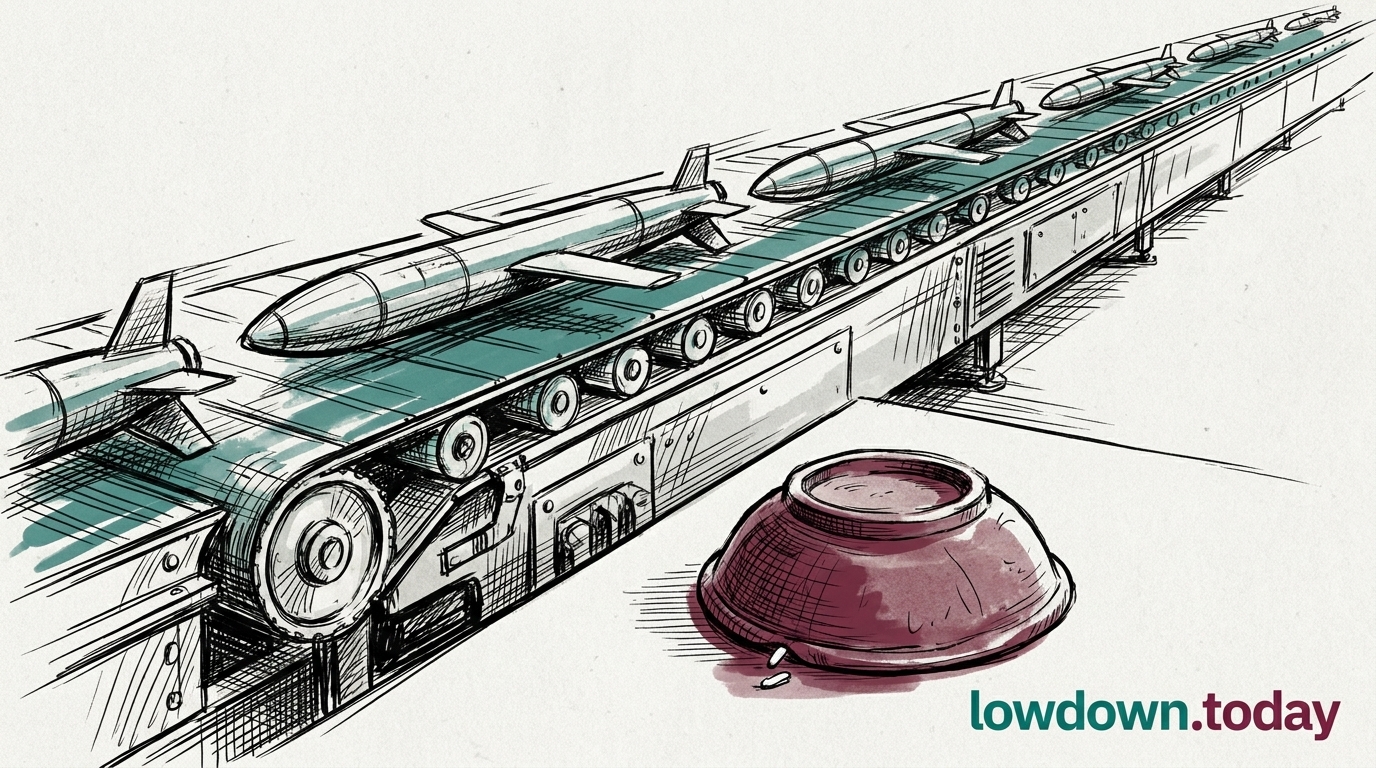
Signed a $22.9bn, seven-year contract with Raytheon on 17 August to raise Tomahawk output from about 60 a year to more than 1,000. The Acting Navy Secretary, quoted via an X post, framed it as the "Arsenal of Freedom" initiative; it replaces the 850 missiles fired by 1 April in about ten months at the new rate.
UK Maritime Trade Operations
UKMTO logged six armed men boarding a tanker 136 nautical miles east of Al Mukalla on 20 August and redirecting it toward Somalia. A vessel steered toward the Somali coast reads as an attempted seizure, a distinct hazard from the stand-off strikes the same lane has seen before.