Skip to content
You can now search across every topic, entity and event.What's new
Iran Conflict 2026
19JUL

TTF swings EUR 9 in a week

3 min read
14:05UTC

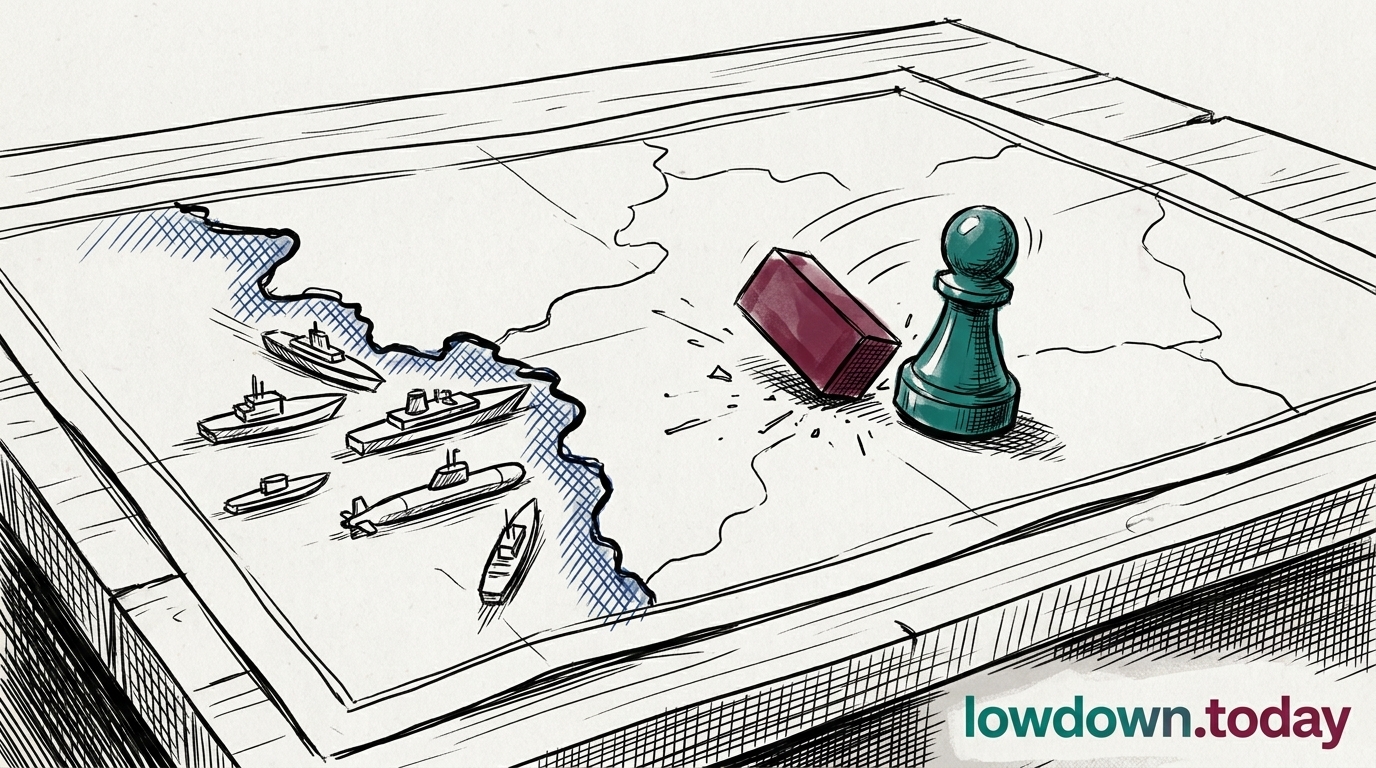
Ceasefire relief drove a 20% drop to EUR 44/MWh; a Hormuz blockade threat from President Trump bounced it back within days.

ConflictDeveloping
Key takeaway

TTF moved EUR 9 in a week on political headlines with no change in physical supply.

TTF (Title Transfer Facility, the European gas benchmark) peaked near EUR 70/MWh in March, fell a fifth to EUR 44/MWh on the ceasefire announcement day, then bounced to EUR 47.27/MWh by mid-April when President Trump threatened a Strait of Hormuz blockade. The week's range: EUR 44-53/MWh. No LNG cargo has transited Hormuz for over a month.

Physical supply did not change across that week; no new cargoes arrived, no facility restarted, no storage injection rate shifted. Price moved on political statements alone. For utilities hedging summer procurement and industrials managing feedstock costs, the signal-to-noise ratio in TTF has deteriorated sharply.

Argus Media data shows the summer-winter spread has inverted, with summer contracts trading above winter, a structure that reflects the market pricing injection-season scarcity rather than the normal seasonal pattern of cheap summer gas and dear winter gas.

Deep Analysis

In plain English

TTF (Title Transfer Facility) is the main price benchmark for natural gas in Europe, similar to how Brent crude is the oil price benchmark. It is traded on the ICE exchange in the Netherlands and its price influences gas bills across Europe. This week, that price swung by 20% in a single day, and then bounced back again when another headline came out. This kind of volatility is unusual and makes it very difficult for businesses that use large amounts of gas to plan their costs. It also reflects genuine uncertainty about whether the disruption to global LNG supply will get worse or better.

Deep Analysis
Root Causes

TTF's price sensitivity to geopolitical news reflects the absence of Hormuz LNG transit for over a month, which has created a persistent optionality premium in forward prices.

Market participants are pricing both current tightness and the probability distribution of supply scenarios: full Hormuz closure for six months (implying EUR 80+/MWh), gradual reopening over four weeks (implying EUR 50-55/MWh), or immediate normalisation (implying EUR 38-40/MWh based on physical storage fundamentals alone).

The structural factor amplifying this sensitivity is that EU gas storage entered the period with no buffer: at 40-50% fill, a geopolitical news event would move TTF by EUR 2-4/MWh. At 28-29% fill, the same event moves it by EUR 8-12/MWh because the insurance value of physical supply is proportionally higher.

Escalation

No LNG cargo has transited Hormuz for over a month. Each week that transit remains suspended reduces the probability that markets will price a swift return to normal, pushing the physical fundamentals anchor higher. If Hormuz remains closed through May, the EUR 53/MWh weekly high may become the new floor.

What could happen next?
  • Risk

    Sustained TTF volatility above EUR 44/MWh makes it commercially unattractive for gas storage operators to inject volumes at risk of a price collapse, slowing the injection season further.

  • Consequence

    Gas-fired power generators facing intraday TTF swings above EUR 5/MWh are reducing day-ahead market participation, reducing power market liquidity and widening electricity price spreads.

First Reported In

Update #1 · Europe's thinnest gas cushion since 2018

Argus Media· 13 Apr 2026
Read original
Causes and effects
This Event
TTF swings EUR 9 in a week
The week's EUR 44-53/MWh range demonstrates that geopolitical headlines now move European gas prices faster than physical supply changes, complicating hedging and procurement timing.
Different Perspectives
China's foreign ministry
Spokesman Lin Jian rejected Treasury Secretary Scott Bessent's 25 August warning that Iranian oil buyers face an "economic D-Day", saying sanctions do not help and that Beijing would safeguard its own rights and interests. China's Iranian crude imports had already halved for unrelated reasons.
Iraq's government and Erbil authorities
Erbil authorities said 10 explosive-laden drones were shot down over the city on 1-2 September with no casualties. Iraq's government condemned the attacks without naming Iran as their source, and neither Washington nor Baghdad confirmed the IRGC's claim to have hit US bases there.
Bahrain Defence Force
The General Command said air defences intercepted several Iranian missiles and drones on 1-2 September and called the use of such weapons against civilians and private property a flagrant violation of international humanitarian law.
Kuwait's Fire Force and foreign ministry
KUNA reported a hostile Iranian drone struck a residential complex in Kuwait City on 2 September; Fire Force spokesman Brigadier General Mohammad Al-Gharib said losses were confined to property. Kuwait's foreign ministry called the attack a clear breach of its sovereignty.
Jordan's Armed Forces
Petra carried a statement that air defences intercepted eight missiles violating Jordanian airspace early on 31 August and 10 of 13 fired on 1 September. The statement named no target and did not address the IRGC's claim to have struck Camp Titin and killed US personnel.
CENTCOM
CENTCOM
CENTCOM's 1 September target list named IRGC air defence, radar, maritime and mine-laying sites in Iran but no tanker, after Axios reported anonymous officials describing a Trump-approved "tanker for tanker" drone policy. A CENTCOM spokesman declined to confirm the policy and referred questions to policymakers.