Skip to content
Briefings are running a touch slower this week while we rebuild the foundations.See roadmap
Iran Conflict 2026
6JUN

HRW demands freeze of arms to Israel

3 min read
12:17UTC

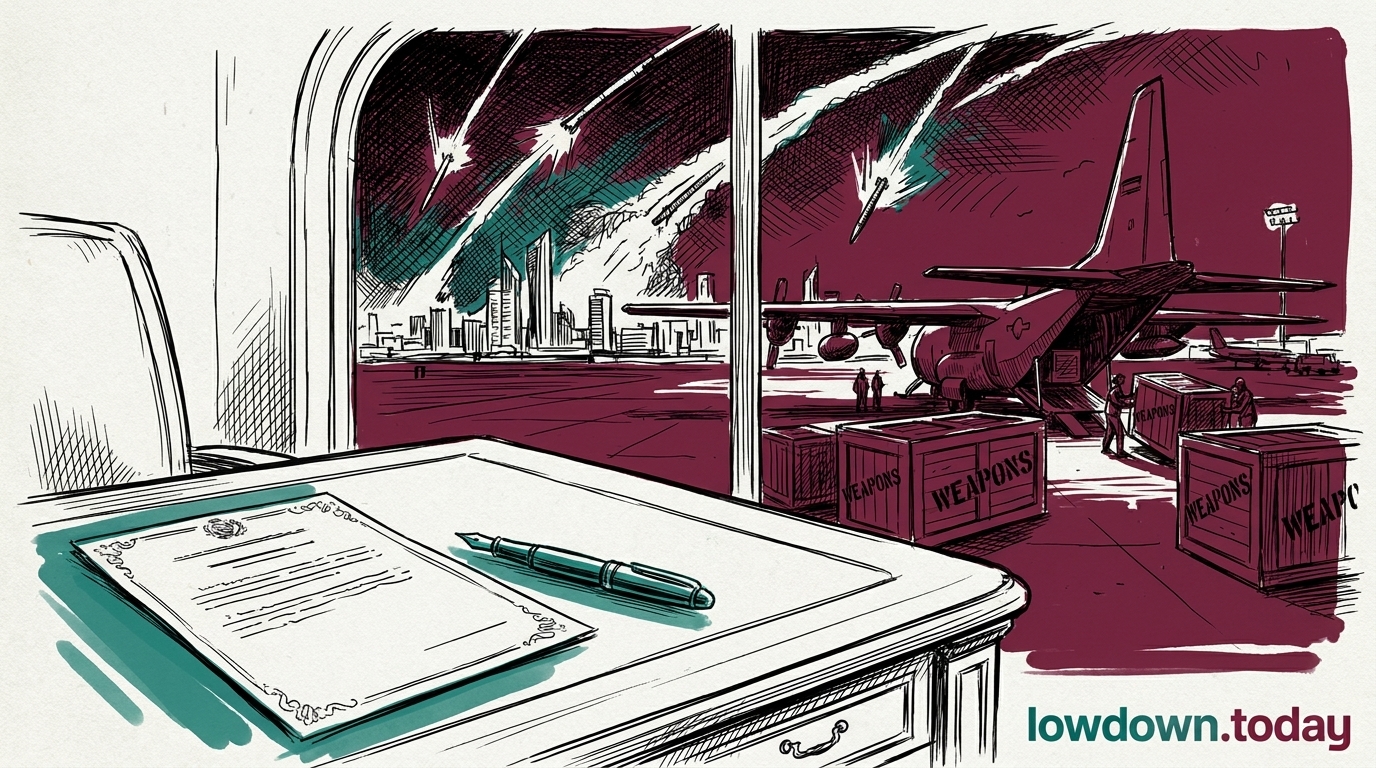
Human Rights Watch invoked the Arms Trade Treaty to demand the US, UK, and Germany halt military transfers — and one of those governments has already done it once, over Gaza, under the same prime minister.

ConflictDeveloping
Key takeaway

HRW's report converts a moral argument into a live legal liability for UK and German governments, using a "clear risk" standard that their own prior conduct has already validated.

Human Rights Watch published a formal report on 2 March calling on the United States, United Kingdom, and Germany to suspend all military assistance and arms sales to Israel and impose targeted sanctions on officials credibly implicated in grave crimes. The legal basis: under the Arms Trade Treaty, state parties must not authorise transfers where there is a 'clear risk' of use to commit serious violations of International humanitarian law. Ramzi Kaiss, HRW's Lebanon researcher, stated: 'When war crimes and other grave abuses take place with complete impunity, they are likely to happen again.'

The demand lands on three different legal surfaces. The UK suspended some arms transfers to Israel in September 2024 over the Gaza campaign — a precedent set under the same Starmer government now in office. That government has since authorised US use of Diego Garcia and RAF Fairford for strikes on Iranian missile and launch sites , while simultaneously telling Parliament that Britain would not join offensive operations, citing the lessons of Iraq 2003 . The ATT obligation exists independently of the UK's operational role: London must assess whether weapons already transferred to Israel are being used in violations, regardless of whether British forces participate directly.

Germany faces parallel obligations as an ATT state party and a major European arms supplier to Israel. The United States has not ratified the ATT, placing The Administration outside the treaty's requirements. Congress retains an independent mechanism, however: war powers resolutions. Senator Mark Warner, vice-chairman of the Senate Intelligence Committee, has stated publicly that he saw 'no intelligence' supporting the administration's imminent-threat justification for the strikes , and war powers challenges to the campaign's legal authority are active. If those challenges succeed, the legal basis for continued military transfers in the context of the current operation narrows accordingly.

The UK's September 2024 suspension covered only some categories of transfers and did not halt Israel's military operations in Gaza. The ATT entered into force in 2014 but has never been invoked against a major supplier during an active, expanding conflict in which that supplier is itself operationally involved — as the UK now is through its base authorisations. Whether the treaty's Article 7 risk assessment requirement can function as a real-time constraint, rather than a retrospective legal judgement, is the question HRW's report has placed before three governments simultaneously.


Deep Analysis

In plain English

The Arms Trade Treaty is an international agreement signed by over 110 countries that prohibits weapon sales when there is a clear risk those weapons will be used to commit serious war crimes. HRW is not merely making a moral appeal — it is formally documenting that the legal threshold for mandatory suspension has been met. In the UK this matters because courts have already shown they will review government arms export decisions and overturn them: a Court of Appeal ruling in 2024 forced the UK government to suspend some Israel arms licences over Gaza. With 787 people now confirmed killed in Iran across 131 cities, HRW is building an evidentiary record in real time — each additional documented casualty strengthens the "clear risk" argument under the treaty's Article 7.

Deep Analysis
Synthesis

The HRW report creates a compounding legal dynamic: as the body's own casualty figures mount daily, the evidentiary threshold for "clear risk" under ATT Article 7 becomes progressively easier for litigants to meet in domestic courts. The report is therefore not a static NGO publication but a legal instrument whose coercive force increases with each briefing cycle — meaning the UK and German governments face growing legal exposure regardless of whether they respond to the report itself.

Root Causes

The structural weakness HRW is exploiting is the ATT's reliance on domestic implementation with no international enforcement body: the only coercive mechanism is national courts applying national interpretations of treaty obligations. The UK and Germany ratified the ATT with differing implementing legislation, creating jurisdiction-specific vulnerabilities — Germany's arms export law was already under constitutional challenge before this conflict. The US's non-ratification insulates it from this legal vector entirely, concentrating the alliance's legal exposure on its two most significant European partners.

Escalation

Legal escalation is the most probable near-term trajectory: the same UK NGOs that successfully litigated the 2024 Gaza suspension (Campaign Against Arms Trade, Al-Haq) have the standing, the precedent, and now a fresh evidentiary basis to seek emergency judicial review. German courts face parallel pressure under the stricter domestic Kriegswaffenkontrollgesetz, which imposes obligations beyond the ATT itself. Each day of documented civilian casualties in Iran strengthens the claimants' case, compressing the timeline before a legal challenge becomes very difficult to resist.

What could happen next?
1 precedent2 risk1 consequence1 meaning
  • Precedent

    The UK's September 2024 suspension under an active government creates a domestic legal pathway that can be re-activated by the same NGO litigants under the same courts — a formal suspension precedent the government cannot credibly argue does not exist.

    Immediate · Assessed
  • Risk

    If UK or German courts compel suspension during active operations, it could fracture the political cohesion of Western support for Israeli operations and trigger secondary diplomatic tensions within the alliance at a moment of simultaneous strategic stress over Iran.

    Short term · Assessed
  • Consequence

    The US faces no ATT legal exposure but the war powers resolutions cited face a historically poor success rate against executive arms transfer authority, meaning HRW's pressure on Washington is structurally weaker than on London and Berlin.

    Short term · Assessed
  • Risk

    Targeted sanctions demands against named officials set a precedent for individual criminal accountability that, if adopted, could complicate post-conflict diplomatic normalisation by creating personal legal jeopardy for officials who might otherwise participate in peace processes.

    Medium term · Suggested
  • Meaning

    The HRW report's evidentiary value grows with each day of the conflict — its legal force is not fixed at publication but accumulates, making delay in government response a compounding rather than a resolving strategy.

    Immediate · Assessed
First Reported In

Update #14 · Natanz unverified; Hormuz sealed

HRW· 3 Mar 2026
Read original
Causes and effects
This Event
HRW demands freeze of arms to Israel
The report tests whether the Arms Trade Treaty functions as a constraint during active hostilities. The UK's September 2024 partial suspension of Israeli arms transfers provides a domestic legal precedent under the same Starmer government that has now authorised British bases for the campaign.
Different Perspectives
IAEA (Board of Governors, Vienna)
Grossi's 4 June Board report invoked 'loss of continuity of knowledge' on Iran's 440.9 kg stockpile after 97 days without access, the IAEA's formal finding that the evidentiary break cannot be retroactively closed. A Board censure resolution before 12 June would harden Iran's refusal to restore access.
Russia (Kremlin / SPIEF)
Putin reaffirmed Russia's offer to hold Iran's uranium at the St Petersburg Economic Forum on 6 June, positioning Moscow as the preferred custodian even after Trump vetoed the arrangement on 27 May. The offer allows Russia to present itself as a constructive actor while the IAEA verification gap renders any custodian arrangement unworkable.
Bahrain (Government and US Fifth Fleet host)
Bahrain's PAC-3 magazine reached 87% depletion after the 5 June IRGC salvo, with its resupply last in a Camden queue behind Qatar and Saudi Arabia. Manama hosts the US Fifth Fleet with terminal air defences that the supply chain cannot replenish before 2027.
China (Ministry of Commerce)
Washington designated Shanghai Qianye Energy on 5 June, the first mainland Chinese firm under Iran energy sanctions this war, the same week Beijing was pitched as a uranium custodian. China has not yet invoked its Blocking Statute; whether it absorbs the designation as a calibrated cost or retaliates is unresolved.
Iran (IRGC and Expediency Council)
The IRGC fired seven ballistic missiles at US bases in Kuwait and Bahrain on 5 June and Rezaei doubled the asset precondition to $24bn on 6 June, blocking both military and diplomatic de-escalation simultaneously. Tehran's hardliners are setting terms the civilian Foreign Ministry cannot override.
Trump administration (White House)
Trump claimed the uranium was 'entombed' and the deal '95% done' on 4 June, while signing no Iran executive instrument across Days 99-100. The gap between presidential assertion and signed executive action is now 100 days wide and structurally unchanged.



