Skip to content
Briefings are running a touch slower this week while we rebuild the foundations.See roadmap
Iran Conflict 2026
31MAY

Athlete Benyamin Naqdi sentenced to death

2 min read
09:14UTC

A Shiraz Revolutionary Court sentenced martial-arts champion Benyamin Naqdi, 26, to death on Saturday 30 May on a moharebeh charge, with state media airing a forced-confession video.

ConflictDeveloping
Key takeaway

Iran sentenced a named young athlete to death as wartime judicial repression continues alongside the conflict.

A Revolutionary Court in Shiraz sentenced martial-arts champion Benyamin Naqdi, 26, to death on Saturday 30 May on a moharebeh charge 1. moharebeh, "enmity against God", is a capital offence under Iranian law. Naqdi was arrested on Saturday 3 January during protests in Shiraz, and his lawyer said the charge relates to a flammable canister at a demonstration.

State media aired a forced-confession video, a recurring feature of wartime judicial messaging in Iran, where televised confessions are routinely obtained under duress and later retracted by defendants. The sentence continues the pattern of moharebeh convictions against protest detainees that Amnesty tallied in its count of political executions since the February war start . Naqdi's profile as a named champion gives the case unusual visibility, and it hands the international campaign against the executions a recognisable face at a moment when Washington is seeking allied legitimacy for its blockade.

Deep Analysis

In plain English

Benyamin Naqdi is a 26-year-old martial arts champion arrested on 3 January 2026 during protests in Shiraz. On 30 May, an Iranian Revolutionary Court sentenced him to death on a charge of 'enmity against God', which carries the death penalty. His lawyer says the specific act that triggered the charge was related to a flammable canister during a demonstration. The Shiraz court also followed an established pattern from this conflict: it aired a video of Naqdi appearing to confess. Iranian courts have used forced-confession videos in protest cases since the 2019 crackdown. Human rights monitors consider these confessions inadmissible because they are made under conditions where the detainee has no access to independent legal counsel. Naqdi still has the right to appeal to the Supreme Court and to the pardons commission. Iran's execution of protest detainees since February 2026 has reached 39 confirmed cases, per Amnesty International's 28 May count.

Deep Analysis
Root Causes

Revolutionary Courts in Iran operate outside the normal judiciary; their judges are appointed by the Supreme Leader, and their rulings on national-security matters are not subject to the same evidence standards as civilian courts. During periods of mass protest, these courts have historically processed cases in batches, accelerating timelines when political conditions allow.

The forced-confession broadcast is not incidental: Iranian law requires a public confession for certain capital charges to proceed. Broadcasting it on state media both satisfies the legal requirement and transmits a deterrent signal. The timing on 30 May, simultaneous with the Situation Room meeting in Washington, creates a domestic audience context: Iranian state media can frame the sentence as sovereignty assertion against a foreign enemy, not as internal repression.

What could happen next?
  • Risk

    If Naqdi is executed before any diplomatic resolution, his case will become an anchor point for international sanctions arguments against any post-conflict normalisation, as Karami's execution did for the 2023 JCPOA revival talks.

First Reported In

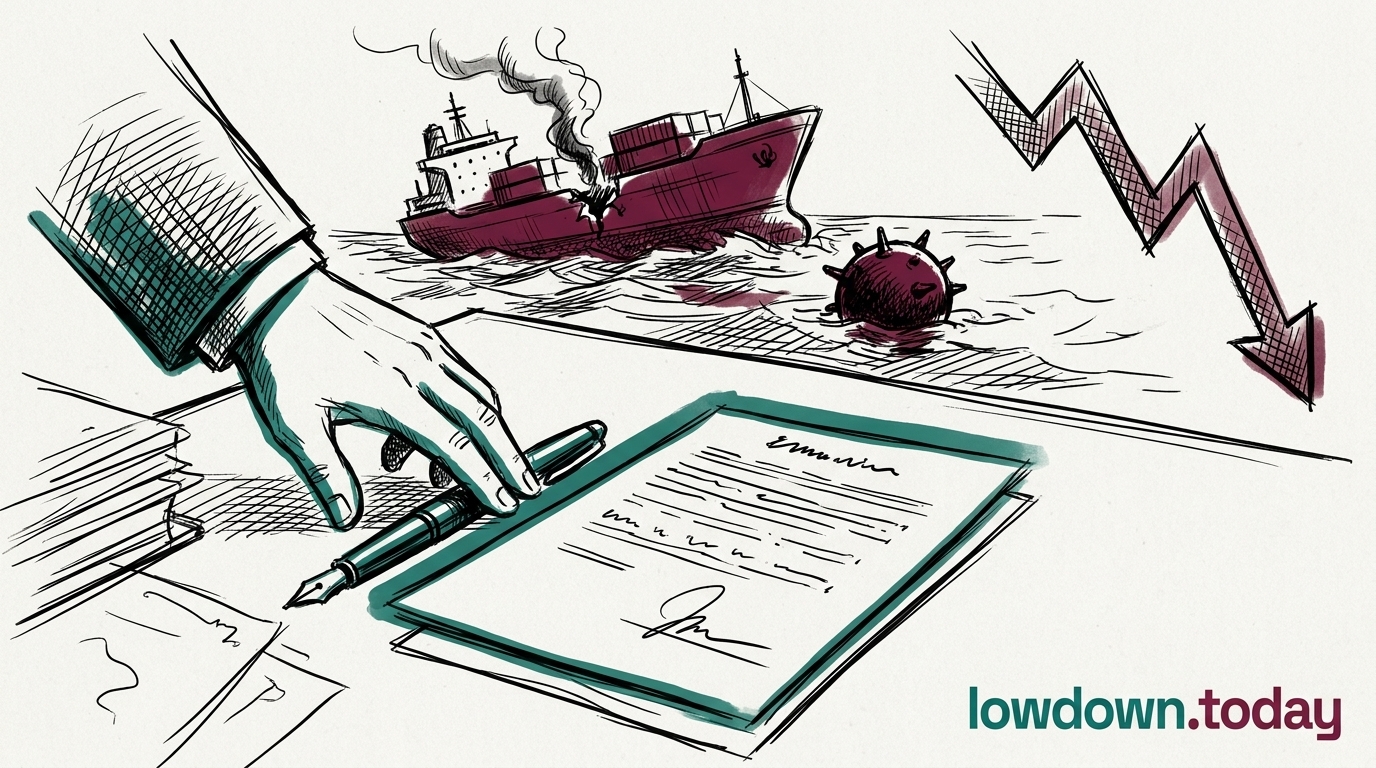
Update #113 · Trump signs nothing as a Hellfire hits a hull

Iran International· 31 May 2026
Read original
Different Perspectives
Iran human rights monitors (Amnesty International, Iran HRM, Hengaw)
Monitors documented 30 women held on capital moharebeh charges in a basement prison ward, Benyamin Naqdi's death sentence with a forced-confession broadcast, and 39 political executions since February. Iran's security courts have processed protest cases at uninterrupted wartime tempo regardless of the diplomatic track.
Lloyd's of London (war-risk underwriters)
Lloyd's held its Hormuz war-risk designation at $10-14 million per voyage while Brent fell 19%, maintaining a structural divergence from futures pricing. Underwriters require a UN Security Council resolution or government certification letter, not diplomatic optimism, before de-listing the strait.
Oman (Sultan Haitham's government)
Muscat issued a mine alert in its own territorial waters while denying any Hormuz toll plan after US Treasury threatened sanctions. A suspected mine in Omani waters on the same weekend as US financial pressure forces Muscat to demonstrate sovereignty without appearing to choose sides.
China (PRC)
China (PRC)
Beijing sent scholars rather than its defence minister to Shangri-La for the second year running and addressed Taiwan and multilateralism without mentioning Iran. China maintains its bilateral energy corridor protection with Tehran while refusing the diplomatic exposure of a public position at multilateral forums.
Iran Supreme National Security Council
The SNSC framed the unsigned MOU as a 10-point Iranian victory with enrichment already recognised, and the foreign ministry rejected Trump's nuclear conditions within hours. Tehran treats each unsigned day as validation that Iran has retained its stockpile without surrendering it.
Trump administration (CENTCOM/White House)
Trump posted three non-negotiable public conditions while CENTCOM disabled a commercial ship and Hegseth threatened resumed strikes from Singapore. The administration treats the unsigned MOU as leverage to extract maximum Iranian concessions before any ceasefire instrument is committed to paper.