Skip to content
Briefings are running a touch slower this week while we rebuild the foundations.See roadmap
Iran Conflict 2026
21MAY

Four unsigned deadlines in twelve days

4 min read
09:55UTC

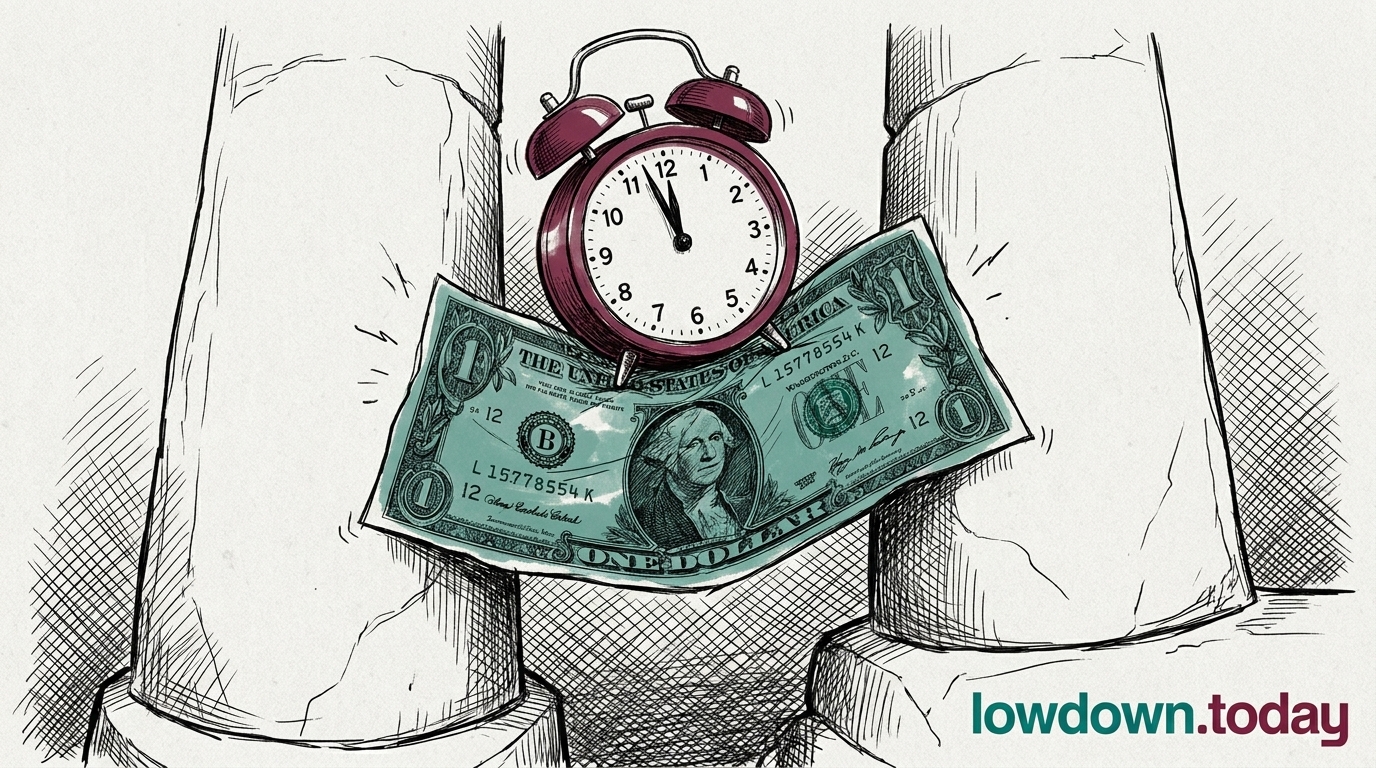
GL-U lapses 19 April, the Iran ceasefire expires 22 April, the Lebanon truce expires around 26 April, and the War Powers 60-day clock runs out 29 April, all without signed US paper behind them.

ConflictDeveloping
Key takeaway

Four deadlines, one method; the period between Saturday and 29 April is the most legally exposed window of the war.

The calendar from 19 April to 29 April is not four events. It is one stack. GL-U lapses on Saturday . The Iran two-week ceasefire expires on Tuesday. Regional officials told Bloomberg and the Associated Press that the sides reached an in-principle two-week extension; Karoline Leavitt said the US has not formally requested one, and no signed text has been published. The Lebanon truce announced on Truth Social runs out around Sunday 26 April. The War Powers Resolution 60-day clock, triggered by the 28 February start of hostilities, runs out on Wednesday 29 April following the House 213-214 defeat and the Senate 47-52 defeat .

Leavitt's line is the cleanest evidence the method documented across this briefing is still live: "The US has not formally requested a ceasefire extension." An in-principle agreement reported by two wires has not produced a signed disclosure from the podium that would normally carry it. The Iran ceasefire will therefore either receive a public text before the ceasefire clock running out, or it will converge in a single week with three other unsigned deadlines, each of which behaves differently when it meets an institution that responds to paper rather than posts.

Those institutions are distinct. OFAC is a Treasury function; its clock is mechanical and cannot be argued with. Congress is a political function; the WPR 60-day mark creates leverage for a third floor vote but does not compel one. The Iran and Lebanon ceasefires are foreign-policy instruments; they rely on verbal assurance, spokesperson statements and the operational posture of military forces retaining unilateral self-defence rights. The four deadlines are therefore not uniform pressure on a single actor. They are uniform pressure on the method, applied through four different institutional surfaces at once.

Every prior administration that ran a war past day 48 had produced signed paper by this point. The Trump administration has produced Enbridge Pipeline permits and a budget sequestration order. The topic-specific silence on Iran means the 19-29 April window is not a tempo pinch. It is a deliberate test of whether rhetoric can carry legal weight when the instruments it substitutes for start demanding their documented form. Base case is that GL-U lapses cold, the Iran ceasefire gets a verbal extension, Lebanon holds to 26 April and the WPR runs out without a third floor vote. The upside risk is Hawley forcing an AUMF vote at day 60, which would produce the first signed Iran instrument of the war under the most adversarial conditions available.

Deep Analysis

In plain English

Four different legal and political deadlines fall within 12 days of each other: an oil sanctions licence expires on 19 April, the Iran ceasefire runs out on 22 April, the Lebanon ceasefire ends around 26 April, and the legal 60-day limit on US military action without Congress's approval hits on 29 April. None of these have been set up with formal signed agreements, which means the US President has flexibility to informally extend or ignore them , but also means none of them carry legal certainty for the other parties relying on them.

Deep Analysis
Root Causes

The cascade structure is the direct consequence of the zero-instrument pattern (event-01): because none of the deadlines are grounded in signed executive instruments, the executive has both maximum flexibility (nothing to legally enforce) and minimum credibility (nothing to legally extend). GL-U is the one exception , it is a signed OFAC general licence with a hard expiry , which is precisely why it is the first deadline in the cascade and the hardest to manage informally.

The convergence was not planned; it emerged from the gap between Trump's Truth Social policy cycle (rapid announcements, no implementation documents) and the institutional calendars of Treasury, Congress, and allied governments, each of which set its own deadlines based on events announced via social media.

Escalation

High escalation risk from cascade failure. The GL-U lapse is the triggering event: an oil-price spike between 19 and 22 April would increase economic pressure on all parties simultaneously, while the WPR clock's approach gives Congress its strongest near-term leverage point.

What could happen next?
  • Risk

    A GL-U expiry followed by Brent crude spiking above $110 in the three days before the Iran ceasefire deadline creates maximum political pressure for a ceasefire extension at exactly the moment when no signed extension mechanism exists.

    Immediate · Medium
  • Consequence

    The WPR 60-day clock's 29 April expiry is the legal backstop of the cascade; if all prior deadlines are missed, Congress has its strongest available argument for invoking the WPR withdrawal requirement.

    Short term · High
  • Risk

    The informal nature of all four deadlines means the executive can characterise each lapse as a continuation rather than a termination , which may be accurate legally but will be characterised as bad faith by allied governments who built operational plans around the deadline dates.

    Medium term · Medium
First Reported In

Update #71 · Netanyahu learned from the media

The White House· 17 Apr 2026
Read original
Causes and effects
This Event
Four unsigned deadlines in twelve days
Any one deadline missing its instrument creates a legal problem; all four missing simultaneously is the working assumption.
Different Perspectives
Turkey (Shakarab consideration)
Ankara serves as one of two Western-adjacent Iran back-channels while Turkish national Gholamreza Khani Shakarab faces imminent execution on espionage charges in Iran. President Erdogan cannot deflect the domestic political crisis that a Turkish execution would trigger, which would force suspension of the mediating role.
Germany (Bundestag gap)
Belgium, Germany, Australia, and France committed Hormuz coalition hardware on 18 May. Germany's Bundestag authorisation for the coalition deployment remains pending, creating a constitutional gap between the commitment announced and the parliamentary mandate required to operationalise it.
IEA and oil market analysts
The IEA's $106 May Brent projection met the market in one session on 20 May as Brent fell 5.16% on diplomatic optimism. Goldman Sachs and Morgan Stanley's two-layer premium framework holds: the kinetic component compressed; the structural insurance component tied to Lloyd's ROE remains unresolved.
Hengaw
Hengaw
Documented the dual Kurdish execution at Naqadeh on 21 May, the two Iraqi-national espionage executions on 20 May, and Gholamreza Khani Shakarab's imminent execution risk. The 24-hour cluster covers two executions at one facility, the first foreign-national espionage executions, and a Turkish national whose death would suspend Ankara's mediation.
Lloyd's of London
Lloyd's of London
Hull rates stand at 110-125% of vessel value on the secondary market; the Joint War Committee has conditioned cover reopening on written ROE from the coalition or PGSA. The Majlis rial bill makes any compliant ROE structurally impossible to draft while the PGSA's yuan portal remains its operational mechanism.
United Kingdom and France (Northwood coalition)
The 26-nation coalition paper requires Lloyd's to see written rules of engagement before Hormuz war-risk cover reopens. The Majlis rial bill adds a second governance incompatibility on top of the unpublished PGSA fee schedule; coalition ROE cannot mention rial without conceding Iranian sovereignty over the strait.