Skip to content
You can now search across every topic, entity and event.What's new
European Energy Markets
31JUL

UK picks champions as EU shares the bet

3 min read
09:44UTC

The UK Sovereign AI Unit's Strategic Assets competition closes at 14:00 BST on 5 June, with second-wave contracts of up to GBP 5m each from July, advancing a national-champion model that diverges sharply from the EU's shared-procurement approach.

EconomicDeveloping
Key takeaway

Britain funds national AI champions directly while the EU shares the bet, and neither model has closed the chip gap.

The UK Sovereign AI Unit's Strategic Assets competition closes for full applications at 14:00 BST on Friday 5 June, with second-wave contracts of up to GBP 5m each expected from July 1. The unit sits inside DSIT, the UK Department for Science, Innovation and Technology, and invests in nationally strategic AI through equity stakes and compute access. Each contract runs 12 to 24 months across challenge areas including national security, cybersecurity, energy and health. The competition follows the GBP 80m procurement launched in April and the first cohort that took an equity stake in Callosum and awarded compute to six firms .

The two sovereignty models now sit side by side. Britain builds national isolation, picking domestic champions and funding them directly through equity and compute. The EU builds shared dependency through pan-EU procurement frameworks , spreading the bet across a single market. The British design concentrates risk in a handful of state-backed firms: if the chosen champions fail, the strategy fails with them. The EU design spreads that risk but ties delivery to the slowest legislative clock in the bloc, the same clock that has held CAIDA on its fourth scheduled date.

Neither doctrine reaches the layer that matters most. For British founders the offer is up to GBP 5m of non-dilutive funding within weeks, but only for projects the state has pre-selected as strategic. For European firms it is access to a shared procurement pool that depends on a law not yet adopted. Both run on US or Chinese chips, and neither has closed the compute gap Bruegel measured.


Deep Analysis

In plain English

The UK government has a programme called the Sovereign AI Unit that funds British AI companies working on national security, cybersecurity, energy and health. In June 2026 the competition for a second wave of contracts closed, with each contract worth up to GBP 5m and running for one to two years. Unlike EU programmes that mainly give grants, the UK model takes a small ownership stake in the companies it funds. The idea is that the government becomes a part-owner of promising AI firms, which gives it access to their technology and a share of any future success. The first round backed a company called Callosum and gave compute access to six other firms.

What could happen next?
  • Consequence

    If UK equity-backed AI firms outperform EU grant-funded alternatives in commercial uptake, the UK's post-Brexit industrial policy framework gains a visible advantage in attracting AI investment over EU member states.

  • Risk

    GBP 5m contracts are too small to fund sovereign AI compute infrastructure; the programme builds capability at the application layer while remaining dependent on US hyperscaler cloud for training and inference.

First Reported In

Update #7 · Sovereignty arrives, minus Brussels

UK DSIT (GOV.UK)· 3 Jun 2026
Read original
Different Perspectives
Spain's LNG terminal operators
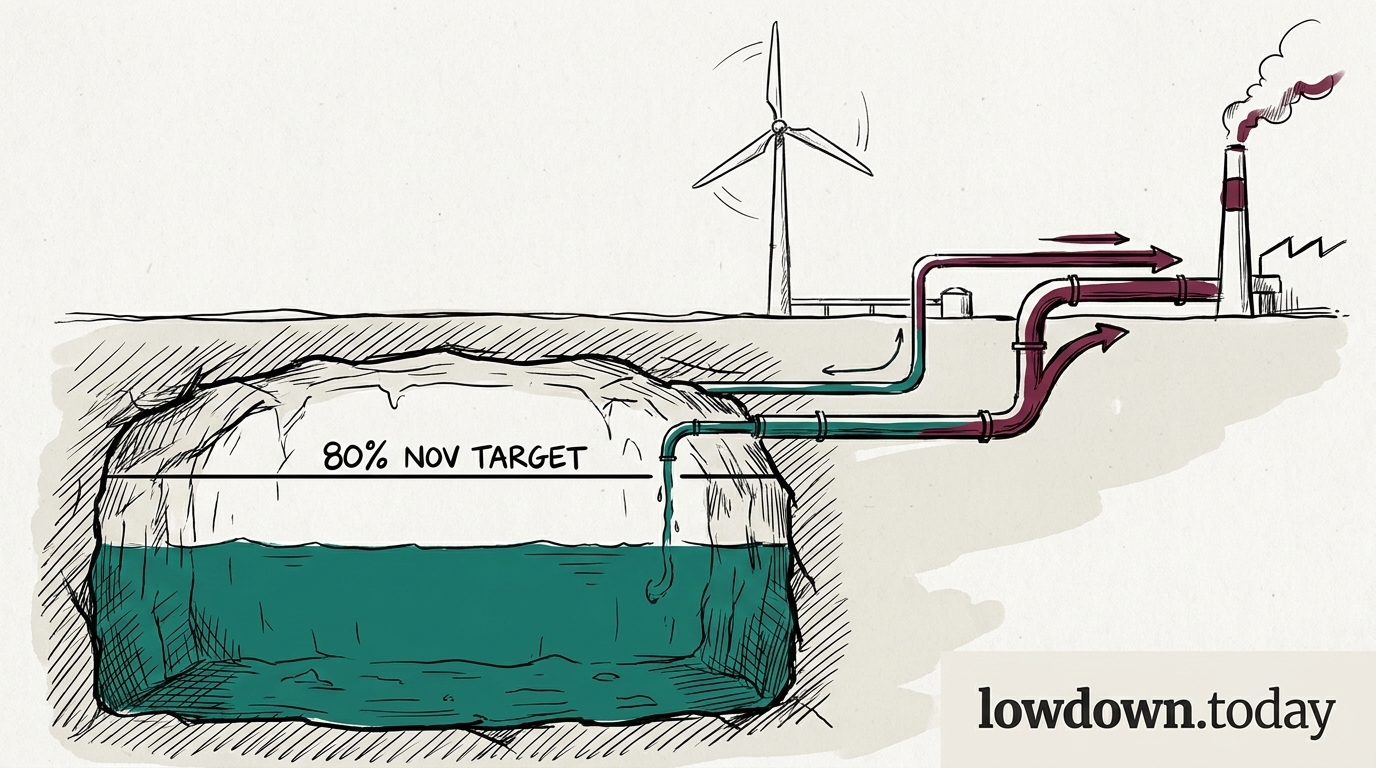
Spain's 9,145 GWh terminal inventory is the largest single stock in the EU LNG network, an option value that can reroute cargoes wherever the winter strip pays best rather than a cavern gas obligation tied to a fixed date. That flexibility matters more as Germany's cavern shortfall pushes more of the winter security question onto import infrastructure.
European Commission
European Commission
Brussels holds the bloc to 90% on a flexible window while Germany, holding roughly a quarter of EU storage capacity, tracks toward missing its own lower 80% figure by 21 points. A national shortfall this size in the anchor market matters more to bloc security than the flexible timetable alone can absorb.
French power exporters and CRE
French day-ahead rose in step with Germany but by less, reopening a EUR 7-17 premium that makes northward export flows commercially attractive again after the EUR 43.09 discount evaporated in days. CRE separately authorised RTE and Enedis to buy flexibility locally, betting the coming winter's binding constraint is grid congestion rather than a shortage of firm capacity.
TTF trading desk
TTF trading desk
A visible national shortfall like Germany's 21-point gap is a directional signal, not noise, for a desk holding the summer-winter spread. TTF's flat EUR 58-60 range through this week's German price swings says the market has not yet chosen to reprice refill risk into the front of the curve.
German cavern and CCGT operators
German caverns kept buying prompt gas at TTF near EUR 58-60 through the inversion; the wind collapse to 2.4 GW then flipped the spark spread to plus EUR 29 and put turbines back in the same queue. Every day turbines win that bid, injection at a third of the 877 GWh/day pace needed falls further behind.
Slovakia
Slovakia
Slovakia says it dropped its hold-out on the 21st sanctions package only after Ursula von der Leyen personally signed written gas-price and supply guarantees. The Council of the European Union's own 17,238-character release on the package names neither Slovakia nor any guarantee, leaving Bratislava's account unconfirmed by the institutional record.



