Skip to content
You can now search across every topic, entity and event.What's new
European Energy Markets
31JUL

SPD threatens to block German 10 GW gas plant law

2 min read
09:44UTC

The SPD-led Environment Ministry threatened on 16 April to block the CDU/CSU Economy Ministry's draft law supporting Germany's 10 GW hydrogen-capable gas plant auction by 2032, three years into legislative preparation, demanding renewables carve-outs.

EconomicDeveloping
Key takeaway

The SPD block on the 10 GW gas plant law compounds Germany's short-term storage failure with a long-term legislative one.

Germany's SPD-led Environment Ministry threatened on 16 April 2026 to block the CDU/CSU Economy Ministry's draft law supporting the planned 10 GW hydrogen-capable gas plant auction by 2032, three years into legislative preparation, and demanded renewables carve-outs as the price of cooperation 1.

The SPD is the Sozialdemokratische Partei Deutschlands, the Social Democratic Coalition partner in Chancellor Friedrich Merz's government; the CDU/CSU is the conservative bloc leading the Coalition. The draft law sits inside the Bundeswirtschaftsministerium, the Federal Ministry for Economic Affairs and Climate Action. The fight is not a policy difference at the margins. It is a Coalition partner threatening to block, three years in, a statute the other partner's ministry has been preparing since the prior government.

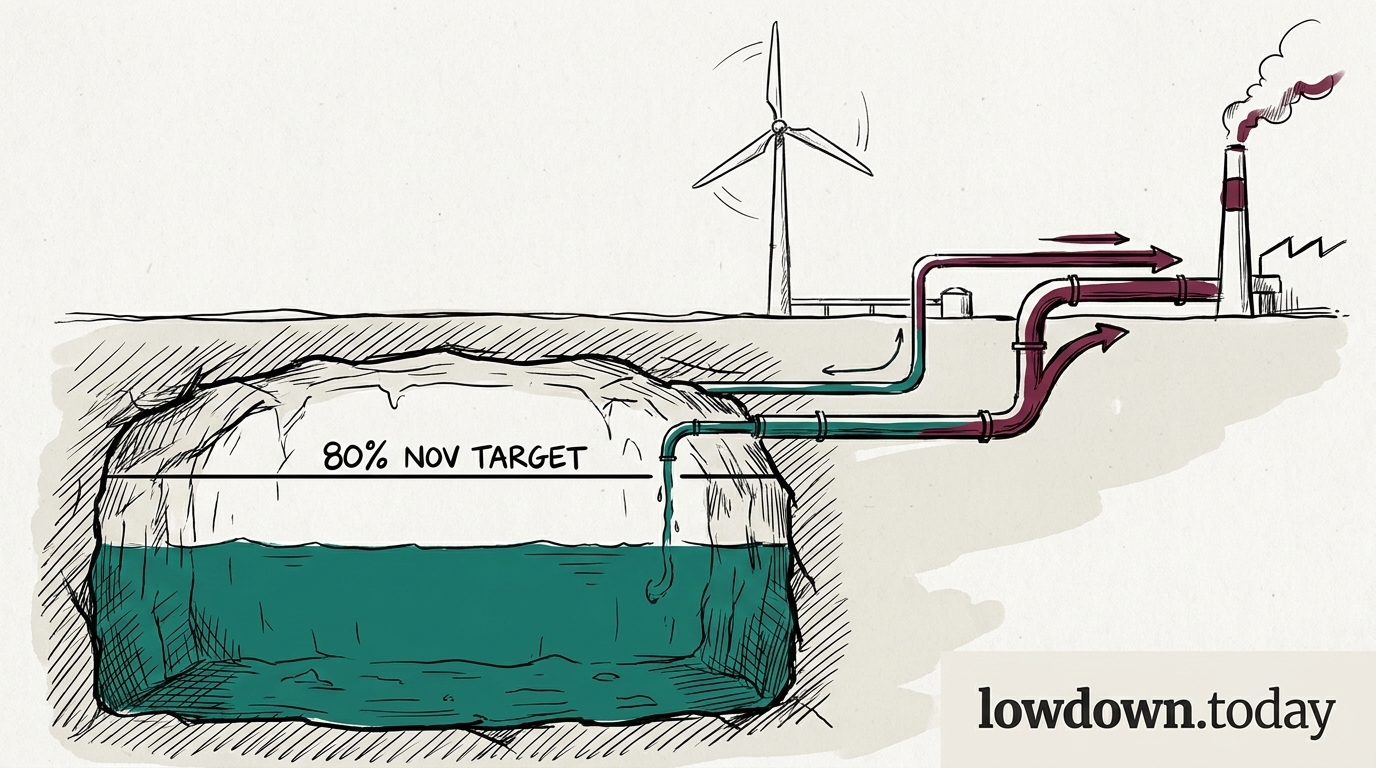
Two policy failures run in parallel, and each exposes what the other is not solving. Germany is withdrawing gas from storage while the short-term LNG ban approaches and the Coalition fails to legislate the supply-side infrastructure that would reduce long-term gas dependency. VNG AG's public call for state intervention in storage refill sits on one end of the same policy failure; the SPD blocking pattern sits on the other.

The alternative path has been costed. Bruegel has recommended switching to existing coal plants, which have approximately 568 TWh of unused generation potential available across the EU, rather than building new gas capacity inside a Coalition that cannot legislate it 2. That recommendation is a working hypothesis, not yet a policy. What remains is a Coalition unable to move legislation on long-term supply architecture while its short-term storage mechanism fails. For procurement desks and long-range utility planners, the signal is that Germany's long-term gas-plant build-out cannot be taken as a given inside the current Coalition arithmetic, regardless of the policy merits of the underlying plan.


Deep Analysis

In plain English

Germany wants to build new power stations that can run on gas now and switch to hydrogen in the future, once green hydrogen becomes more widely available. These plants would help keep the lights on as Germany closes its remaining coal and nuclear plants. The draft law to fund this plan has been three years in preparation, but Germany's Social Democrats (SPD) a junior partner in the governing coalition threatened on 16 April to block it unless more renewable energy requirements are added. This fight inside the German government is slowing down the construction of the power plants that Germany needs to both reduce gas dependency and keep electricity prices affordable in the longer term.

Deep Analysis
Root Causes

The SPD-CDU/CSU conflict on the 10 GW gas plant law reflects a structural disagreement about the pathway to Germany's 2045 carbon-neutrality target. The Economy Ministry's draft law frames hydrogen-capable gas plants as a bridge technology: built on gas, capable of switching to hydrogen when the hydrogen supply chain matures.

The Environment Ministry's position is that the hydrogen switch is speculative and that renewable carve-outs are the instrument for ensuring the bridge does not become a permanent fossil-fuel commitment.

This disagreement has been three years in the making because the underlying technology uncertainty is real: no commercial hydrogen supply chain at the scale required to fuel 10 GW of generation capacity exists in Germany today, and the timeline for one to emerge is contested. The Economy Ministry is betting on a transition technology whose transition timeline is undefined. The Environment Ministry is objecting to precisely that openness.

Bruegel's coal-switching recommendation citing 568 TWh of EU-wide unused coal generation potential represents a third option that avoids the coalition disagreement entirely by using existing infrastructure. The political obstacle is domestic and EU climate commitments that make coal switching contentious even as a stated-temporary measure.

What could happen next?
  • Risk

    Legislative delay beyond the 2026 legislative year pushes the 10 GW build programme into the next electoral cycle, creating a multi-year gap in Germany's long-term gas security architecture.

  • Consequence

    Coalition friction on the gas plant law signals that Germany's long-term supply-side planning is politically unreliable, increasing risk premiums in forward German power and gas contracts.

First Reported In

Update #3 · TTF holds six-week low as supply stack hardens

EnergyConnects· 17 Apr 2026
Read original
Causes and effects
This Event
SPD threatens to block German 10 GW gas plant law
Coalition friction is delaying the supply-side infrastructure legislation that would ease Germany's long-term gas dependency, in parallel with the injection-season failure at Reden.
Different Perspectives
Spain's LNG terminal operators
Spain's 9,145 GWh terminal inventory is the largest single stock in the EU LNG network, an option value that can reroute cargoes wherever the winter strip pays best rather than a cavern gas obligation tied to a fixed date. That flexibility matters more as Germany's cavern shortfall pushes more of the winter security question onto import infrastructure.
European Commission
European Commission
Brussels holds the bloc to 90% on a flexible window while Germany, holding roughly a quarter of EU storage capacity, tracks toward missing its own lower 80% figure by 21 points. A national shortfall this size in the anchor market matters more to bloc security than the flexible timetable alone can absorb.
French power exporters and CRE
French day-ahead rose in step with Germany but by less, reopening a EUR 7-17 premium that makes northward export flows commercially attractive again after the EUR 43.09 discount evaporated in days. CRE separately authorised RTE and Enedis to buy flexibility locally, betting the coming winter's binding constraint is grid congestion rather than a shortage of firm capacity.
TTF trading desk
TTF trading desk
A visible national shortfall like Germany's 21-point gap is a directional signal, not noise, for a desk holding the summer-winter spread. TTF's flat EUR 58-60 range through this week's German price swings says the market has not yet chosen to reprice refill risk into the front of the curve.
German cavern and CCGT operators
German caverns kept buying prompt gas at TTF near EUR 58-60 through the inversion; the wind collapse to 2.4 GW then flipped the spark spread to plus EUR 29 and put turbines back in the same queue. Every day turbines win that bid, injection at a third of the 877 GWh/day pace needed falls further behind.
Slovakia
Slovakia
Slovakia says it dropped its hold-out on the 21st sanctions package only after Ursula von der Leyen personally signed written gas-price and supply guarantees. The Council of the European Union's own 17,238-character release on the package names neither Slovakia nor any guarantee, leaving Bratislava's account unconfirmed by the institutional record.



