Skip to content
You can now search across every topic, entity and event.What's new
European Energy Markets
31JUL

Russia drone delivery unconfirmed

1 min read
09:44UTC

The Kremlin denies everything. The deadline has passed. Whether Iran received upgraded Shaheds is now an operational question, not a diplomatic one.

EconomicDeveloping
Key takeaway

Whether Russia armed Iran with upgraded drones will be answered on the battlefield, not by diplomats.

Russia's drone delivery window closed on 31 March with no public confirmation that Iran received upgraded Shahed-136 variants with AI guidance and jet propulsion. 1 The Kremlin continues to deny all transfers. EU High Representative Kaja Kallas confirmed at the G7 on 26 March that the phased deliveries were due for completion by end of March.

The absence of confirmation is not evidence of non-delivery. Iranian operational use of upgraded Shaheds, identifiable by their flight characteristics and targeting precision, would be the first clear indicator. The Prince Sultan Air Base strike on 27 March used 29 drones of unconfirmed origin .


Deep Analysis

In plain English

Russia has been reportedly transferring upgraded versions of its Shahed drone to Iran. These are the same type of drone Russia has used extensively in Ukraine, but with improved AI guidance and jet propulsion that makes them faster and harder to intercept. Western intelligence said the delivery was expected to be complete by end of March. The deadline passed with no confirmation either way. Russia denies all transfers. Whether Iran received these drones will only become clear when they are used in combat. An upgraded drone that adjusts its flight path in real time is significantly harder to shoot down than the current versions Iran has been using.

First Reported In

Update #53 · Trump drops Hormuz goal; toll becomes law

Washington Post· 31 Mar 2026
Read original
Different Perspectives
Spain's LNG terminal operators
Spain's 9,145 GWh terminal inventory is the largest single stock in the EU LNG network, an option value that can reroute cargoes wherever the winter strip pays best rather than a cavern gas obligation tied to a fixed date. That flexibility matters more as Germany's cavern shortfall pushes more of the winter security question onto import infrastructure.
European Commission
European Commission
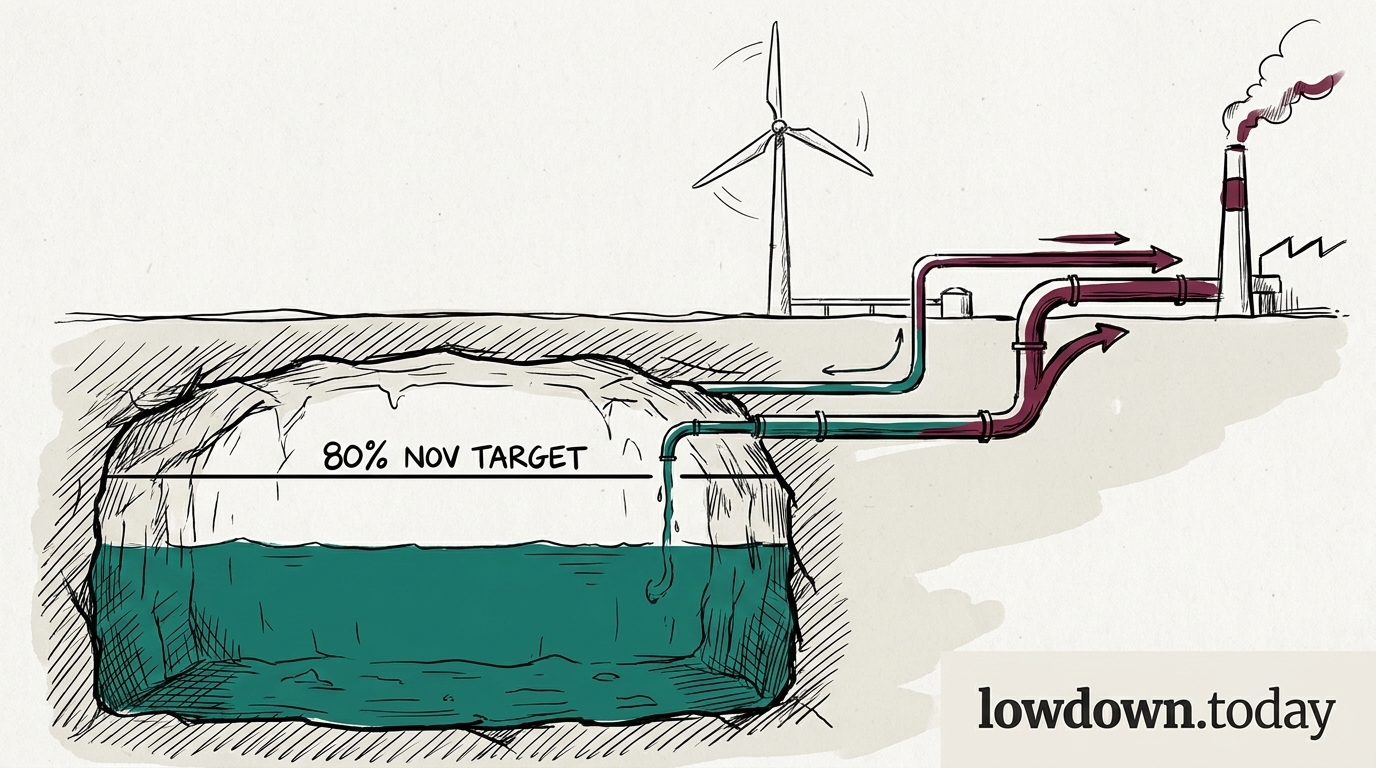
Brussels holds the bloc to 90% on a flexible window while Germany, holding roughly a quarter of EU storage capacity, tracks toward missing its own lower 80% figure by 21 points. A national shortfall this size in the anchor market matters more to bloc security than the flexible timetable alone can absorb.
French power exporters and CRE
French day-ahead rose in step with Germany but by less, reopening a EUR 7-17 premium that makes northward export flows commercially attractive again after the EUR 43.09 discount evaporated in days. CRE separately authorised RTE and Enedis to buy flexibility locally, betting the coming winter's binding constraint is grid congestion rather than a shortage of firm capacity.
TTF trading desk
TTF trading desk
A visible national shortfall like Germany's 21-point gap is a directional signal, not noise, for a desk holding the summer-winter spread. TTF's flat EUR 58-60 range through this week's German price swings says the market has not yet chosen to reprice refill risk into the front of the curve.
German cavern and CCGT operators
German caverns kept buying prompt gas at TTF near EUR 58-60 through the inversion; the wind collapse to 2.4 GW then flipped the spark spread to plus EUR 29 and put turbines back in the same queue. Every day turbines win that bid, injection at a third of the 877 GWh/day pace needed falls further behind.
Slovakia
Slovakia
Slovakia says it dropped its hold-out on the 21st sanctions package only after Ursula von der Leyen personally signed written gas-price and supply guarantees. The Council of the European Union's own 17,238-character release on the package names neither Slovakia nor any guarantee, leaving Bratislava's account unconfirmed by the institutional record.



