Skip to content
You can now search across every topic, entity and event.What's new
European Energy Markets
31JUL

May heatwave squeezes injection to 0.3 pp/day

3 min read
09:44UTC

A blocking high pushed record May temperatures across Europe from 24-28 May, with 35.1C at Kew Gardens and 28.8C in Ireland, squeezing storage injection to just 0.3 percentage points per day as cooling demand competed with gas-fired generation.

EconomicDeveloping
Key takeaway

The heatwave tightened the margin without breaking it; a June repeat at higher baselines would tip the trajectory into deficit.

Record May temperatures swept Europe from 24-28 May. The UK recorded 35.1C at Kew Gardens on Monday 26 May (a May record), Paris sat 14C above seasonal normal, and Ireland logged 28.8C at Clonmel and Killarney (a national May record). The blocking high held for five days, compressing the window for overnight cooling and sustaining daytime electricity demand across the continent.

The energy market consequence is a competition for gas-fired generation between cooling demand and storage injection. Storage injection on 28 May showed only a 0.3 percentage-point daily gain. French nuclear export capacity, which has been suppressing the FR-DE spread all year on EDF's 350-370 TWh full-year guidance , faced a domestic cooling load precisely when German importers needed cross-border flows most. The spread doubled to EUR 46.58 on 21 May , and the heatwave pushed domestic French demand further into nuclear capacity that would otherwise have crossed the interconnector.

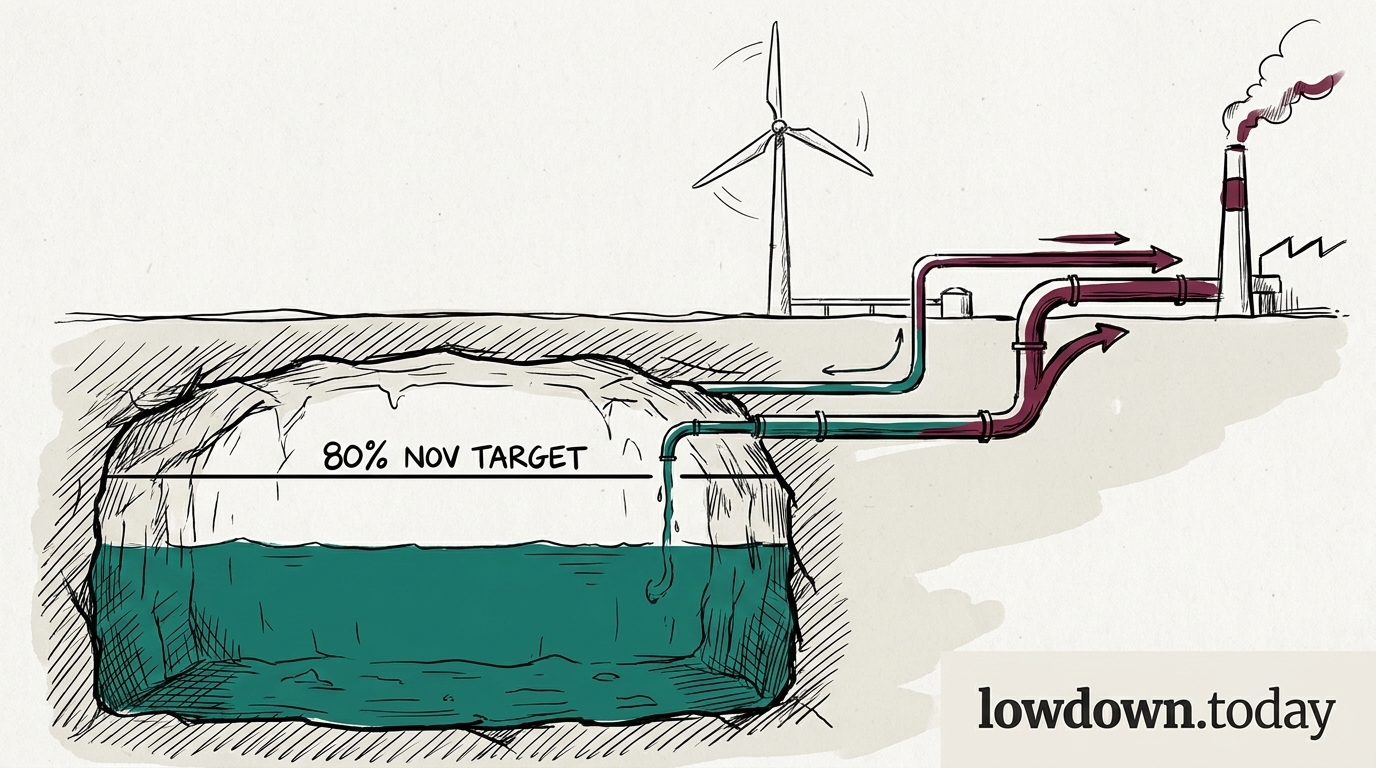
The 0.3 pp daily gain did not break the trajectory. The 45 GWh/day margin survived the May event. The forward risk is a June repeat: at higher baseline temperatures, with Norwegian supply still constrained by the Troll outage residual and Hammerfest offline since 22 April, the buffer disappears into cooling demand before the injection season's strongest months arrive.


Deep Analysis

In plain English

When it gets very hot across Europe, millions of people turn on air conditioning for the first time. That air conditioning is mainly powered by electricity, and a lot of European electricity comes from gas-fired power stations. The problem is that gas-fired power stations and gas storage injection both need gas , and right now there is not enough to do both at once without falling behind on the winter filling target. The record May temperatures in the UK and Ireland were part of a Europe-wide heat event that forced Germany to run expensive gas peaking plants to keep the lights on, rather than injecting that gas into underground storage for winter.

Deep Analysis
Root Causes

The competition between cooling demand and storage injection is structural in gas-dependent grids: gas-fired peakers are the marginal technology that responds to both functions simultaneously. When temperatures rise above 28°C, residential and commercial air-conditioning load adds approximately 0.8-1.2 GW per degree in France and Germany combined, drawing on the same gas-fired generation fleet that would otherwise run below its marginal cost to compress gas into storage.

The FR-DE day-ahead spread doubling to EUR 46.58/MWh on 21 May shows that French nuclear surplus, which normally suppresses Continental clearing, was fully absorbed by domestic cooling load, leaving Germany to clear at EUR 106.35/MWh on gas peakers.

What could happen next?
  • Risk

    A June heat event at higher baseline temperatures than May would push daily storage gains below 0.2 pp for multiple consecutive days, compounding the Troll A supply deficit into a trajectory break that would require emergency regulatory intervention.

  • Consequence

    Flamanville-3's September overhaul removes 1.6 GW from the French nuclear fleet precisely when heating-season demand begins, reversing the FR-DE spread dynamic and turning France from a net exporter to a net importer during autumn market tightness.

First Reported In

Update #13 · Storage on track by 45 GWh; one outage away

Trading Economics / ICE· 29 May 2026
Read original
Different Perspectives
Spain's LNG terminal operators
Spain's 9,145 GWh terminal inventory is the largest single stock in the EU LNG network, an option value that can reroute cargoes wherever the winter strip pays best rather than a cavern gas obligation tied to a fixed date. That flexibility matters more as Germany's cavern shortfall pushes more of the winter security question onto import infrastructure.
European Commission
European Commission
Brussels holds the bloc to 90% on a flexible window while Germany, holding roughly a quarter of EU storage capacity, tracks toward missing its own lower 80% figure by 21 points. A national shortfall this size in the anchor market matters more to bloc security than the flexible timetable alone can absorb.
French power exporters and CRE
French day-ahead rose in step with Germany but by less, reopening a EUR 7-17 premium that makes northward export flows commercially attractive again after the EUR 43.09 discount evaporated in days. CRE separately authorised RTE and Enedis to buy flexibility locally, betting the coming winter's binding constraint is grid congestion rather than a shortage of firm capacity.
TTF trading desk
TTF trading desk
A visible national shortfall like Germany's 21-point gap is a directional signal, not noise, for a desk holding the summer-winter spread. TTF's flat EUR 58-60 range through this week's German price swings says the market has not yet chosen to reprice refill risk into the front of the curve.
German cavern and CCGT operators
German caverns kept buying prompt gas at TTF near EUR 58-60 through the inversion; the wind collapse to 2.4 GW then flipped the spark spread to plus EUR 29 and put turbines back in the same queue. Every day turbines win that bid, injection at a third of the 877 GWh/day pace needed falls further behind.
Slovakia
Slovakia
Slovakia says it dropped its hold-out on the 21st sanctions package only after Ursula von der Leyen personally signed written gas-price and supply guarantees. The Council of the European Union's own 17,238-character release on the package names neither Slovakia nor any guarantee, leaving Bratislava's account unconfirmed by the institutional record.



