Skip to content
You can now search across every topic, entity and event.What's new
European Energy Markets
31JUL

EU storage clears 40% but trajectory lags

3 min read
09:44UTC

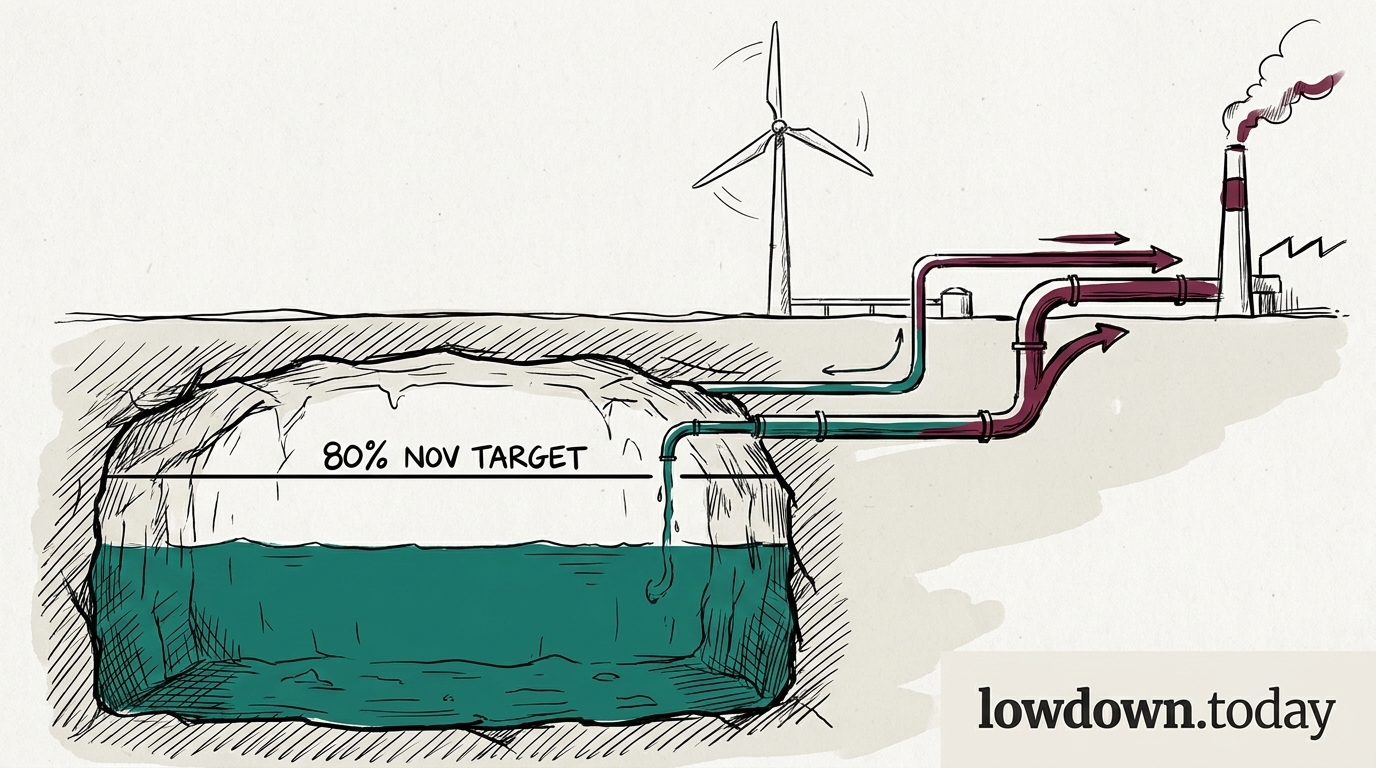
EU gas storage reached 41.0% on 4 June, crossing the 40% milestone, but the 3,309 GWh/day refill pace still points to a ~67% November landing against the 80% mandatory floor.

EconomicDeveloping
Key takeaway

EU storage's 40% milestone masks a 67% November trajectory, 13 points short, with refill running on mandate not market signal.

GIE AGSI+ recorded EU aggregate gas storage at 41.0% on Thursday 4 June 1, clearing the 40% mark. It is the third round-number milestone of the season after 35.4% on 12 May and the deficit-widening injection slowdown of 17 May , and each has landed with the same structural read underneath: the pace is mandate-driven, not commercial, and the trajectory to November sits below the 80% floor. At 3,309 GWh/day the refill runs short of the rate needed to land at 80% by 1 November, leaving a straight-line projection of roughly 67%.

The inverted summer-winter TTF strip makes the shortfall structural rather than seasonal, removing any commercial reason to inject, so the aggregate number is carried by regulated demand from the Dutch, French and Italian mandates rather than by traders booking storage. FNB Gas's declaration that the market-based mechanism is broken explains why. The operative risk figure is the 67% November landing, not the 41.0% headline: a thin Q4 buffer under a cold winter is the horizon the forward strip and option vol structure should already be pricing, and the only path to acceleration is a TTF backtrack below the inverted-strip threshold.


Deep Analysis

In plain English

European gas storage crossed 40% full on 4 June 2026, a round-number milestone that sounds encouraging but masks a more difficult picture. At the current refill speed of 3,309 gigawatt-hours per day, EU storage will reach only about 67% by November , when winter heating demand peaks. The EU's own rules require 80% by that date. The 13-percentage-point gap exists because storing gas for winter is not commercially worthwhile at current prices. Operators are filling only because governments are ordering them to, and mandatory orders cannot ramp up the same way that market economics can if a cold snap arrives.

Deep Analysis
Root Causes

The 13-percentage-point gap between the 41.0% actual and the trajectory required for 80% by November reflects a structural mismatch between physical injection incentive and regulatory mandate.

The TTF summer-winter strip inversion , summer gas priced above winter, removing all commercial arbitrage motive to inject and sell later , means the 3,309 GWh/day pace runs entirely on regulated buying from Dutch EBN (mandate raised to 80 TWh in May, ), French CRE and Italian ARERA, not on commercial economics.

FNB Gas's 27 May declaration that zero lots cleared in the January 2026 capacity auctions for the 2026-27 storage year demonstrates the extent of the incentive failure: operators declined to book storage capacity even at zero cost. The GMTF's 2 June 'functioning well' verdict on derivatives confirmed no market manipulation is driving the inaction , the injection shortfall is purely an incentive problem that derivatives market health cannot address.

The 40% milestone itself is a real number: the bloc crossed it on the back of mandate-driven buying that cannot be levered up the way a commercial response to a price signal can. If a cold Q3 or a supply disruption requires accelerated injection above the current pace, the mandate framework has limited headroom without either emergency storage-levy reinstatement or direct member-state fiscal support to operators.

What could happen next?
  • Risk

    A 67% November landing against the 80% mandatory floor leaves the EU exposed to Q4 price spikes during a cold winter, with Bruegel estimating EUR 25-45 billion additional procurement costs at mandate-level shortfall.

    Medium term · Assessed
  • Risk

    The mandate-driven pace cannot be levered upward the way a commercial response can; a cold Q3 or a supply disruption would require either a storage-levy reinstatement or direct fiscal support to accelerate injection above the current trajectory.

    Short term · Assessed
  • Opportunity

    An Iran ceasefire or confirmed Troll A restart that depresses TTF below EUR 46 could repair the strip inversion and restore commercial injection incentive, accelerating the fill rate without regulatory intervention.

    Short term · Suggested
First Reported In

Update #15 · France EUR 9, Germany EUR 103: heat splits

GIE AGSI+ / EnergyRiskIQ· 4 Jun 2026
Read original
Different Perspectives
Spain's LNG terminal operators
Spain's 9,145 GWh terminal inventory is the largest single stock in the EU LNG network, an option value that can reroute cargoes wherever the winter strip pays best rather than a cavern gas obligation tied to a fixed date. That flexibility matters more as Germany's cavern shortfall pushes more of the winter security question onto import infrastructure.
European Commission
European Commission
Brussels holds the bloc to 90% on a flexible window while Germany, holding roughly a quarter of EU storage capacity, tracks toward missing its own lower 80% figure by 21 points. A national shortfall this size in the anchor market matters more to bloc security than the flexible timetable alone can absorb.
French power exporters and CRE
French day-ahead rose in step with Germany but by less, reopening a EUR 7-17 premium that makes northward export flows commercially attractive again after the EUR 43.09 discount evaporated in days. CRE separately authorised RTE and Enedis to buy flexibility locally, betting the coming winter's binding constraint is grid congestion rather than a shortage of firm capacity.
TTF trading desk
TTF trading desk
A visible national shortfall like Germany's 21-point gap is a directional signal, not noise, for a desk holding the summer-winter spread. TTF's flat EUR 58-60 range through this week's German price swings says the market has not yet chosen to reprice refill risk into the front of the curve.
German cavern and CCGT operators
German caverns kept buying prompt gas at TTF near EUR 58-60 through the inversion; the wind collapse to 2.4 GW then flipped the spark spread to plus EUR 29 and put turbines back in the same queue. Every day turbines win that bid, injection at a third of the 877 GWh/day pace needed falls further behind.
Slovakia
Slovakia
Slovakia says it dropped its hold-out on the 21st sanctions package only after Ursula von der Leyen personally signed written gas-price and supply guarantees. The Council of the European Union's own 17,238-character release on the package names neither Slovakia nor any guarantee, leaving Bratislava's account unconfirmed by the institutional record.



