Skip to content
You can now search across every topic, entity and event.What's new
European Energy Markets
31JUL

COSCO ships pay IRGC toll at Hormuz

3 min read
09:44UTC

Two COSCO container vessels completed the Strait transit on their second attempt, normalising Iran's toll corridor at the container shipping level.

EconomicDeveloping
Key takeaway

China is helping normalise Iran's Hormuz toll by paying it with state-backed ships.

Two COSCO container ships, the CSCL Indian Ocean and CSCL Arctic Ocean, transited the Strait of Hormuz on 30 March. 1 They are the first container vessels operated by a major state-backed Chinese company to cross since the war began. An earlier attempt on 27 March was aborted with a U-turn near Iranian waters; the successful crossing took roughly 12 hours via Larak and Qeshm islands.

Container traffic matters differently from tanker traffic. Tankers moved through Hormuz under shadow-fleet arrangements and favoured-nation exemptions. Container ships carry manufactured goods, consumer products, and supply chain inputs. Their passage signals the IRGC's toll corridor is expanding beyond crude oil into general commerce. NBC News and Lloyd's List confirmed at least two vessels paid the IRGC approximately $2 million each to transit. 2 More than 20 vessels have used the tolled corridor since it opened.

The aborted 27 March attempt followed by success three days later suggests terms were negotiated in the interval, likely between Beijing and the IRGC directly. China is operationalising the toll at the container level, a step beyond tanker exemptions. For consumers beyond the Gulf, the toll will eventually surface not just in petrol prices but in the cost of electronics, clothing, and anything else that crosses the Indian Ocean.


Deep Analysis

In plain English

The Strait of Hormuz is the world's most important oil passage. Since the war began, Iran has been charging ships a toll to cross it, roughly $2 million per vessel. Two large Chinese state-owned ships crossed on 30 March after paying the toll. This matters because China is the world's largest trading nation. When Chinese state companies pay the toll, they signal to every other country that the toll is legitimate and here to stay. Iran's parliament is now drafting a law to make the toll permanent. The Strait went from a free international waterway to a paid checkpoint in 32 days. That cost eventually reaches consumers as higher prices on petrol, electronics, and imported goods.

Deep Analysis
Root Causes

China's supply chains depend on cross-Hormuz shipping for oil imports and Indian Ocean container transit. The two COSCO ships represent a pragmatic decision that the cost of continued blockage exceeds the political cost of paying the toll.

Beijing has leveraged its position as Iran's largest trading partner and diplomatic backer to secure transit. The aborted 27 March attempt followed by success three days later suggests direct negotiation between Chinese officials and the IRGC in the intervening period. China is operationalising its neutrality as commercial access, not political endorsement.

What could happen next?
  • Consequence

    China's state-backed commercial participation legitimises the toll system, making it far harder for any future administration to demand its removal as a non-negotiable condition.

    Immediate · 0.85
  • Consequence

    The toll corridor expanding from tankers to container shipping embeds the cost into consumer goods prices globally within weeks.

    Short term · 0.8
  • Precedent

    First instance of a major state-backed shipping operator paying an IRGC-operated toll, establishing the system as commercially viable and diplomatically tolerated.

    Medium term · 0.9
  • Risk

    Once codified in Iranian domestic law, reversing the toll requires a sovereignty concession no Iranian government can make without domestic political destruction.

    Long term · 0.8
First Reported In

Update #53 · Trump drops Hormuz goal; toll becomes law

gCaptain / Bloomberg· 31 Mar 2026
Read original
Different Perspectives
Spain's LNG terminal operators
Spain's 9,145 GWh terminal inventory is the largest single stock in the EU LNG network, an option value that can reroute cargoes wherever the winter strip pays best rather than a cavern gas obligation tied to a fixed date. That flexibility matters more as Germany's cavern shortfall pushes more of the winter security question onto import infrastructure.
European Commission
European Commission
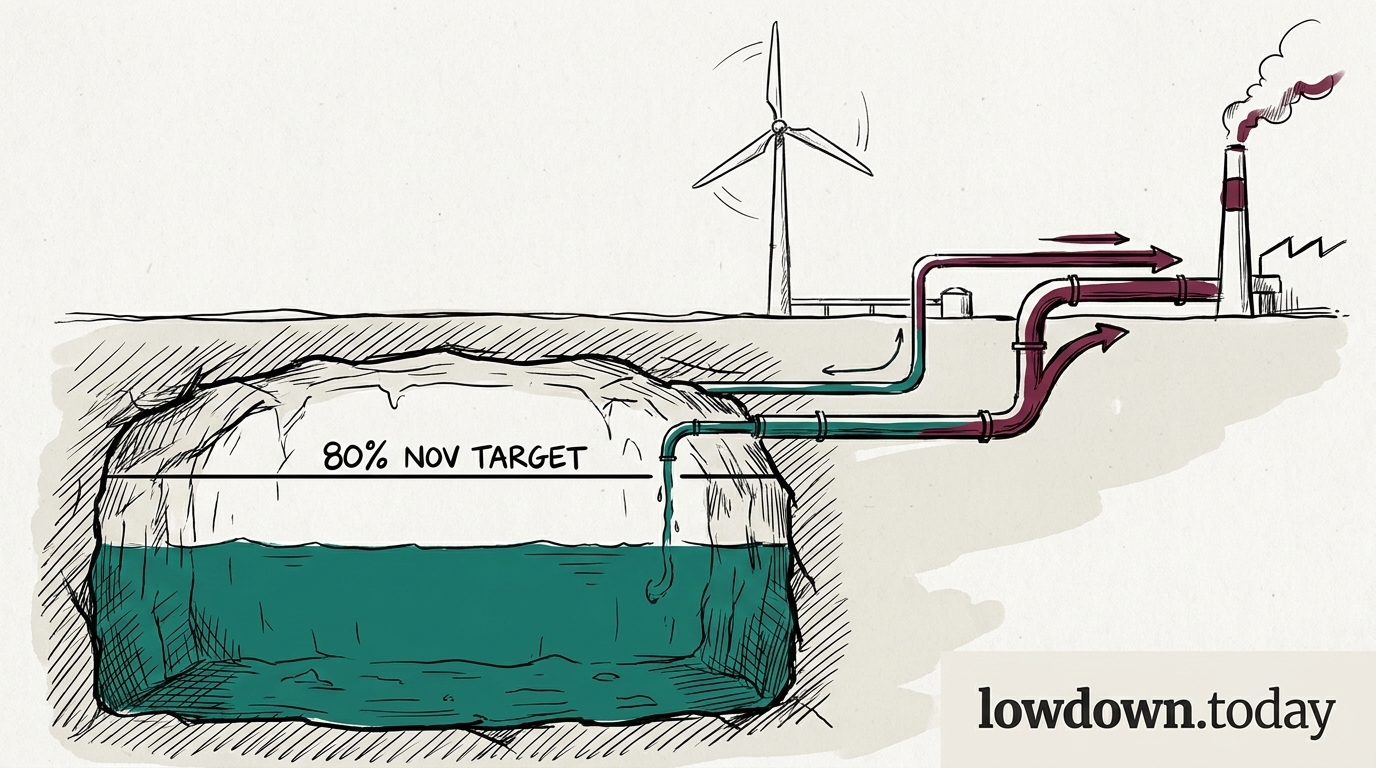
Brussels holds the bloc to 90% on a flexible window while Germany, holding roughly a quarter of EU storage capacity, tracks toward missing its own lower 80% figure by 21 points. A national shortfall this size in the anchor market matters more to bloc security than the flexible timetable alone can absorb.
French power exporters and CRE
French day-ahead rose in step with Germany but by less, reopening a EUR 7-17 premium that makes northward export flows commercially attractive again after the EUR 43.09 discount evaporated in days. CRE separately authorised RTE and Enedis to buy flexibility locally, betting the coming winter's binding constraint is grid congestion rather than a shortage of firm capacity.
TTF trading desk
TTF trading desk
A visible national shortfall like Germany's 21-point gap is a directional signal, not noise, for a desk holding the summer-winter spread. TTF's flat EUR 58-60 range through this week's German price swings says the market has not yet chosen to reprice refill risk into the front of the curve.
German cavern and CCGT operators
German caverns kept buying prompt gas at TTF near EUR 58-60 through the inversion; the wind collapse to 2.4 GW then flipped the spark spread to plus EUR 29 and put turbines back in the same queue. Every day turbines win that bid, injection at a third of the 877 GWh/day pace needed falls further behind.
Slovakia
Slovakia
Slovakia says it dropped its hold-out on the 21st sanctions package only after Ursula von der Leyen personally signed written gas-price and supply guarantees. The Council of the European Union's own 17,238-character release on the package names neither Slovakia nor any guarantee, leaving Bratislava's account unconfirmed by the institutional record.



