Skip to content
You can now search across every topic, entity and event.What's new
European Energy Markets
31JUL

Brent at $112 as Houthis join the war

2 min read
09:44UTC

The IEA's largest-ever emergency oil release has not stabilised prices; a Dow executive warned supply chains will take nine months to recover after the strait reopens.

EconomicDeveloping
Key takeaway

Nine months of supply chain damage is locked in regardless of when the war ends.

Brent crude closed at $112.57 on 28 March, up 4.22% on the day. Pre-war Brent was $67.41; the current price represents a 67% increase in 29 days. The Houthi entry and Iran's firm rejection of negotiations drove the reversal. 1

The IEA's record 400 million barrel emergency release, the largest in the agency's 50-year history, has not stabilised prices. The IEA itself said why: "The most important factor is resumption of regular transit through the strait of Hormuz." 2 European reserves are predominantly industry-held: 74.8 million barrels from industry versus 32.7 million from government, giving European governments less direct control than the headline figure implies.

Dow CEO Jim Fitterling stated the damage is already locked in: even if Hormuz reopens tomorrow, petrochemical supply chains will take 250-275 days to unwind. The US-Asia petrochemical pricing gap has surged from under $500 to over $1,200 per metric tonne. 3 US farmers face a 2 million tonne urea shortfall during spring planting, with urea prices up 49% to $720 per tonne. Corn and wheat yields on affected fields could fall 10-20%, with downstream effects on global grain prices by autumn.


Deep Analysis

In plain English

Oil prices closed at $112.57 per barrel on 28 March, up about 4% on the day. Before the war started, a barrel cost $67.41. The 67% rise in 29 days is one of the fastest sustained oil price increases in modern history. The IEA, a group of oil-consuming countries, released the largest emergency oil reserve in its history: 400 million barrels. It has not reduced prices. The IEA itself said why: reserves cover a temporary supply disruption; they cannot substitute for a closed shipping route. For a British driver, $112 oil means roughly £1.80 per litre at the pump. For farmers, fertiliser is the bigger problem. Urea, the chemical used to grow corn and wheat, has risen 49% in price and the US faces a 2 million tonne shortage this spring planting season. Crop yields could fall 10-20%, and those effects will reach food prices by autumn.

What could happen next?
  • Consequence

    A ceasefire today does not end the economic damage: Dow's 250-275 day supply chain unwind means petrochemical-driven inflation persists into Q1 2027 regardless of conflict resolution.

  • Risk

    The 2 million tonne urea shortfall is not substitutable within a planting season; US crop yields in autumn 2026 are already compromised regardless of war outcome.

First Reported In

Update #50 · Houthis join; Iran holds two chokepoints

Fortune· 28 Mar 2026
Read original
Different Perspectives
Spain's LNG terminal operators
Spain's 9,145 GWh terminal inventory is the largest single stock in the EU LNG network, an option value that can reroute cargoes wherever the winter strip pays best rather than a cavern gas obligation tied to a fixed date. That flexibility matters more as Germany's cavern shortfall pushes more of the winter security question onto import infrastructure.
European Commission
European Commission
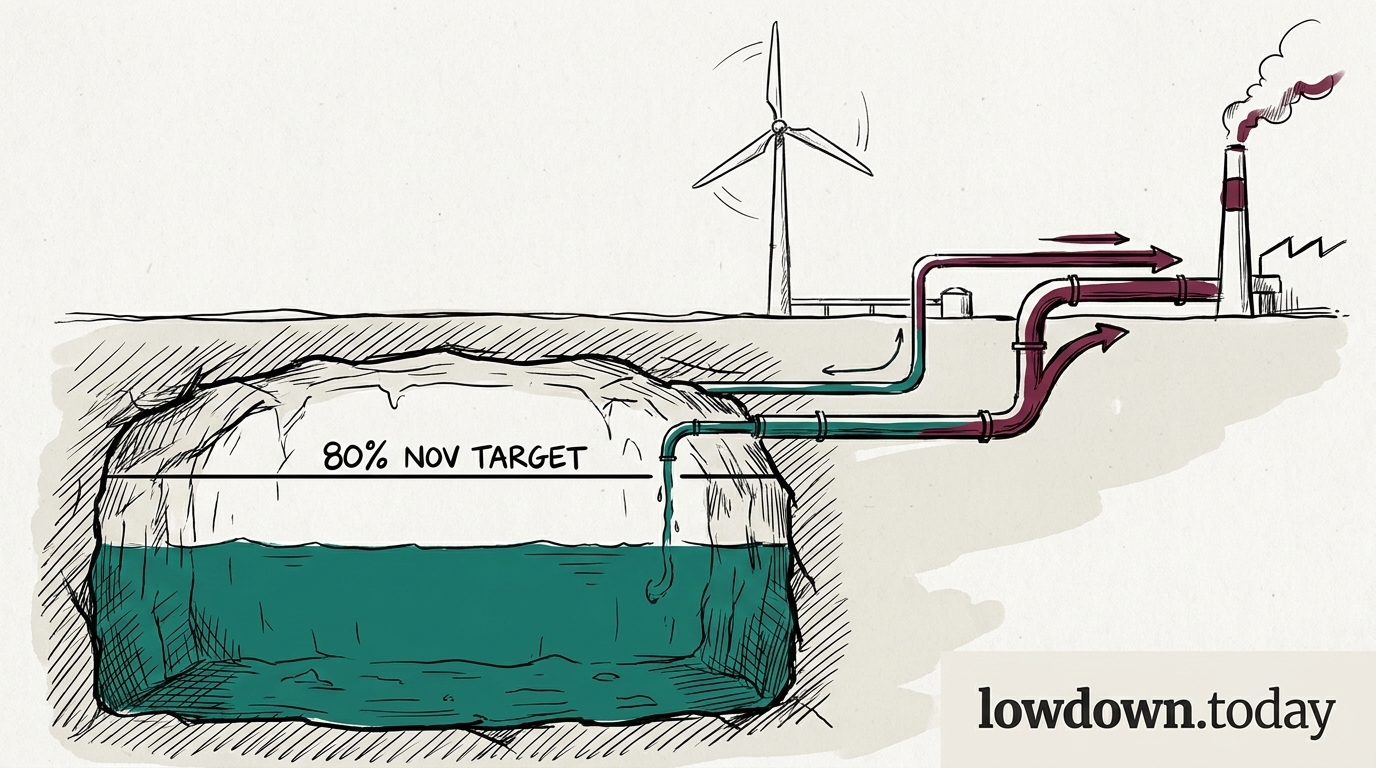
Brussels holds the bloc to 90% on a flexible window while Germany, holding roughly a quarter of EU storage capacity, tracks toward missing its own lower 80% figure by 21 points. A national shortfall this size in the anchor market matters more to bloc security than the flexible timetable alone can absorb.
French power exporters and CRE
French day-ahead rose in step with Germany but by less, reopening a EUR 7-17 premium that makes northward export flows commercially attractive again after the EUR 43.09 discount evaporated in days. CRE separately authorised RTE and Enedis to buy flexibility locally, betting the coming winter's binding constraint is grid congestion rather than a shortage of firm capacity.
TTF trading desk
TTF trading desk
A visible national shortfall like Germany's 21-point gap is a directional signal, not noise, for a desk holding the summer-winter spread. TTF's flat EUR 58-60 range through this week's German price swings says the market has not yet chosen to reprice refill risk into the front of the curve.
German cavern and CCGT operators
German caverns kept buying prompt gas at TTF near EUR 58-60 through the inversion; the wind collapse to 2.4 GW then flipped the spark spread to plus EUR 29 and put turbines back in the same queue. Every day turbines win that bid, injection at a third of the 877 GWh/day pace needed falls further behind.
Slovakia
Slovakia
Slovakia says it dropped its hold-out on the 21st sanctions package only after Ursula von der Leyen personally signed written gas-price and supply guarantees. The Council of the European Union's own 17,238-character release on the package names neither Slovakia nor any guarantee, leaving Bratislava's account unconfirmed by the institutional record.



