Skip to content
You can now search across every topic, entity and event.What's new
European Energy Markets
31JUL

ACER opens the REMIT reporting annex

1 min read
09:44UTC

ACER opened its consultation on the REMIT transaction-reporting annex on 16 July, exactly on schedule, and set the close for 11 September.

EconomicDeveloping
Key takeaway

ACER's REMIT annex consultation closes 11 September, one quarter before cross-border enforcement activates.

ACER, the EU agency that coordinates national energy regulators from Ljubljana, opened its public consultation on the REMIT transaction-reporting annex on 16 July, on exactly the date it had scheduled , and set the close for 11 September 1. REMIT, the EU Regulation on Wholesale Energy Market Integrity and Transparency, obliges trading firms to report their wholesale energy transactions to the agency; the annex specifies the format and scope of those reports.

The substantive change sits in the scope clarification. The annex covers energy derivative transaction reporting and draws the boundary against Regulation (EU) 648/2012, the EMIR framework governing OTC derivatives, central counterparties and trade repositories 2. Where a trade falls determines which reporting pipe it goes down, and firms running both frameworks have been carrying duplicate builds against an unclear line.

The stated audience names who has to answer: market participants, national regulators, registered reporting mechanisms and organised marketplaces. Cross-border REMIT enforcement activates in Q4, so roughly seven weeks remain to comment on the standard, then a single quarter to implement against a final text nobody has seen yet.


Deep Analysis

In plain English

ACER, the EU agency that watches over energy markets to catch price manipulation and unfair trading across borders, enforces its rulebook, REMIT, in every member state. To enforce REMIT properly, ACER needs companies that trade energy contracts to report their trades in a standard format. It has opened a public consultation, running from 16 July to 11 September, asking traders, regulators and market operators for feedback on exactly what that reporting format should cover. This is a technical, behind-the-scenes step, but it matters because it sets up the data ACER will use later this year when its stronger cross-border investigation powers switch on.

Deep Analysis
Root Causes

REMIT's 2024 revision gave ACER direct cross-border investigatory powers, but those powers depend on regulators and trading venues reporting energy-derivative transactions in a consistent format. The consultation exists because that reporting format has to be clarified against EMIR, Regulation (EU) 648/2012's rules for OTC derivatives, clearing houses and trade repositories, before ACER's enforcement teeth can be used with confidence in the data underneath them.

Without an agreed annex, national regulators and reporting mechanisms would be free to interpret reporting scope differently, which would undermine the cross-border investigations the 2024 revision was designed to enable.

What could happen next?
  • Precedent

    A clarified reporting annex gives ACER a firmer evidential basis once its expanded cross-border investigatory powers activate in the second half of 2026, strengthening any future enforcement action against suspected market manipulation.

Sources:ACER
First Reported In

Update #28 · Hormuz premium inverts the German spark spread

ACER· 20 Jul 2026
Read original
Causes and effects
This Event
ACER opens the REMIT reporting annex
Firms get roughly seven weeks to shape the reporting standard and a single quarter to build systems against whatever emerges from it.
Different Perspectives
Spain's LNG terminal operators
Spain's 9,145 GWh terminal inventory is the largest single stock in the EU LNG network, an option value that can reroute cargoes wherever the winter strip pays best rather than a cavern gas obligation tied to a fixed date. That flexibility matters more as Germany's cavern shortfall pushes more of the winter security question onto import infrastructure.
European Commission
European Commission
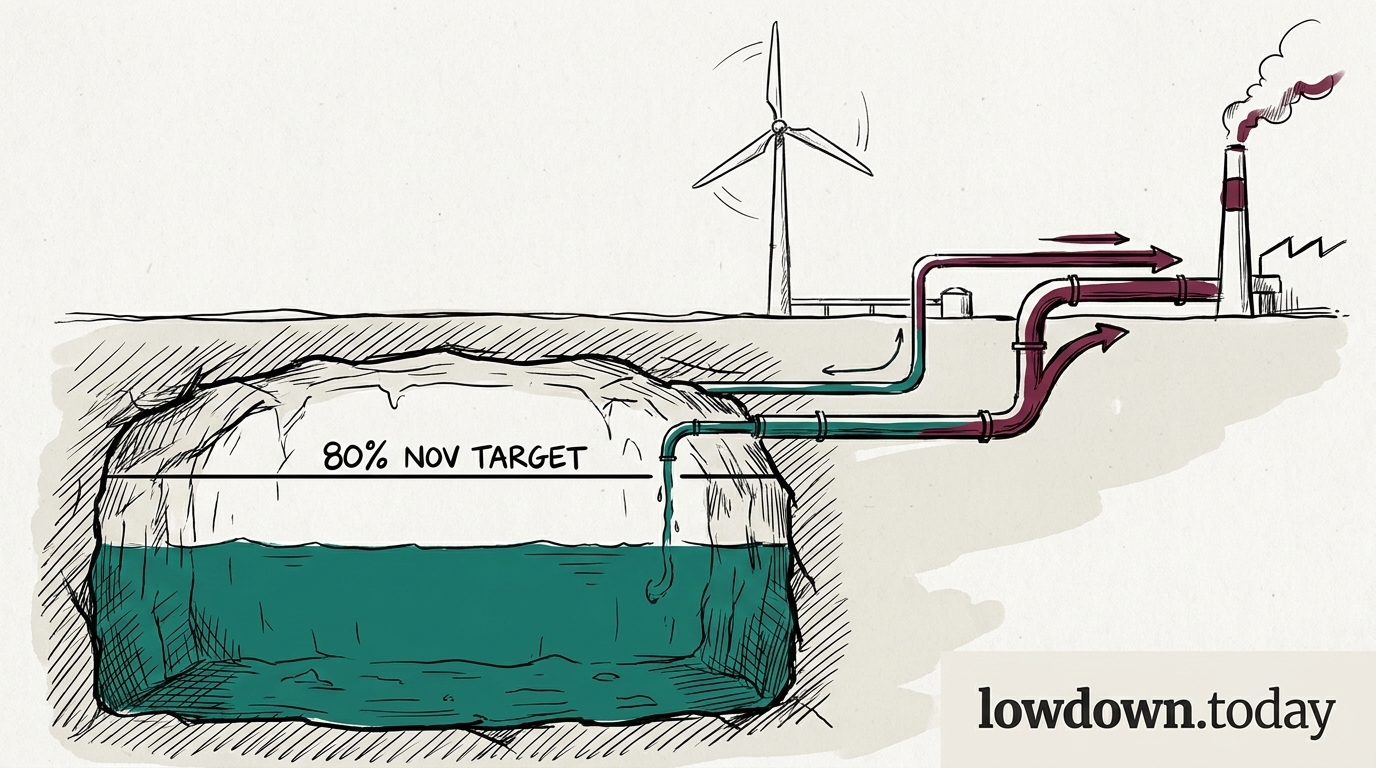
Brussels holds the bloc to 90% on a flexible window while Germany, holding roughly a quarter of EU storage capacity, tracks toward missing its own lower 80% figure by 21 points. A national shortfall this size in the anchor market matters more to bloc security than the flexible timetable alone can absorb.
French power exporters and CRE
French day-ahead rose in step with Germany but by less, reopening a EUR 7-17 premium that makes northward export flows commercially attractive again after the EUR 43.09 discount evaporated in days. CRE separately authorised RTE and Enedis to buy flexibility locally, betting the coming winter's binding constraint is grid congestion rather than a shortage of firm capacity.
TTF trading desk
TTF trading desk
A visible national shortfall like Germany's 21-point gap is a directional signal, not noise, for a desk holding the summer-winter spread. TTF's flat EUR 58-60 range through this week's German price swings says the market has not yet chosen to reprice refill risk into the front of the curve.
German cavern and CCGT operators
German caverns kept buying prompt gas at TTF near EUR 58-60 through the inversion; the wind collapse to 2.4 GW then flipped the spark spread to plus EUR 29 and put turbines back in the same queue. Every day turbines win that bid, injection at a third of the 877 GWh/day pace needed falls further behind.
Slovakia
Slovakia
Slovakia says it dropped its hold-out on the 21st sanctions package only after Ursula von der Leyen personally signed written gas-price and supply guarantees. The Council of the European Union's own 17,238-character release on the package names neither Slovakia nor any guarantee, leaving Bratislava's account unconfirmed by the institutional record.



