Skip to content
You can now search across every topic, entity and event.What's new
European Energy Markets
31JUL

€659m for four fabs, none at the edge

3 min read
09:44UTC

The European Commission approved €659m of German state aid on 14 July for four semiconductor plants, the largest €353m to Element 3-5 for silicon-carbide wafers. Every one sits at the power and analog layer, not leading-edge logic.

EconomicDeveloping
Key takeaway

Germany's four newly-funded fabs build power and analog chips, not the leading-edge logic Europe lacks.

The European Commission approved €659m of German state aid on 14 July for four first-of-a-kind semiconductor plants under the European Chips Act, the EU's 2023 framework for subsidising domestic chip production. 1 The money splits four ways: Element 3-5 takes €353m for silicon-carbide (SiC) epitaxial wafers in North Rhine-Westphalia; Vishay takes €214m for power metal-oxide-semiconductor field-effect transistors (MOSFETs) in Schleswig-Holstein; KLA-Tencor's metrology arm takes €74.4m for chip quality-control measurement equipment in Hesse; and KETEK takes €17.9m for specialised industrial chips in Bavaria.

These are projects 15 to 18 under the Chips Act, taking cumulative approved support across member states to roughly €14.2bn. Every one sits at the power, analog and metrology layer where Europe already holds ground, not at the leading-edge logic layer where it does not. Silicon carbide and power MOSFETs handle high-voltage switching in electric vehicles and grid hardware, a tier of the value chain well away from the sub-7-nanometre logic that runs AI and smartphones.

None of the four plants is in Dresden, keeping this tranche distinct from Infineon's €5bn Smart Power Fab that opened there on 2 July . European fabs have already shown they can run a sovereign flow end to end at this tier, as GlobalFoundries and Qualinx did at Dresden last month .

Element 3-5's silicon-carbide wafers and Vishay's power transistors add capacity Europe can use. They do not move the number The Commission most wants moved, which its own Digital Decade scorecard put at 9% of global chip output against a 20% target .


Deep Analysis

In plain English

The EU's Chips Act is a subsidy programme meant to reduce Europe's dependence on Asian and American chip factories. On 14 July, the European Commission approved €659m of German state aid split across four projects: money for silicon-carbide wafers, used in electric vehicles and renewable energy, power transistors, chip-testing equipment, and specialised industrial chips, spread across North Rhine-Westphalia, Schleswig-Holstein, Bavaria and Hesse. None of these make the most advanced chips that power the newest AI systems; that manufacturing stays concentrated in Taiwan, South Korea and the US. Instead, the money targets areas where German and European firms already have real expertise: power electronics and specialised industrial chips, not the cutting edge.

Deep Analysis
Root Causes

Leading-edge logic fabrication requires EUV tools only ASML makes and packaging expertise concentrated in Taiwan and South Korea, a chain Europe cannot shortcut with state aid alone.

Europe's realistic near-term edge sits upstream, in power and analogue chips such as silicon carbide and MOSFETs, where firms like Infineon, STMicro and Vishay already compete globally. The €659m follows that comparative-advantage logic rather than chasing the leading edge, a gap COREPER's $40bn Pax Silica commitment effectively concedes by buying US chips instead.

What could happen next?
  • Opportunity

    Directing aid to power and analogue segments where German firms already lead could compound Europe's existing comparative advantage rather than chase an unwinnable leading-edge race.

  • Risk

    None of the four projects address the leading-edge logic dependency the $40bn Pax Silica chip-purchase commitment (ID:4094) is meant to offset through US imports instead.

First Reported In

Update #12 · ASML's tool boom skips Europe's logic gap

European Commission· 16 Jul 2026
Read original
Causes and effects
This Event
€659m for four fabs, none at the edge
Europe funded the chip layers where it already competes, leaving the leading-edge logic gap that defines its dependence untouched.
Different Perspectives
Spain's LNG terminal operators
Spain's 9,145 GWh terminal inventory is the largest single stock in the EU LNG network, an option value that can reroute cargoes wherever the winter strip pays best rather than a cavern gas obligation tied to a fixed date. That flexibility matters more as Germany's cavern shortfall pushes more of the winter security question onto import infrastructure.
European Commission
European Commission
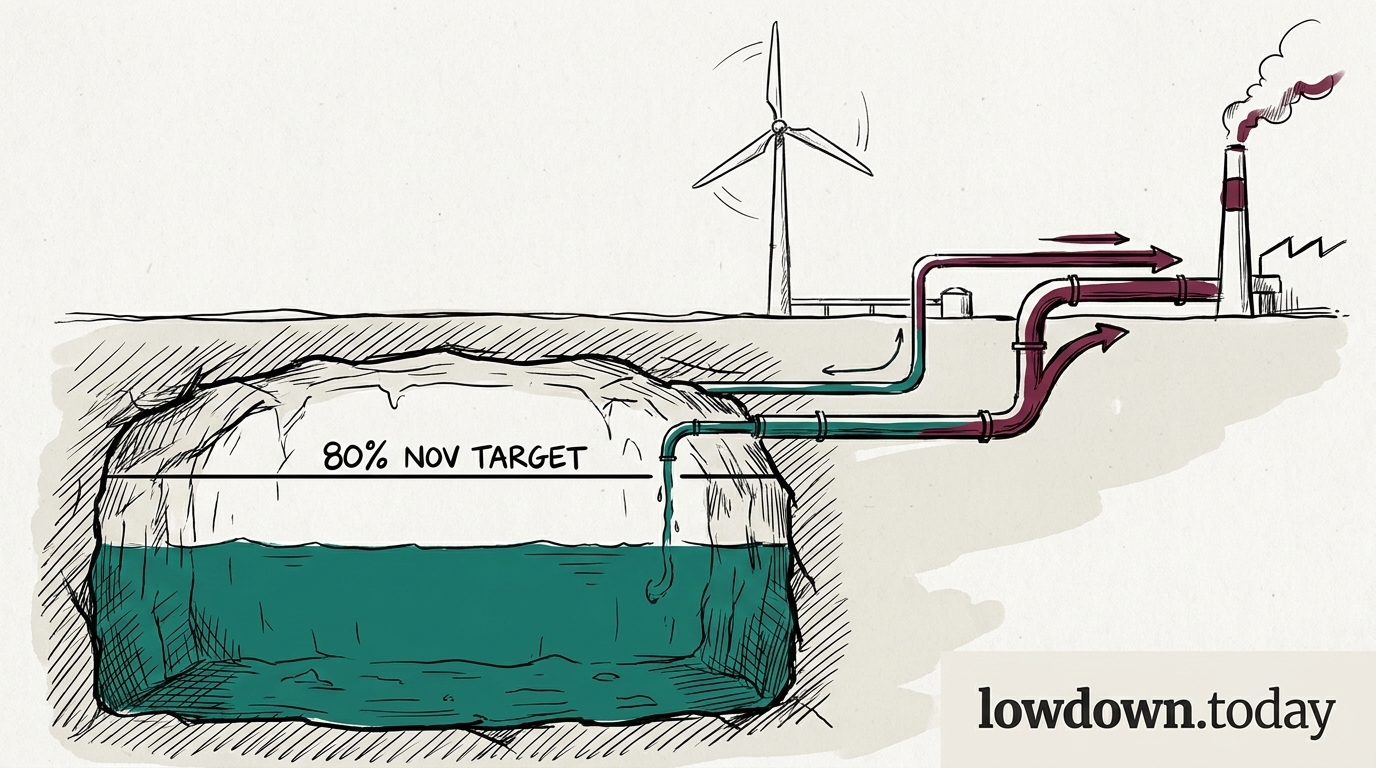
Brussels holds the bloc to 90% on a flexible window while Germany, holding roughly a quarter of EU storage capacity, tracks toward missing its own lower 80% figure by 21 points. A national shortfall this size in the anchor market matters more to bloc security than the flexible timetable alone can absorb.
French power exporters and CRE
French day-ahead rose in step with Germany but by less, reopening a EUR 7-17 premium that makes northward export flows commercially attractive again after the EUR 43.09 discount evaporated in days. CRE separately authorised RTE and Enedis to buy flexibility locally, betting the coming winter's binding constraint is grid congestion rather than a shortage of firm capacity.
TTF trading desk
TTF trading desk
A visible national shortfall like Germany's 21-point gap is a directional signal, not noise, for a desk holding the summer-winter spread. TTF's flat EUR 58-60 range through this week's German price swings says the market has not yet chosen to reprice refill risk into the front of the curve.
German cavern and CCGT operators
German caverns kept buying prompt gas at TTF near EUR 58-60 through the inversion; the wind collapse to 2.4 GW then flipped the spark spread to plus EUR 29 and put turbines back in the same queue. Every day turbines win that bid, injection at a third of the 877 GWh/day pace needed falls further behind.
Slovakia
Slovakia
Slovakia says it dropped its hold-out on the 21st sanctions package only after Ursula von der Leyen personally signed written gas-price and supply guarantees. The Council of the European Union's own 17,238-character release on the package names neither Slovakia nor any guarantee, leaving Bratislava's account unconfirmed by the institutional record.



