Skip to content
You can now search across every topic, entity and event.What's new
European Energy Markets
16JUL

Three states 15 months late on price directive

3 min read
09:48UTC

The European Commission issued reasoned opinions on 29 April against Croatia, Poland and Portugal for failing to transpose Directive 2024/1711, fifteen months past the 17 January 2025 deadline and one procedural step from Court of Justice referral.

EconomicAssessed
Key takeaway

The consumer-price directive is fifteen months overdue in three states facing next winter.

The European Commission issued reasoned opinions on Wednesday 29 April against Croatia, Poland and Portugal for failing to transpose Directive 2024/1711, the EU electricity-market design reform written under the prior Commission to stabilise consumer electricity prices and reduce dependency on fossil fuel pricing 1. The transposition deadline was 17 January 2025, fifteen months before the reasoned opinions landed.

Reasoned opinions are the second formal step in EU infringement proceedings, after formal notice. The Commission had sent formal notice letters in March 2025 to 26 of 27 member states for the same failure. Three of those have now reached the reasoned-opinion stage, leaving them one procedural step from referral to the Court of Justice of the European Union. Each respondent has a two-month response window before The Commission can refer; that places potential referral on a late-June or early-July clock.

Directive 2024/1711 amends two earlier instruments, Directive 2018/2001 on renewable energy and Directive 2019/944 on the electricity market. Its central tools are dynamic-pricing protections, peak-shaving mechanisms and capacity-market rationalisation. Chatham House's energy programme has previously flagged that the directive's most contested provision is the capacity mechanism reform, which national TSOs in central Europe have lobbied against. The directive's core instruments require domestic primary legislation in most jurisdictions rather than regulator-level rulemaking, which is why transposition has slipped past the deadline in over half the bloc.

Consumers in Croatia, Poland and Portugal still see electricity bills set under pre-2024/1711 frameworks. The dynamic-pricing protections and peak-shaving consumer mechanisms the directive would unlock are not available to households or SMEs in those jurisdictions for the 2026-27 winter. The directive's 17 January 2025 deadline came nine months before the storage withdrawal that left the bloc at 28% on 1 April 2026 . The Commission's AccelerateEU package on 22 April omitted any gas storage injection mechanism; the same week's infringement proceedings reveal three states have not transposed the consumer-price directive built for exactly this price environment. The five-finance-minister windfall letter to Climate Commissioner Wopke Hoekstra sits in the same regulatory moment.


Deep Analysis

In plain English

In 2024, the EU passed a law designed to protect consumers when energy prices spike; through mechanisms like price stabilisation and adjusted electricity market rules. Every EU country had until 17 January 2025 to write that law into their own national legislation. Croatia, Poland and Portugal missed the deadline by fifteen months. Brussels has now formally told those three countries: comply within two months or we take you to the EU's top court, which can impose daily financial penalties. In the meantime, the consumer protections that directive would unlock are not available to households or businesses in those three countries during this winter's energy crunch.

Deep Analysis
Root Causes

Directive 2024/1711's central instruments; peak-shaving obligations, two-way CfDs for generators, capacity mechanism rationalisation; require domestic primary legislation in Croatia, Poland and Portugal.

Their national energy regulators cannot simply adopt the directive's provisions by regulatory decision; parliaments must pass amending energy acts. In all three states, energy market legislation competes for parliamentary time with fiscal and housing legislation in election cycles that ran across 2024-25.

The March 2025 formal notice cohort of 26 member states reveals that slow transposition is near-universal, not a failure specific to these three states. The move to reasoned-opinion stage for Croatia, Poland and Portugal reflects that they responded inadequately or not at all to the March 2025 formal notice, while other states submitted partial transposition or timeline commitments that held the Commission back.

What could happen next?
  • Consequence

    Two-month response window places potential Court of Justice referral on a late-June or early-July clock, overlapping the start of the summer injection season and adding political cost to any Commission decision to escalate.

    Short term · 0.8
  • Risk

    The 2026-27 winter arrives with no domestic CfD or peak-shaving mechanism in Croatia, Poland and Portugal; households in those markets carry full exposure to gas-price volatility in electricity settlement.

    Medium term · 0.82
  • Precedent

    The March 2025 formal notice cohort of 26 member states means the Commission can escalate further reasoned opinions rapidly; this package is the first of potentially several infringement waves on Directive 2024/1711.

    Medium term · 0.75
First Reported In

Update #6 · REMIT II live; storage instrument absent

European Commission DG Energy· 29 Apr 2026
Read original
Causes and effects
This Event
Three states 15 months late on price directive
The legal instrument written specifically to cushion European consumers against the next price shock has no domestic enforcement footprint in three jurisdictions for the upcoming 2026-27 winter.
Different Perspectives
LNG spreads desk
LNG spreads desk
The JKM-TTF arb flipped to a TTF premium of roughly USD 0.6/MMBtu on 15 July, the first time this cycle Europe has outbid Asia, yet no Atlantic cargo has rerouted west. Until a cargo actually moves, the desk reads the Hormuz premium as unconfirmed and the EUR 55 print as vulnerable to a fast reversal.
United States
United States
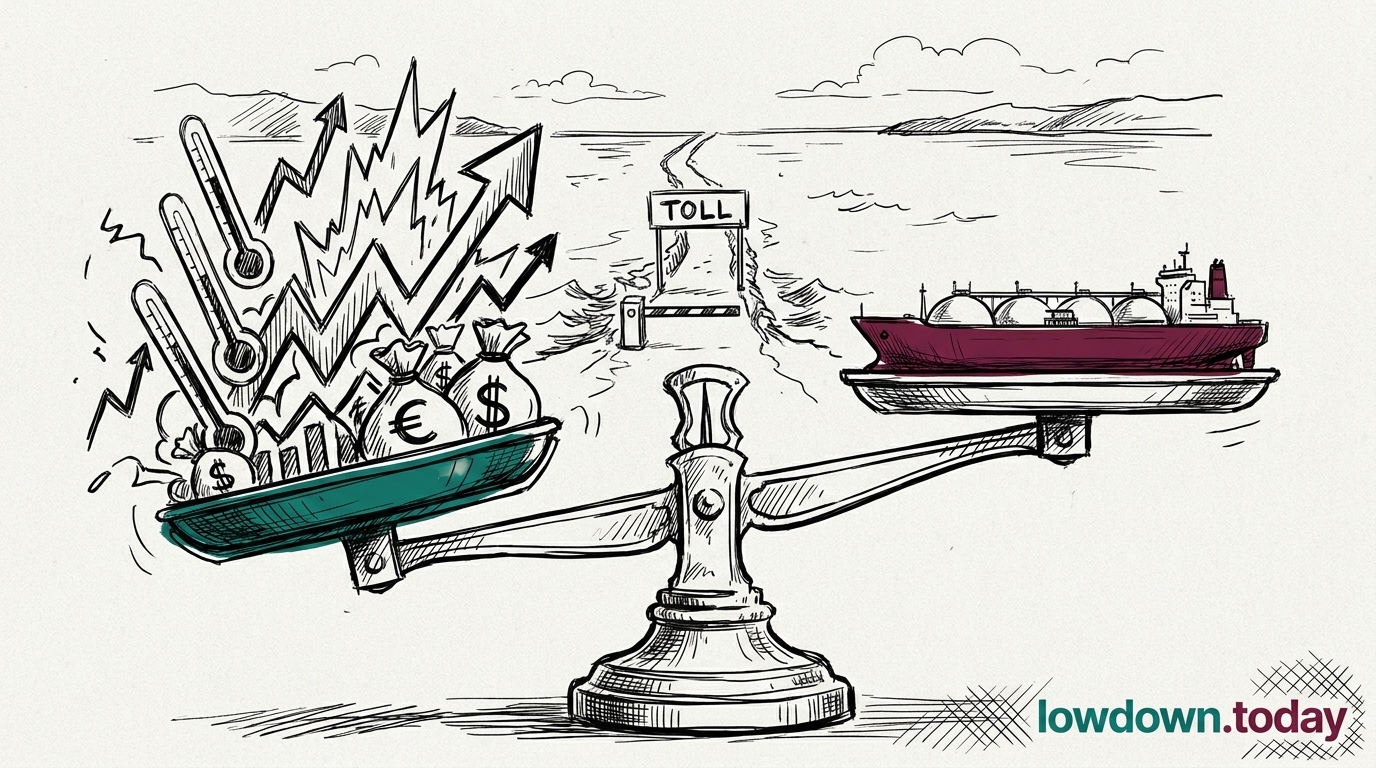
Washington reimposed a blockade on Iranian ports and a 20% Strait of Hormuz cargo toll on 13 July, driving TTF's 9% two-session rally to EUR 54.995/MWh. The posture is again setting Europe's gas benchmark by sentiment rather than by any confirmed change in cargo flows.
EDF
EDF
EDF slipped the Bugey 3, Golfech 2 and Chooz 2 restarts to 19, 22 and 25 July, pushing all three past the 20 July Bugey heat exemption, after river-cooling limits on the Rhone, Garonne and Meuse forced the cuts. The same thermal ceiling has capped the fleet in every major heatwave since 2003, and this cycle is no exception.
German power desk
German power desk
German day-ahead power climbed from EUR 126 to EUR 156/MWh over 14-16 July as the heat dome held, flipping the clean spark spread positive for the first time since 14 July. Gas-for-power demand is now back in competition with mandate storage injection right as the injection margin itself is thinning.
EU carbon and storage regulators
EUA carbon broke EUR 81/tonne on 13 July as the ETS Market Stability Reserve's scheduled withdrawals met fresh fuel-switching demand from France's nuclear curtailment. Brussels' mandatory storage-fill rule kept German and French injection running regardless of the TTF swings, the mechanism working as designed four years after the 2022 shock.
Equinor
Equinor
Equinor returned its Asgard field from maintenance on 11 July, lifting Gassco's exit nominations to 319.8 mcm/day just as TTF round-tripped on Hormuz risk. The restart gave Norway spare pipeline capacity to help Europe absorb the gas rally without drawing down storage, reinforcing its role as the post-2022 swing supplier.
