Skip to content
You can now search across every topic, entity and event.What's new
European Energy Markets
16JUL

Renewables pass fossil fuels, gas bill rises

3 min read
09:48UTC

Wind and solar generated more EU electricity than fossil fuels for the first time in 2025, yet the power sector's gas bill still climbed 16%.

EconomicDeveloping
Key takeaway

Wind and solar hit 30% of EU generation in 2025, but the gas bill still rose 16% on hydro shortfalls.

Ember published its European Electricity Review showing wind and solar exceeded fossil fuels in EU electricity generation for the first time in 2025: renewables at thirty percent against fossil fuels' share. The milestone marks a structural shift in the generation mix. But the EU power sector's gas import bill still reached EUR 32 billion in 2025, up 16% year-on-year, because gas generation itself rose 8% to compensate for reduced hydro output.

The transition insulates unevenly. Spain is largely protected from TTF pass-through; Italy, the Netherlands, and Belgium are fully exposed. Ember's data confirms that the merit order mechanism, where the most expensive fuel needed to meet demand sets the price for all generation, means gas retains pricing power far beyond its share of actual generation. In markets where gas sets the marginal price most hours (Italy being the clearest case), the rising renewables share delivers environmental benefit but limited consumer price relief.

The structural implication for traders: EU-wide renewables statistics overstate the degree to which the bloc is insulated from gas price shocks. Market-by-market merit order composition, not aggregate generation share, determines price exposure.


Deep Analysis

In plain English

In 2025, for the first time ever, European wind turbines and solar panels produced more electricity than all fossil fuels combined. This sounds like a major milestone for clean energy, and in generation terms it is. But here is the complication: Europe's gas import bill for electricity still went up by 16%, to EUR 32 billion. This is because wind and solar do not blow and shine all the time. When they stop, something else needs to fill in quickly, and right now gas stations are the primary backup. Gas is now used less for routine power but more for emergency top-ups, which happen to be at the most expensive market hours.

Deep Analysis
Root Causes

The simultaneous achievement of renewable majority and rising gas bills reflects the merit order's structural mechanics: wind and solar push gas out of baseload hours but increase gas's role in marginal hours, where gas must provide rapid ramping to cover renewable generation shortfalls.

Gas-fired plants running fewer hours but at higher marginal prices can generate the same or higher revenue, and their fuel costs per unit of production are higher because they operate less efficiently at low capacity factors.

The hydro shortfall is the second structural factor. European reservoir hydro output fell 8% in 2025 due to below-average Alpine snowpack and drought in Iberia's river basins. Gas compensated for this on an essentially unplanned basis, at spot prices, because the hydro shortfall was not foreseeable six months in advance when storage injection contracts were placed.

What could happen next?
  • Consequence

    The EUR 32 billion gas bill for power generation creates a permanent structural argument for accelerating battery storage and interconnection investment, as each alternative capacity unit reduces the volume of spot gas purchased at peak prices.

  • Risk

    If Alpine hydro output continues below long-run averages due to climate-related snowpack decline, gas compensation demand will remain a structural feature of EU electricity markets regardless of renewable capacity growth.

First Reported In

Update #1 · Europe's thinnest gas cushion since 2018

Bruegel· 13 Apr 2026
Read original
Causes and effects
This Event
Renewables pass fossil fuels, gas bill rises
The paradox of rising renewables share alongside a rising gas bill exposes the merit order's structural flaw: even a minority fuel can set prices for the majority of hours.
Different Perspectives
LNG spreads desk
LNG spreads desk
The JKM-TTF arb flipped to a TTF premium of roughly USD 0.6/MMBtu on 15 July, the first time this cycle Europe has outbid Asia, yet no Atlantic cargo has rerouted west. Until a cargo actually moves, the desk reads the Hormuz premium as unconfirmed and the EUR 55 print as vulnerable to a fast reversal.
United States
United States
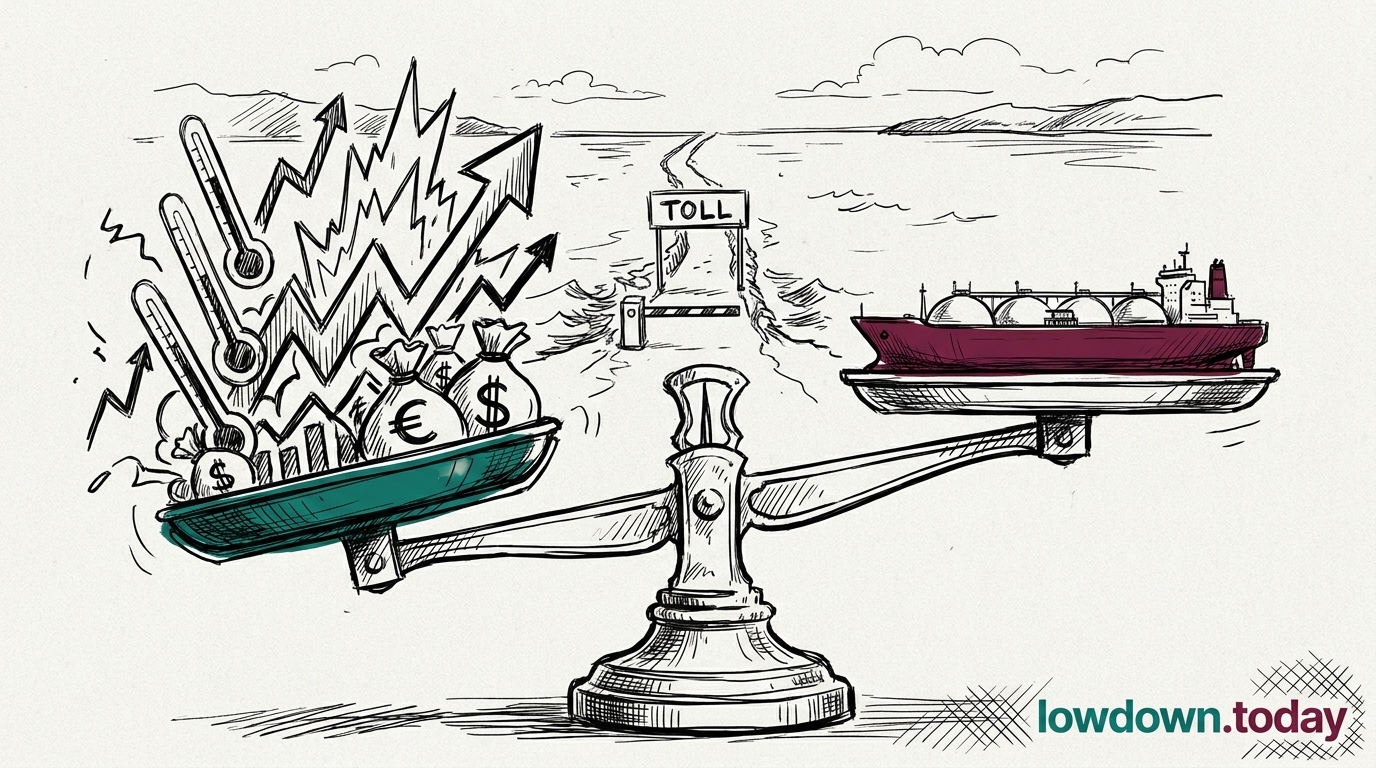
Washington reimposed a blockade on Iranian ports and a 20% Strait of Hormuz cargo toll on 13 July, driving TTF's 9% two-session rally to EUR 54.995/MWh. The posture is again setting Europe's gas benchmark by sentiment rather than by any confirmed change in cargo flows.
EDF
EDF
EDF slipped the Bugey 3, Golfech 2 and Chooz 2 restarts to 19, 22 and 25 July, pushing all three past the 20 July Bugey heat exemption, after river-cooling limits on the Rhone, Garonne and Meuse forced the cuts. The same thermal ceiling has capped the fleet in every major heatwave since 2003, and this cycle is no exception.
German power desk
German power desk
German day-ahead power climbed from EUR 126 to EUR 156/MWh over 14-16 July as the heat dome held, flipping the clean spark spread positive for the first time since 14 July. Gas-for-power demand is now back in competition with mandate storage injection right as the injection margin itself is thinning.
EU carbon and storage regulators
EUA carbon broke EUR 81/tonne on 13 July as the ETS Market Stability Reserve's scheduled withdrawals met fresh fuel-switching demand from France's nuclear curtailment. Brussels' mandatory storage-fill rule kept German and French injection running regardless of the TTF swings, the mechanism working as designed four years after the 2022 shock.
Equinor
Equinor
Equinor returned its Asgard field from maintenance on 11 July, lifting Gassco's exit nominations to 319.8 mcm/day just as TTF round-tripped on Hormuz risk. The restart gave Norway spare pipeline capacity to help Europe absorb the gas rally without drawing down storage, reinforcing its role as the post-2022 swing supplier.
