Skip to content
You can now search across every topic, entity and event.What's new
European Energy Markets
16JUL

EU 20th package would block Arc7 dry-dock servicing

4 min read
09:48UTC

The EU 20th sanctions package would block Arc7 ice-class LNG tanker maintenance, with six vessels due European dry-dock servicing in summer 2026 after their last cycle in 2023.

EconomicDeveloping
Key takeaway

Six European-owned Arc7 carriers face summer 2026 dry-dock; the 20th package would close that engineering window.

The EU 20th sanctions package, currently in draft, would block Arc7 ice-class LNG tanker maintenance in European yards, with six vessels due European dry-dock servicing in summer 2026 after their last cycle in 2023 1. The proposal tightens the carve-out left unresolved when the Russian LNG spot ban entered force on 25 April . Russia delivered its first domestically assembled Arc7 carrier, Alexey Kosygin, in January 2026, signalling domestic replacement capacity is building.

The Arc7 class, the only LNG carriers rated for Yamal LNG Northern Sea Route operations, runs three-year dry-dock cycles for hull plating and propulsion checks; missing a cycle compounds operational risk in ice conditions. Of the existing 15-vessel Yamal fleet, 11 are European-owned (Seapeak Maritime, Dynagas) and have historically used Damen Shipyards in the Netherlands and Spanish facilities. The proposal's mechanism is service prohibition rather than asset freeze, which keeps the legal framing inside maritime services law and avoids the fund-flow constraints EU insurers already face under the existing carve-out.

The transmission channel runs through Yamal LNG's deliverable summer schedule. If summer 2026 dry-dock access closes, Novatek's ability to maintain throughput at the 17.4 mtpa Yamal complex tightens against fleet availability rather than against export demand. The Alexey Kosygin delivery is the leading indicator on Russian substitution capacity; Zvezda Shipyard's replacement cadence is the operative constraint on whether the 20th package bites or just delays. For desks tracking Russian LNG export volumes against the spot ban, the maintenance restriction is the supplementary mechanism that closes the carve-out Squire Patton Boggs flagged in their 25 April compliance guidance: rerouting and resale loopholes in the recast text are immaterial if the vessels themselves cannot be kept seaworthy.


Deep Analysis

In plain English

Arc7 tankers are specialised vessels designed to carry liquefied natural gas through Arctic ice. They are used primarily to ship Russian Arctic LNG from the Yamal Peninsula and Arctic LNG 2 projects to European and Asian buyers. The 'Arc7' classification means the vessel can break through ice up to 2.1 metres thick. The EU's proposed 20th sanctions package would ban these ships from using European shipyards for maintenance. Six Arc7 vessels are due for their mandatory periodic dry-dock service in summer 2026, and they were last serviced in European yards in 2023. Without European yards, they must find alternative facilities, and Russia's domestic shipbuilding capacity for this specialised maintenance is still limited, even after delivering its first domestically built Arc7 in January 2026.

Deep Analysis
Escalation

The Arc7 maintenance ban, if adopted in the 20th sanctions package, would force Russia to choose between operating ageing vessels without mandated maintenance (a safety risk) or building domestic dry-dock capability faster than Zvezda's current timeline. Neither option removes Arctic LNG from the market in the near term, but both reduce the fleet's operational availability over 2027-28.

What could happen next?
  • Consequence

    Six Arc7 vessels unable to dry-dock in European yards in summer 2026 face either deferred maintenance (MARPOL compliance risk) or unplanned diversion to Chinese yards, with 60-90 day voyage and service delays removing each vessel from Arctic LNG service for the equivalent of two or three additional cargo cycles.

  • Precedent

    Russia's January 2026 Alexey Kosygin delivery demonstrates domestic Arctic LNG shipbuilding capacity; the maintenance ban accelerates Russia's investment in domestic dry-dock infrastructure, reducing the long-term effectiveness of European sanctions on Arctic LNG logistics.

First Reported In

Update #5 · Ban day muted; Germany doubles injection rate

High North News· 26 Apr 2026
Read original
Different Perspectives
LNG spreads desk
LNG spreads desk
The JKM-TTF arb flipped to a TTF premium of roughly USD 0.6/MMBtu on 15 July, the first time this cycle Europe has outbid Asia, yet no Atlantic cargo has rerouted west. Until a cargo actually moves, the desk reads the Hormuz premium as unconfirmed and the EUR 55 print as vulnerable to a fast reversal.
United States
United States
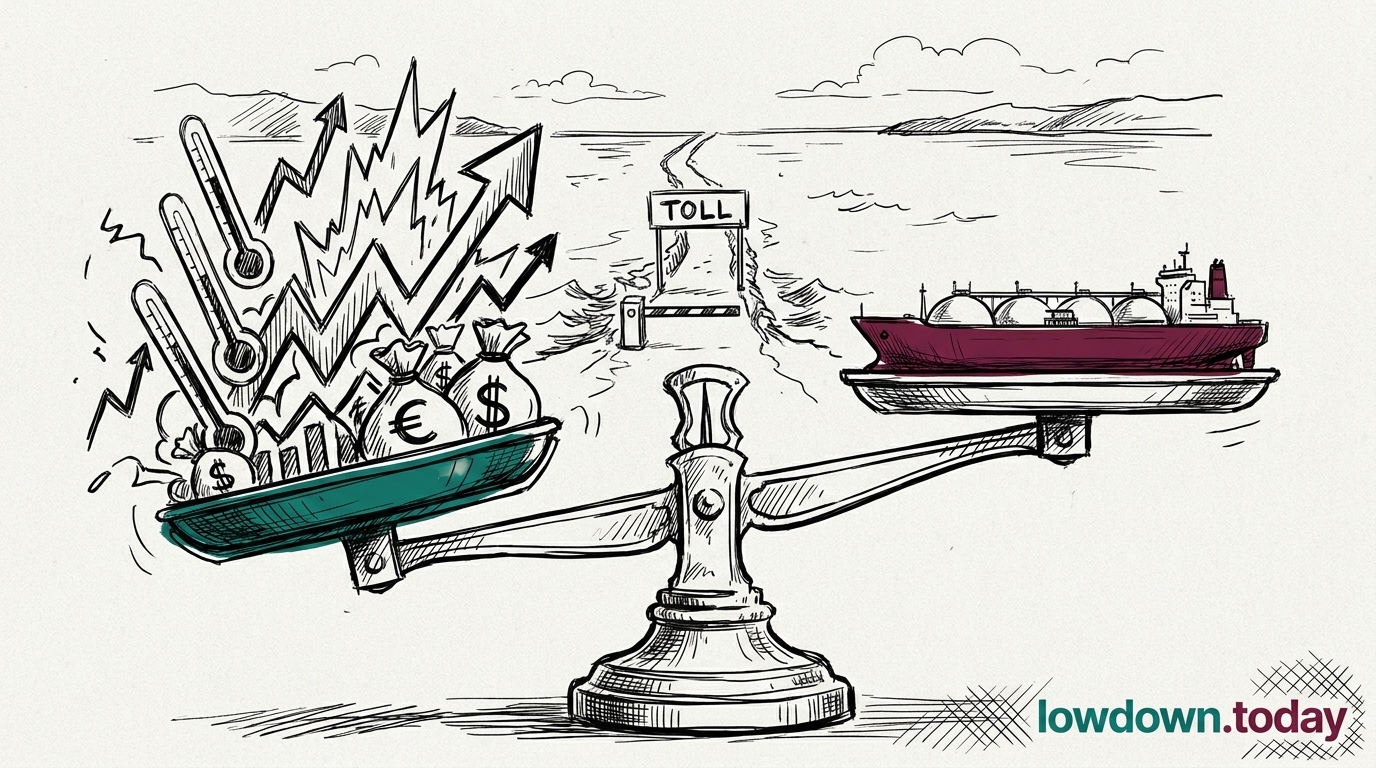
Washington reimposed a blockade on Iranian ports and a 20% Strait of Hormuz cargo toll on 13 July, driving TTF's 9% two-session rally to EUR 54.995/MWh. The posture is again setting Europe's gas benchmark by sentiment rather than by any confirmed change in cargo flows.
EDF
EDF
EDF slipped the Bugey 3, Golfech 2 and Chooz 2 restarts to 19, 22 and 25 July, pushing all three past the 20 July Bugey heat exemption, after river-cooling limits on the Rhone, Garonne and Meuse forced the cuts. The same thermal ceiling has capped the fleet in every major heatwave since 2003, and this cycle is no exception.
German power desk
German power desk
German day-ahead power climbed from EUR 126 to EUR 156/MWh over 14-16 July as the heat dome held, flipping the clean spark spread positive for the first time since 14 July. Gas-for-power demand is now back in competition with mandate storage injection right as the injection margin itself is thinning.
EU carbon and storage regulators
EUA carbon broke EUR 81/tonne on 13 July as the ETS Market Stability Reserve's scheduled withdrawals met fresh fuel-switching demand from France's nuclear curtailment. Brussels' mandatory storage-fill rule kept German and French injection running regardless of the TTF swings, the mechanism working as designed four years after the 2022 shock.
Equinor
Equinor
Equinor returned its Asgard field from maintenance on 11 July, lifting Gassco's exit nominations to 319.8 mcm/day just as TTF round-tripped on Hormuz risk. The restart gave Norway spare pipeline capacity to help Europe absorb the gas rally without drawing down storage, reinforcing its role as the post-2022 swing supplier.
