Skip to content
You can now search across every topic, entity and event.What's new
European Energy Markets
16JUL

Equinor NOK 17bn drilling; Eirin first gas

4 min read
09:48UTC

Equinor signed NOK 17 billion in Q1 2026 drilling contracts and started the Eirin field on Tuesday 5 May, routing 27.6 million barrels of oil equivalent of design recovery into the Gassled pipeline system via the Sleipner hub.

EconomicAssessed
Key takeaway

Drilling spend is a multi-year signal; Sodir's monthly print is the 2026-injection signal.

Equinor signed NOK 17 billion in drilling contracts during Q1 2026 and started the Eirin field on Tuesday 5 May , routing first gas into the Gassled pipeline system that supplies the European market. Eirin's design recovery is 27.6 million barrels of oil equivalent across its producing life, a subsea tieback to the Sleipner hub rather than a standalone development. Equinor is Norway's state-majority energy company and Europe's second-largest pipeline gas supplier; Gassled is the export pipeline network linking Norwegian Continental Shelf production to UK and Continental terminals.

The two signals run on different time horizons. Eirin's 27.6 mmboe routes via Sleipner into Gassled within the 2026 injection window. The drilling cash spend will not arrive as molecules until multi-year horizons. Sodir, the Norwegian Offshore Directorate, published March production at 10.8 bcm and 349.3 mcm/day, down 1.6% month-on-month and the second consecutive monthly decline . The March print is the binding read on the 2026 injection arithmetic; the NOK 17 billion is a forward statement of intent against the underlying decline rate.

The substitution arithmetic for procurement desks is whether late-life tiebacks compensate for the underlying decline rate or merely slow it. Eirin's 27.6 mmboe adds at the margin while Sodir's March print logs a second consecutive monthly decline. Norwegian fields entered 2026 with an aggregate decline rate consistent with the historical mature-basin trajectory, and the pipeline-gas premium that funds the drilling rests on prevailing TTF rather than a fresh policy instrument. The next data point is the Sodir April print expected 20-25 May.

A confirmed third consecutive monthly decline would shift positioning on Norwegian-priced forward contracts and pressure flexible cargo bidding from Atlantic suppliers. Procurement desks lose a clean read on second-half Norwegian throughput until the April Sodir print lands in the 20-25 May window. Equinor's NOK 17 billion sits against Sodir's monthly cadence as the long-horizon counterweight to a near-term decline trajectory.


Deep Analysis

In plain English

Norway is Europe's biggest supplier of natural gas through pipelines that run under the North Sea. Equinor is Norway's biggest energy company, majority-owned by the Norwegian government. On 5 May, Equinor started pumping gas from a new underwater field called Eirin, which sits about 250 km off the Norwegian coast and connects through existing pipes to markets in Germany and the UK. Equinor also signed NOK 17 billion (roughly EUR 1.5bn) in drilling contracts in the first three months of 2026. This is a bet that Norway's gas fields remain profitable at current prices and worth maintaining. The challenge is that Norway's overall gas output has been falling for two months in a row. Eirin's 27.6 mmboe total recovery converts to roughly 0.5-0.7 bcm per year, a modest addition against Norway's monthly baseline of 10.8 bcm. The bigger question is whether Norway can maintain its overall output level, which Europe depends on heavily now that Russian pipeline supplies have been cut.

Deep Analysis
Root Causes

Norwegian gas production decline on the NCS reflects natural field depletion across a portfolio where the largest fields, Troll, Oseberg, and Åsgard, have been producing for 15-30 years and are past their natural plateau. Troll alone still delivers roughly 30% of Norwegian gas exports, but its daily output has declined from peak levels and cannot be easily replaced by smaller finds.

The Sodir March print at 349.3 mcm/day reflects both the underlying depletion trend and seasonal demand patterns. The NOK 17bn drilling commitment reads as Equinor defending a cash-flow plateau in a EUR 47 TTF environment where NCS pipeline-gas commands a premium over spot LNG, the premium that makes the drilling economic at current prices.

Eirin's tie-back to Gina Krog and routing via Sleipner A into Gassled adds molecules in the 2026 injection window. At 27.6 mmboe total recovery spread across the field's producing life, the annual contribution is modest relative to the Sodir monthly production baseline of 10.8 bcm.

What could happen next?
  • Risk

    A third consecutive Sodir monthly decline print in the April data (expected 20-25 May) would trigger repricing on Norwegian-priced forward gas contracts, as three consecutive months constitutes a confirmed trend rather than seasonal noise.

  • Consequence

    Eirin's modest annual contribution of roughly 0.5-0.7 bcm cannot offset the aggregate NCS decline rate; the drilling commitment defends Equinor's cash plateau but does not change the European supply trajectory on a 12-18 month horizon.

First Reported In

Update #9 · Storage 35% met, 80% trajectory still missed

Equinor· 12 May 2026
Read original
Different Perspectives
LNG spreads desk
LNG spreads desk
The JKM-TTF arb flipped to a TTF premium of roughly USD 0.6/MMBtu on 15 July, the first time this cycle Europe has outbid Asia, yet no Atlantic cargo has rerouted west. Until a cargo actually moves, the desk reads the Hormuz premium as unconfirmed and the EUR 55 print as vulnerable to a fast reversal.
United States
United States
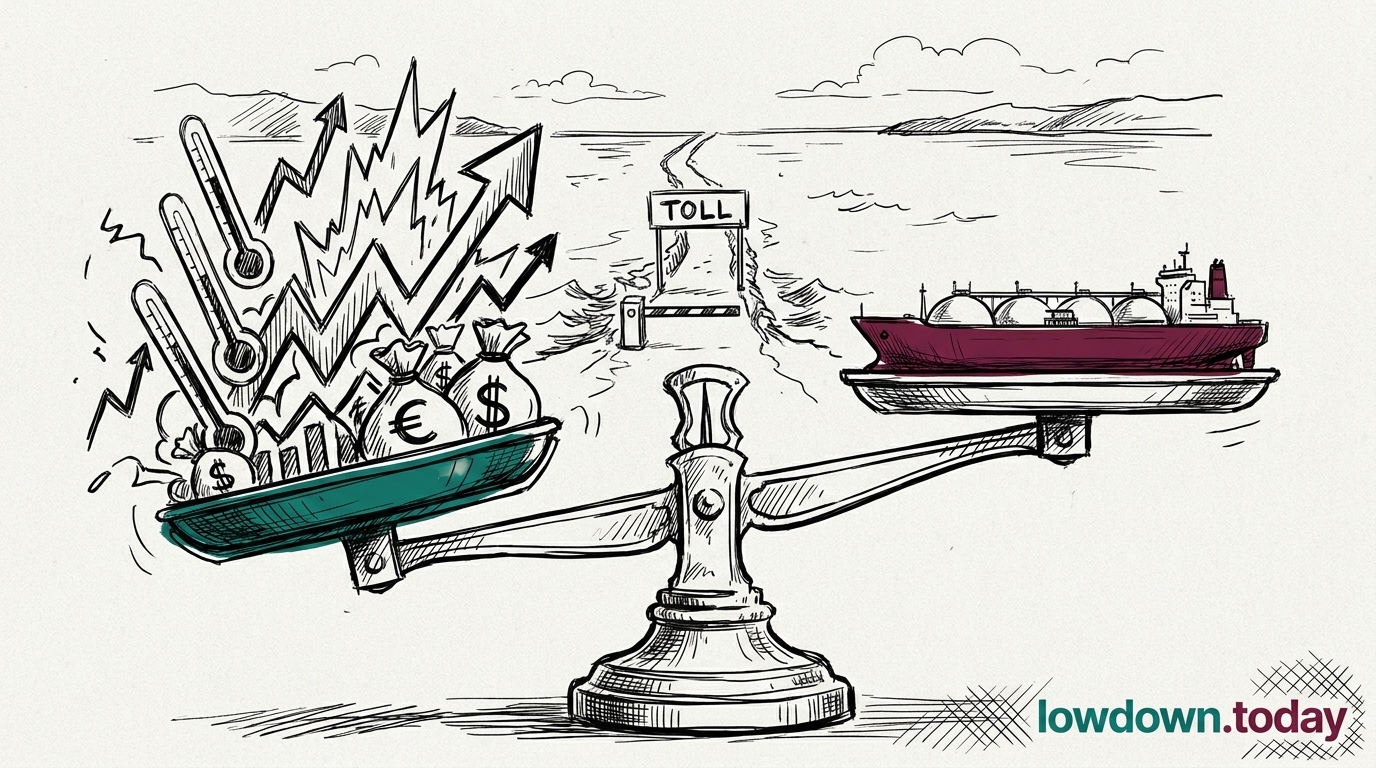
Washington reimposed a blockade on Iranian ports and a 20% Strait of Hormuz cargo toll on 13 July, driving TTF's 9% two-session rally to EUR 54.995/MWh. The posture is again setting Europe's gas benchmark by sentiment rather than by any confirmed change in cargo flows.
EDF
EDF
EDF slipped the Bugey 3, Golfech 2 and Chooz 2 restarts to 19, 22 and 25 July, pushing all three past the 20 July Bugey heat exemption, after river-cooling limits on the Rhone, Garonne and Meuse forced the cuts. The same thermal ceiling has capped the fleet in every major heatwave since 2003, and this cycle is no exception.
German power desk
German power desk
German day-ahead power climbed from EUR 126 to EUR 156/MWh over 14-16 July as the heat dome held, flipping the clean spark spread positive for the first time since 14 July. Gas-for-power demand is now back in competition with mandate storage injection right as the injection margin itself is thinning.
EU carbon and storage regulators
EUA carbon broke EUR 81/tonne on 13 July as the ETS Market Stability Reserve's scheduled withdrawals met fresh fuel-switching demand from France's nuclear curtailment. Brussels' mandatory storage-fill rule kept German and French injection running regardless of the TTF swings, the mechanism working as designed four years after the 2022 shock.
Equinor
Equinor
Equinor returned its Asgard field from maintenance on 11 July, lifting Gassco's exit nominations to 319.8 mcm/day just as TTF round-tripped on Hormuz risk. The restart gave Norway spare pipeline capacity to help Europe absorb the gas rally without drawing down storage, reinforcing its role as the post-2022 swing supplier.
