Skip to content
You can now search across every topic, entity and event.What's new
European Energy Markets
15JUN

EU chip share slips to 9%

3 min read
12:23UTC

The Commission's own scorecard put EU semiconductor share at 9% against its 20% goal for 2030, a gap that has widened, not closed, since the target was written.

EconomicDeveloping
Key takeaway

Europe's chip share has fallen since the target was set, before any new law could act.

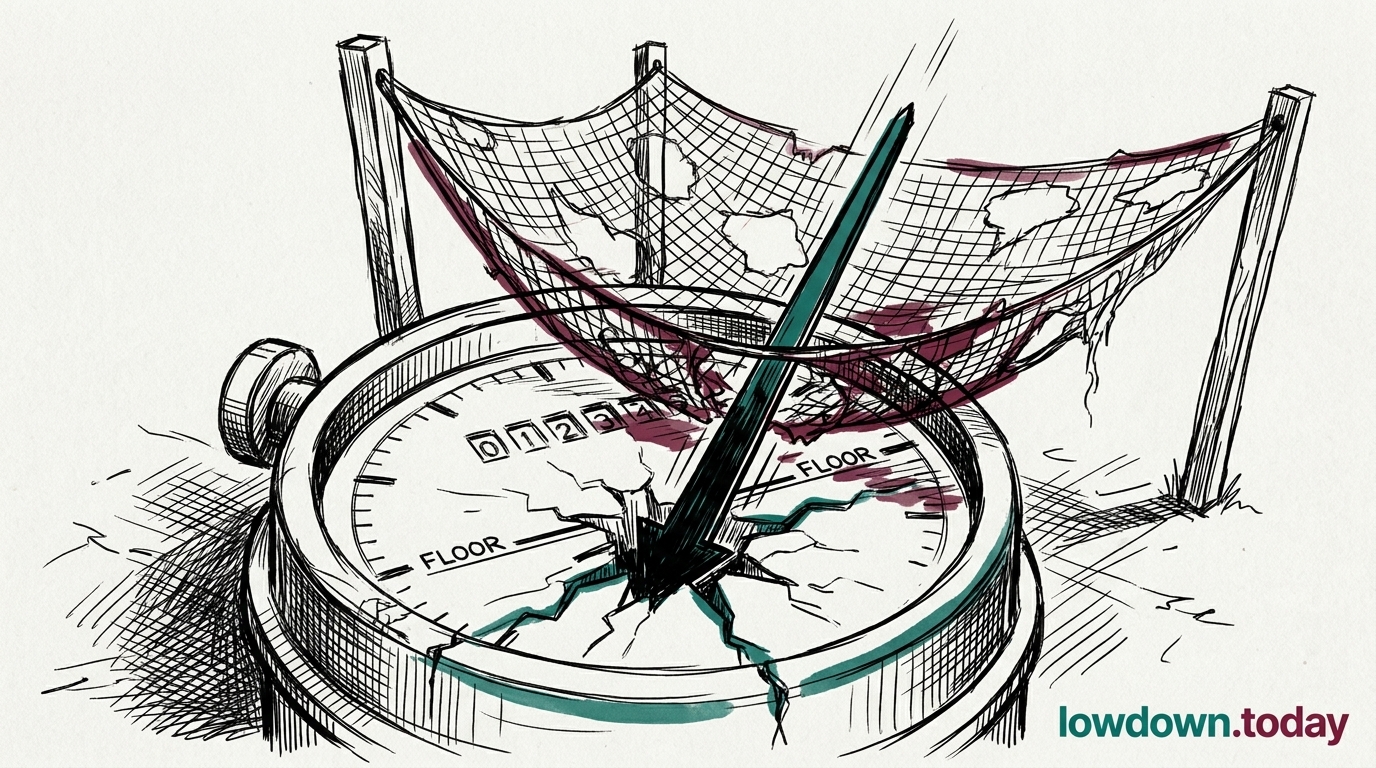
The European Commission published its 2026 State of the Digital Decade report on Wednesday 17 June, and its headline number undercut the law Brussels adopted a fortnight earlier 1. The EU holds 9% of the global semiconductor market against its own 20% target for 2030. That share has not crept towards the goal since the first Chips Act in 2023. It has fallen.

The gap reflects what the original target counted. When Brussels set 20% by 2030, the planned capacity included Intel's 30bn euro Magdeburg fab and the 7.5bn euro GlobalFoundries Crolles project. Intel cancelled Magdeburg; GlobalFoundries suspended Crolles. Roughly 37.5bn euros of assumed leading-edge capacity left the plan, and the baseline collapsed with it.

Chips Act II handed The Commission direct equity-stake authority in fabs on 3 June, so Brussels can fund construction without a member state acting as intermediary . The scorecard showing the gap wider arrived 14 days later. Two weeks is no time at all, and a fab takes years; the data is not a verdict on a law adopted alongside CADA . The 9% measures how far behind the start line the bloc stands before any new law has had time to act.


Deep Analysis

In plain English

The EU set a target in 2023 to make 20% of the world's computer chips by 2030. To get there it assumed two big new factories would be built: one by Intel (a US chipmaker) in Magdeburg, Germany (worth 30bn euros), and one by GlobalFoundries (another US chipmaker) in Crolles, France (worth 7.5bn euros). Intel cancelled Magdeburg in early 2026; GlobalFoundries paused Crolles in 2024. The Commission published its annual progress report on 17 June 2026 and the headline number was 9%, lower than when the target was set. A new law called Chips Act II was adopted two weeks earlier and gives Brussels direct power to invest in chip factories. But factories take years to build, and the scorecard measures where things stand right now.

Deep Analysis
Root Causes

The original Chips Act counted planned fab investments as assumed capacity before those investments had been contractually committed. Intel's Magdeburg depended on a guaranteed customer pipeline that Intel's own Q2 2024 losses ($1.6bn net loss) made untenable; GlobalFoundries' Crolles depended on 10nm FD-SOI demand from European automotive customers who had slowed orders. Neither commitment was demand-backed.

Second, the Commission's instrument for semiconductor investment under the original Chips Act required member states to act as financial intermediaries, adding a political veto layer the Commission could not control. Chips Act II removes that veto, but the demand-side gap it cannot resolve: the EU has no captive high-volume customer for leading-edge chips that would underwrite a new fab's utilisation rate.

What could happen next?
  • Consequence

    Chips Act II's €120bn investment target to 2035 now starts from a lower base than the original Chips Act, with no confirmed leading-edge fab to anchor the trajectory.

    Medium term · Assessed
  • Risk

    If the Commission cannot generate customer-side demand commitments to underwrite a new fab's utilisation rate, direct equity authority alone does not resolve the structural gap Intel and GlobalFoundries cited when cancelling.

    Long term · Suggested
  • Precedent

    The scorecard establishes the 9% figure as the official baseline for all future Chips Act II progress reporting; the 20% target can no longer be measured against the original assumed-capacity trajectory.

    Immediate · Reported
First Reported In

Update #9 · EU chip share slips to 9% as law takes hold

European Commission· 18 Jun 2026
Read original
Different Perspectives
Spain's LNG terminal operators
Spain's 9,145 GWh terminal inventory is the largest single stock in the EU LNG network, an option value that can reroute cargoes wherever the winter strip pays best rather than a cavern gas obligation tied to a fixed date. That flexibility matters more as Germany's cavern shortfall pushes more of the winter security question onto import infrastructure.
European Commission
European Commission
Brussels holds the bloc to 90% on a flexible window while Germany, holding roughly a quarter of EU storage capacity, tracks toward missing its own lower 80% figure by 21 points. A national shortfall this size in the anchor market matters more to bloc security than the flexible timetable alone can absorb.
French power exporters and CRE
French day-ahead rose in step with Germany but by less, reopening a EUR 7-17 premium that makes northward export flows commercially attractive again after the EUR 43.09 discount evaporated in days. CRE separately authorised RTE and Enedis to buy flexibility locally, betting the coming winter's binding constraint is grid congestion rather than a shortage of firm capacity.
TTF trading desk
TTF trading desk
A visible national shortfall like Germany's 21-point gap is a directional signal, not noise, for a desk holding the summer-winter spread. TTF's flat EUR 58-60 range through this week's German price swings says the market has not yet chosen to reprice refill risk into the front of the curve.
German cavern and CCGT operators
German caverns kept buying prompt gas at TTF near EUR 58-60 through the inversion; the wind collapse to 2.4 GW then flipped the spark spread to plus EUR 29 and put turbines back in the same queue. Every day turbines win that bid, injection at a third of the 877 GWh/day pace needed falls further behind.
Slovakia
Slovakia
Slovakia says it dropped its hold-out on the 21st sanctions package only after Ursula von der Leyen personally signed written gas-price and supply guarantees. The Council of the European Union's own 17,238-character release on the package names neither Slovakia nor any guarantee, leaving Bratislava's account unconfirmed by the institutional record.



