Skip to content
You can now search across every topic, entity and event.What's new
European Energy Markets
4JUN

EU storage at 34.3% before 12 May test

3 min read
10:45UTC

EU aggregate gas storage reached 34.3% on 7 May, an injection pace of 0.248 pp/day that sits 0.009 pp/day below the 0.257 pp/day floor needed for 80% by 1 November.

EconomicDeveloping
Key takeaway

The 12 May 35% test is now four working days away with the pace 0.009 pp/day inside the November floor.

EU aggregate gas storage reached 34.3% on 7 May, GIE AGSI+ (Aggregated Gas Storage Inventory) data shows, a 1.24 percentage-point gain on the 33.06% reading from 2 May . The implied pace, 0.248 pp/day, sits 0.009 pp/day inside the 0.257 pp/day floor that update #7 set as the threshold for clearing 80% by 1 November . The 35% threshold sits 0.7 pp away with four working days before the 12 May WATCH FOR resolves.

GIE AGSI+ is the EU's transparency feed for member-state and facility-level fill, published daily. The pace floor is not arbitrary: it is what the 1 November target requires from a 33.06% start. Below it, every session adds a forward-curve problem the front month cannot reflect, because the gap compounds rather than resolves.

At the 0.248 pp/day pace, the 35% threshold crosses on 10 or 11 May. A holiday-weekend deceleration or any aggregate slip pushes that crossing past the 12 May test. Bruegel's EUR 26 billion refill model assumes the floor is met, not stress-tested for the inverse case where merchant operators face inverted spreads. Germany's structural shortfall is the composition risk inside the aggregate, and the next event takes that down to facility level.


Deep Analysis

In plain English

Each year, European countries spend the warm months pumping natural gas into underground storage tanks to prepare for winter. There is a target: reach 80% full by 1 November. Think of it like filling a reservoir before a dry season. As of 7 May, the fill level is 34.3%, rising at 0.248 percentage points per day. To reach 80% by November, Europe needs 0.257 points per day. The gap is small, nine thousandths of a percentage point, but it compounds each day it persists. On 12 May there is a test date: if storage has not crossed 35% by then, it signals the shortfall is structural rather than a slow week. Structural means fixing it becomes progressively harder because the required catch-up rate increases daily.

Deep Analysis
Root Causes

The 0.257 pp/day floor was set against a storage baseline of 33.06% on 2 May with 183 days remaining to 1 November. The required pace follows directly from that starting point. What makes the shortfall structural rather than seasonal is the removal of the gas storage levy on 1 January 2026, the instrument that previously shifted merchant incentives toward injection at spreads where commercial logic would otherwise favour withdrawal or deferred commitment.

Without the levy, injection pace is a function of the summer–winter TTF spread adjusted for storage capacity rental, injection energy cost, and financing cost. At EUR 44/MWh TTF front-month against a EUR 52–55/MWh Cal-26 Q4 implied level, the spread may not clear the all-in injection cost for high-marginal-cost cavern operators.

Bruegel's EUR 26bn refill model bakes in the floor being met; it does not stress-test the case where below-floor pace is the market-clearing outcome rather than the deviation.

What could happen next?
  • Risk

    If EU aggregate pace stays at 0.248 pp/day through June, the November fill projects to 73-75%, below the 80% threshold, triggering Commission emergency review procedures.

    Medium term · 0.7
  • Consequence

    Below-floor pace removes the core assumption in Bruegel's EUR 26bn refill model (ID:2822); the inverse scenario where the same spend buys 73% rather than 80% fill has not been publicly costed.

    Short term · 0.8
  • Precedent

    The removal of the gas storage levy on 1 January 2026 is the first test of whether the EU can achieve its November fill target on commercial incentives alone, without the levy's injection subsidy.

    Long term · 0.85
First Reported In

Update #8 · Storage 34.3 as 12 May test nears; Hammerfest silent

EnergyRiskIQ (aggregating GIE AGSI+)· 8 May 2026
Read original
Different Perspectives
Marine insurers and AIS trackers covering Hormuz
AIS data shows severe curtailment on 20 July, 479 vessels anchored, 36 dark, 123 still broadcasting inside the strait, not the closure the IRGC claims. War-risk premiums move on the unresolved CENTCOM-IRGC contest itself, since underwriters price the dispute as much as the count.
QatarEnergy
QatarEnergy
Ras Laffan has run at minimum output under force majeure into August since 9 July, a constraint already priced before this week's claim. The 17-20 July move is risk premium stacked on that standing loss, not a new physical loss at the plant.
ACER and the European Commission
ACER opened the REMIT reporting consultation on schedule on 16 July, giving firms to 11 September before a quarter to build systems against Regulation 648/2012. Brussels' separate silence on StromVKG state-aid clearance leaves Berlin's own capacity mechanism without legal authorisation.
EDF and French grid operator RTE
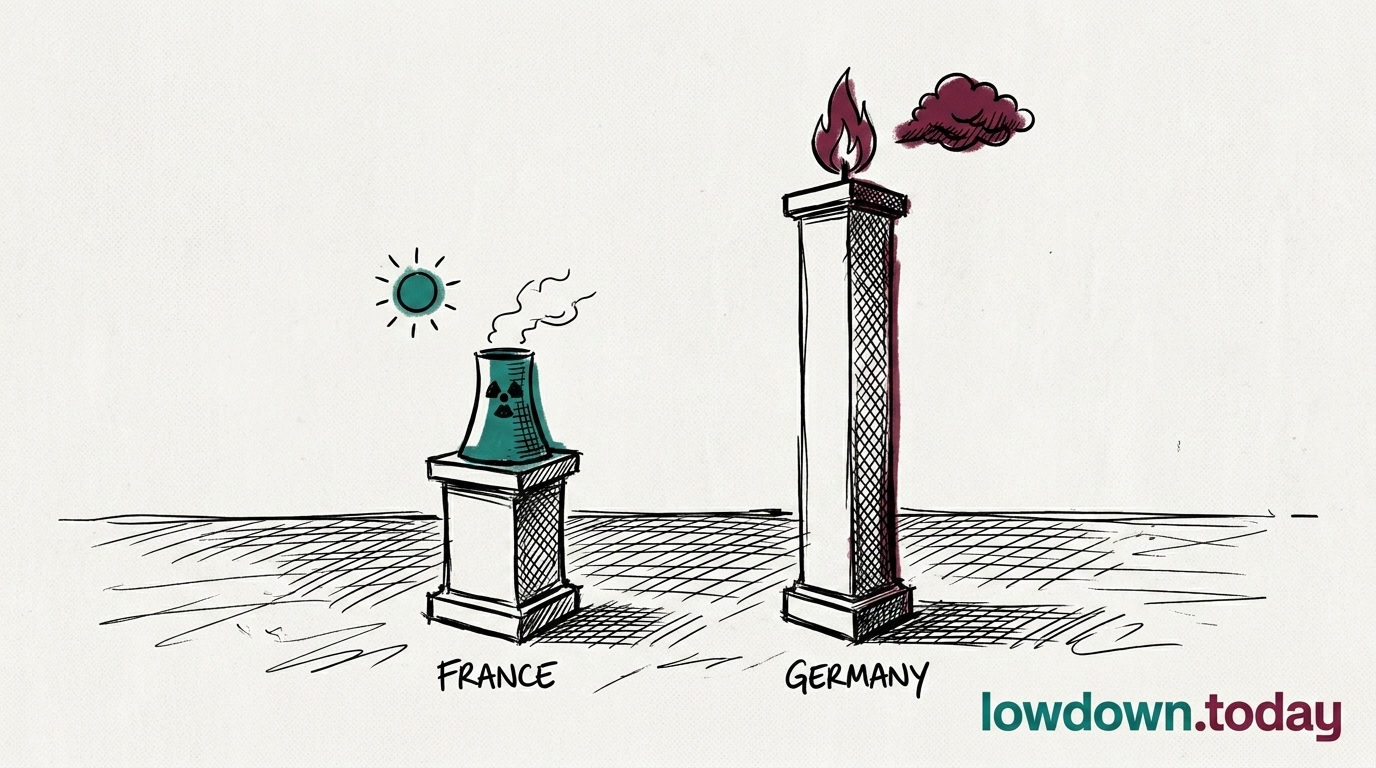
France's discount to Germany rests on an ASNR derogation from the 28C river-cooling limit at Bugey that expires today, not on a nuclear recovery; Chooz, Golfech and Bugey restarts run to 25 July. The cheap leg holds only as long as regulators keep waiving the limit each heatwave.
German CCGT operators and grid balancers
German gas plants went off-merit on 20 July as the clean spark spread inverted to minus EUR 15 to minus EUR 21/MWh, sidelining the flexible capacity storage injection needs. Operators are pricing 2027-28 capacity revenue against Bundesnetzagentur's own admission that Brussels has not cleared the 9 GW StromVKG auctions.
LNG spreads desk
LNG spreads desk
The JKM-TTF arb flipped to a TTF premium of roughly USD 0.6/MMBtu on 15 July, the first time this cycle Europe has outbid Asia, yet no Atlantic cargo has rerouted west. Until a cargo actually moves, the desk reads the Hormuz premium as unconfirmed and the EUR 55 print as vulnerable to a fast reversal.
