Skip to content
You can now search across every topic, entity and event.What's new
European Energy Markets
4JUN

Bergermeer carries Dutch injection load alone

3 min read
10:45UTC

GasTerra depleted Norg (59 TWh) and Grijpskerk (24 TWh) ahead of the NAM handover on 1 April, leaving both at zero carry-in. Bergermeer now carries the full weight of Dutch injection.

EconomicDeveloping
Key takeaway

Norg and Grijpskerk start the season at zero; Bergermeer alone carries the EUR 233m EBN state mandate.

GasTerra depleted Norg (59 TWh of working volume) and Grijpskerk (24 TWh) ahead of the NAM (Nederlandse Aardolie Maatschappij) handover on 1 April, leaving both facilities at structural zero carry-in for the season. Combined with the 8.95% Netherlands fill recorded on 25 April , this leaves Bergermeer carrying the full weight of Dutch injection against the EBN (Energie Beheer Nederland) EUR 233 million state mandate 1.

The GTS (Gasunie Transport Services) 2026/27 security-of-supply target sets a 115 TWh combined fill target across the three facilities. With Norg and Grijpskerk starting empty and Bergermeer the only injection vehicle with active state budget behind it, the Dutch contribution to the EU aggregate pace skews binary on whether EBN can ramp through May and June. Facility-level injection rates are not in the AGSI+ public feed, so the next Dutch-specific data point arrives only indirectly via the bloc-wide print.

The operating consequence is that one facility now carries a system risk that was previously distributed across three. Bergermeer is a depleted reservoir on the conventional Dutch model, and ramping a single asset against a 115 TWh target compresses the timeline for any technical issue across its compression train or wells. The GasTerra-to-NAM handover dynamic that produced the zero carry-in was a contractual tidy-up rather than a market-driven depletion, which is what makes the resulting concentration of injection risk a structural feature of the season rather than a passing data print.


Deep Analysis

In plain English

The Netherlands has three underground gas storage sites: Norg, Grijpskerk and Bergermeer. Think of them as three separate tanks that collectively ensure Dutch homes and businesses have enough gas for winter. Before a planned handover of two of those facilities to a different company on 1 April, the previous operator drew them down to completely empty. So now the Netherlands is heading into summer with only one tank working, Bergermeer, to fill all three tanks' worth of capacity by November. The Dutch government has set aside 233 million euros to fund this injection, but everything now depends on one facility performing without any technical problems all summer.

Deep Analysis
Root Causes

GasTerra's depletion of Norg and Grijpskerk to zero before the NAM handover reflects a contractual rather than commercial logic. GasTerra was unwinding its own balance-sheet exposure to storage assets as part of the broader Dutch government gas-market restructuring following the Groningen phase-out. The timing and depth of the depletion were dictated by the handover agreement terms, not by injection-season planning.

The result is a structural concentration that the storage architecture was not designed to sustain. The Dutch system was built with three facilities specifically to provide redundancy: Norg as the high-deliverability peaker, Grijpskerk as the seasonal buffer, Bergermeer as the commercial merchant facility with state-backstop. Running Bergermeer alone against a 115 TWh target removes all three redundancy layers simultaneously.

What could happen next?
  • Risk

    A compression or well failure at Bergermeer during peak injection removes all Dutch contribution to EU aggregate pace, there is no Norg or Grijpskerk buffer, and directly widens the gap from the 0.257 pp/day required floor.

    Medium term · 0.68
  • Consequence

    EBN's price-insensitive EUR 233m state mandate at Bergermeer creates a structural bid in the TTF spot market through September; traders short summer TTF face a state buyer who will not yield on price.

    Short term · 0.74
  • Risk

    GTS's 115 TWh combined fill target across three facilities now falls entirely on one, Bergermeer's 4.9 bcm working volume, with no published modelling of what happens if the post-2024 compression upgrade encounters sustained high-injection failure.

    Medium term · 0.6
First Reported In

Update #7 · Storage pace 0.21 vs 0.257; floor not yet met

Gasunie Transport Services· 4 May 2026
Read original
Different Perspectives
Marine insurers and AIS trackers covering Hormuz
AIS data shows severe curtailment on 20 July, 479 vessels anchored, 36 dark, 123 still broadcasting inside the strait, not the closure the IRGC claims. War-risk premiums move on the unresolved CENTCOM-IRGC contest itself, since underwriters price the dispute as much as the count.
QatarEnergy
QatarEnergy
Ras Laffan has run at minimum output under force majeure into August since 9 July, a constraint already priced before this week's claim. The 17-20 July move is risk premium stacked on that standing loss, not a new physical loss at the plant.
ACER and the European Commission
ACER opened the REMIT reporting consultation on schedule on 16 July, giving firms to 11 September before a quarter to build systems against Regulation 648/2012. Brussels' separate silence on StromVKG state-aid clearance leaves Berlin's own capacity mechanism without legal authorisation.
EDF and French grid operator RTE
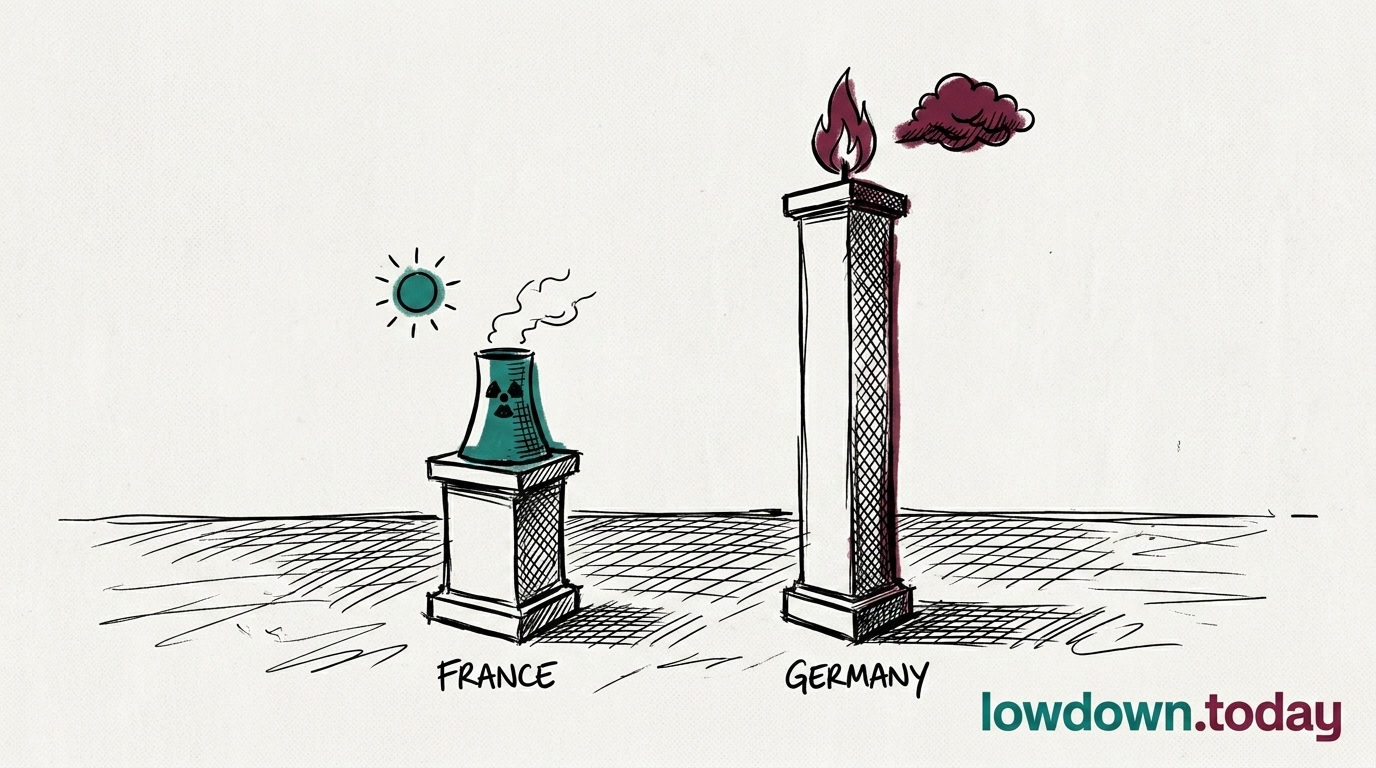
France's discount to Germany rests on an ASNR derogation from the 28C river-cooling limit at Bugey that expires today, not on a nuclear recovery; Chooz, Golfech and Bugey restarts run to 25 July. The cheap leg holds only as long as regulators keep waiving the limit each heatwave.
German CCGT operators and grid balancers
German gas plants went off-merit on 20 July as the clean spark spread inverted to minus EUR 15 to minus EUR 21/MWh, sidelining the flexible capacity storage injection needs. Operators are pricing 2027-28 capacity revenue against Bundesnetzagentur's own admission that Brussels has not cleared the 9 GW StromVKG auctions.
LNG spreads desk
LNG spreads desk
The JKM-TTF arb flipped to a TTF premium of roughly USD 0.6/MMBtu on 15 July, the first time this cycle Europe has outbid Asia, yet no Atlantic cargo has rerouted west. Until a cargo actually moves, the desk reads the Hormuz premium as unconfirmed and the EUR 55 print as vulnerable to a fast reversal.
