Skip to content
You can now search across every topic, entity and event.What's new
European Energy Markets
26MAY

Two shocks squeeze the spark, not FR-DE

2 min read
12:01UTC

German and French day-ahead rose together over 6-10 July, keeping the FR-DE spread compressed while a firmer TTF and flat EUA at EUR 78.95 squeezed the clean spark spread instead.

EconomicAssessed
Key takeaway

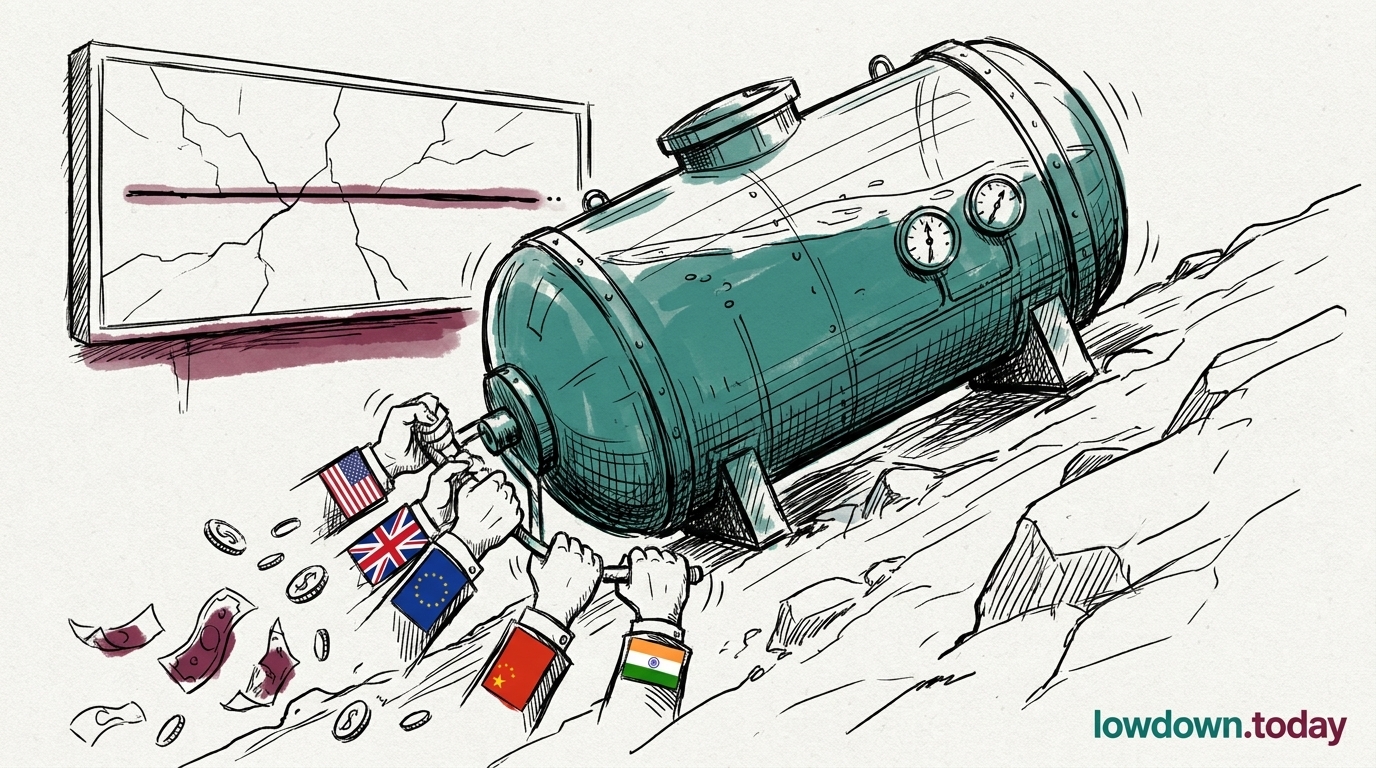
Two shocks at once compressed the FR-DE spread and squeezed the clean spark spread instead.

German day-ahead baseload cleared 93.78, 71.66, 100.73, 124.58 and 123.04 EUR/MWh across 6 to 10 July, while France cleared 86.97, 89.30, 94.32, 110.02 and 118.68 12. Both legs rose together, so the DE-minus-FR spread swung only from -17.64 to +14.56, France the dearer leg on 7 July, a world away from the EUR 71.50 gap the 30 June heat opened when German wind collapsed alone . That spread had already compressed towards EUR 18-26 by 5 July .

The clean spark spread carries this squeeze, not the cross-border one. TTF firmed on the prompt with no matching lift in CCGT running margin, while EUA carbon settled 78.95 EUR/tCO2 on 9 July, roughly flat on the day 3 . The same margin pressure reached EUR 74 as recently as 30 June . Flat carbon isolates the move as fuel-and-power rather than a carbon-cost shift. Settled baseload stayed moderate at 100 to 125 EUR/MWh, well below the 200-plus evening peaks forecasters flagged, so the pressure reads as a margin squeeze on spark economics, not a power-price explosion.


Deep Analysis

In plain English

A spark spread is the profit margin a gas power plant makes: the electricity price it sells at, minus the cost of the gas it burns to make that electricity. When gas prices rise faster than electricity prices, that margin gets squeezed. This week, German and French electricity prices rose together rather than one country becoming much more expensive than the other, which is what usually happens when only one side has a problem like low wind. Instead, both countries are paying more for the gas that increasingly sets their electricity price, a Europe-wide cost pressure rather than a one-country weather problem.

Deep Analysis
Root Causes

Germany's marginal price is set by its gas-fired plants whenever wind is short, so a firming TTF prompt raises the clearing price directly. Because carbon has not moved in the same window, the squeeze lands entirely on the CCGT operating margin rather than being partly offset by cheaper emissions costs.

France normally provides a cheaper nuclear-led floor that decouples its price from Germany's gas-driven one, which is why the two countries usually diverge under stress; this window's parallel rise instead suggests France's own thermal and import-exposed margin is being squeezed by the same TTF move, not by a separate French-specific constraint.

What could happen next?
  • Consequence

    CCGT operators in both Germany and France see thinner margins on new generation even as headline power prices rise, since fuel costs are keeping pace with the power-price increase.

  • Meaning

    A squeeze that hits both countries together, rather than one, marks a fuel-cost-driven episode distinct from the wind-dependent divergence of 30 June.

First Reported In

Update #25 · Qatari LNG strike puts TTF back over EUR 50

Investing.com· 10 Jul 2026
Read original
Different Perspectives
EU carbon and storage regulators
EUA carbon broke EUR 81/tonne on 13 July as the ETS Market Stability Reserve's scheduled withdrawals met fresh fuel-switching demand from France's nuclear curtailment. Brussels' mandatory storage-fill rule kept German and French injection running regardless of the TTF swings, the mechanism working as designed four years after the 2022 shock.
Equinor
Equinor
Equinor returned its Asgard field from maintenance on 11 July, lifting Gassco's exit nominations to 319.8 mcm/day just as TTF round-tripped on Hormuz risk. The restart gave Norway spare pipeline capacity to help Europe absorb the gas rally without drawing down storage, reinforcing its role as the post-2022 swing supplier.
Germany
Germany
Germany briefly became the cheaper leg of the FR-DE spread on 12 July as French reactors went offline, while its own storage injection tripled to 723 GWh on 11 July under the EU's mandatory fill rule. Berlin's CCGT fleet absorbed the extra load at a time when EUA's climb past EUR 81 is raising its own marginal cost too.
EDF
EDF
EDF took Chooz, Golfech and Bugey fully offline on 12 July under river-cooling discharge limits, then secured a temperature exemption for Bugey to 20 July rather than wait for the rivers to cool. The government's willingness to relax the environmental ceiling shows French grid security now outweighs the permit breach when reactor hardware itself is undamaged.
Storage and injection-pace desk
EU storage sat at 51.1% on 8 July, still running below the pace needed for an 80% November target, and the JKM-TTF Asia premium of roughly USD 1.4-2.4/MMBtu was already pulling marginal cargoes east before Qatar's withdrawal compounded the gap. October's top-up remains the binding constraint, not this week's price level.
EDF / France
EDF / France
EDF added Chooz to its heat-curtailment watch list as a precaution against the second heat dome peaking 9-14 July, alongside standing warnings at Blayais, Bugey, Golfech and Saint-Alban. No output cut has been confirmed at any site as of 10 July.
