Skip to content
Briefings are running a touch slower this week while we rebuild the foundations.See roadmap
European Energy Markets
18MAY

Germany sets September 2026 for first 8 GW gas auction

3 min read
11:11UTC

Germany plans its first gas plant auction for September 2026 under the draft law: 8 GW of gas capacity plus 2 GW of other technologies, all hydrogen-ready.

EconomicDeveloping
Key takeaway

Germany's first 8 GW gas-plant auction is set for September 2026, with SPD sign-off the residual gate.

Germany's federal Economy Ministry confirmed in a draft law published this week that the country's first gas plant auction is set for September 2026, tendering 8 GW of gas-fired capacity plus 2 GW of other technologies, all designated hydrogen-ready 1. The SPD Environment Ministry has not yet signed off the CDU/CSU-led Economy Ministry draft, but the September 2026 auction date is the new planning horizon, advancing the coalition tension tracked in update #281 .

The Kraftwerksstrategie, Germany's long-running gas-plant capacity strategy, has been politically contested since the 2024 SPD-CDU/CSU coalition formed; without it, Germany's residual capacity adequacy through 2030 hangs on extending lignite plants whose retirement schedules are already legislated. Hydrogen-ready means the gas turbines must be capable of conversion to hydrogen feedstock, a capex condition that adds roughly 10 to 15% to overall plant cost and currently has no commercial hydrogen supply chain to convert against.

The September 2026 date is procurement-relevant rather than just political. 8 GW at typical capacity factors is roughly 15 to 20 TWh per year of dispatchable supply, which is the order of magnitude required to anchor the German balance through the second half of the decade as EDF takes Flamanville-3 into a one-year major overhaul in September 2026. Italian, Dutch and central European desks pricing 2027 and 2028 calendar contracts against German power-import availability now have a tender date to mark; whether the SPD signs off determines whether the date holds. The auction's hydrogen-ready specification is the residual political cost: SPD support for any gas-plant build has been conditional on a credible decarbonisation pathway, and the conversion clause is what carries that condition into procurement law.


Deep Analysis

In plain English

Germany is planning an auction in September 2026 to commission new gas power plants, totalling 8 gigawatts of capacity. These plants would be designed to run on natural gas now but switch to hydrogen in future, once hydrogen supply is available at commercial scale. The SPD (Social Democrats') Environment Ministry has not yet approved the Economy Ministry's draft law, which is a coalition disagreement that could delay the auction. The plants are not expected to come online until 2031. For the coming winters, Germany must rely on its existing infrastructure, gas storage, interconnectors, and current power plants.

What could happen next?
  • Opportunity

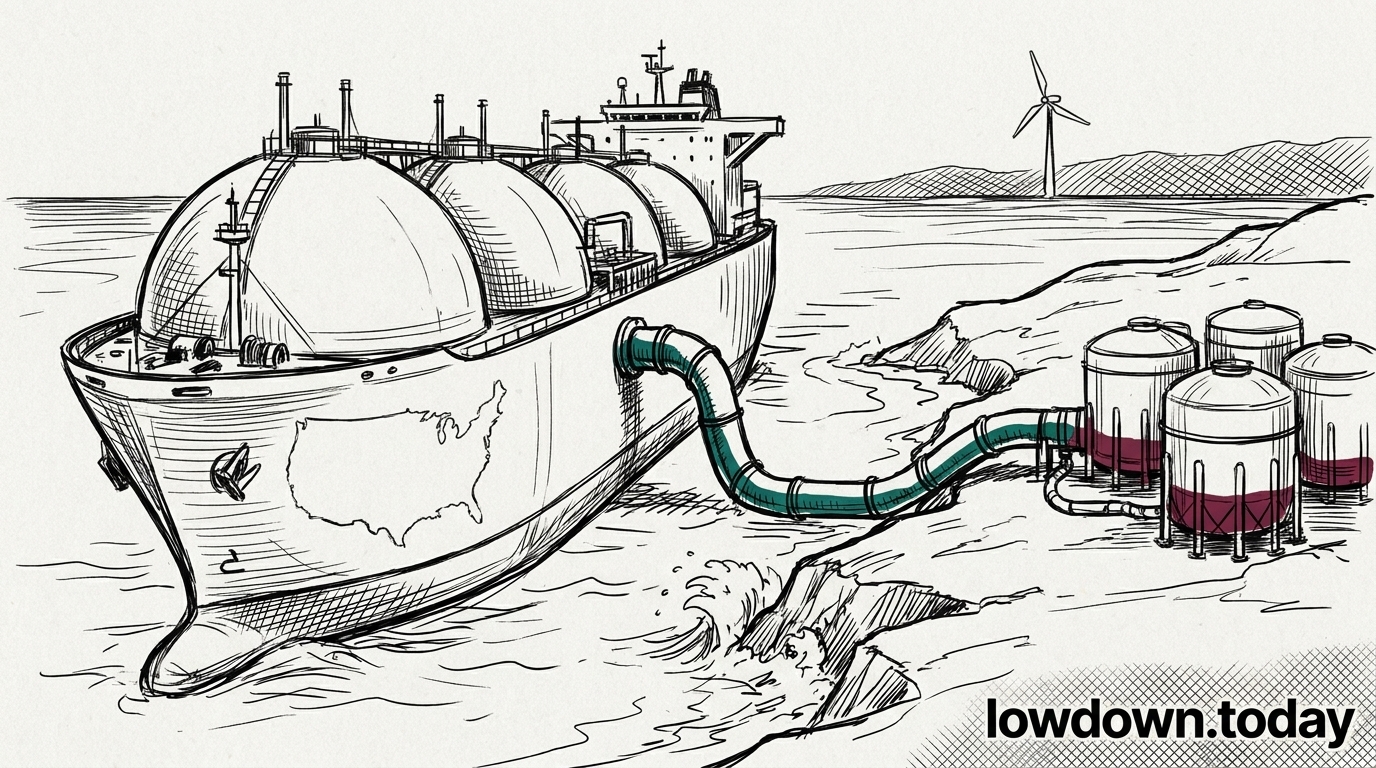
    A confirmed September 2026 auction date signals to Atlantic LNG project developers (Sabine Pass Train 7, Corpus Christi Stage III) that Germany intends long-term gas demand through at least 2040, strengthening the offtake case for new US LNG capacity.

  • Risk

    SPD Environment Ministry non-sign-off could delay the auction to 2027, pushing the 2031 commissioning date to 2032-33 and extending Germany's reliance on imported gas for winter backup beyond the IEA's 2028 LNG capacity recovery horizon.

First Reported In

Update #5 · Ban day muted; Germany doubles injection rate

Bloomberg· 26 Apr 2026
Read original
Different Perspectives
US LNG exporter (Sabine Pass / Corpus Christi)
The 58% EU import share confirmed by ACER, heading toward 65% in 2026, represents a structural long-term offtake position that European terminal operators are now willing to underwrite against the German 2031 gas-demand floor. Ribera's warning lands inside a commercial relationship that is expanding, not contracting.
Teresa Ribera, European Commission EVP
Ribera warned Europe should 'avoid replacing one energy dependency with another', framing the ACER 58% US LNG figure as a supply-security risk in the same week TTF broke EUR 50. Her institution has spent EUR 117 billion on US LNG since 2022.
Yara International (ammonia producer)
Front-month TTF at EUR 50+ touches the demand-destruction threshold at which ammonia output curtailments have historically been triggered. Yara faces the same lock-or-ride binary as financial desks, but the downside is production loss rather than mark-to-market exposure.
Katherina Reiche, German Economy Minister
Reiche confirmed the 12 GW hydrogen-ready gas tender is formally agreed with the EU Commission, with first auctions in 2026 and all units operational by 2031. The confirmation closes three years of SPD environment-ministry obstruction and anchors German gas demand through the early 2030s.
European gas trader (Amsterdam desk)
The EUR 50 break is a watershed signal, not a squeeze: the forward curve at EUR 55.21 twelve months out implies the market has repriced structural winter risk, not a positioning overshoot. The lock-or-ride decision on winter hedges closes in June when injection-pace data for May lands.
Hungarian and Slovak gas buyers and regulators
Hungary cleared EUR 123.23/MWh on 12 May, EUR 54 above Spain's same-day clearing and the largest single-market premium of the briefing series, as ACER named it among seven NRAs in TurkStream derogation opinions with the 5 August EC ruling pending. A denial of derogation removes the only available pipeline substitute for Russian LNG banned since 25 April.
