Skip to content
Briefings are running a touch slower this week while we rebuild the foundations.See roadmap
Drones: Industry & Defence
19MAR

One in ten attack drones hits its target

4 min read
08:30UTC

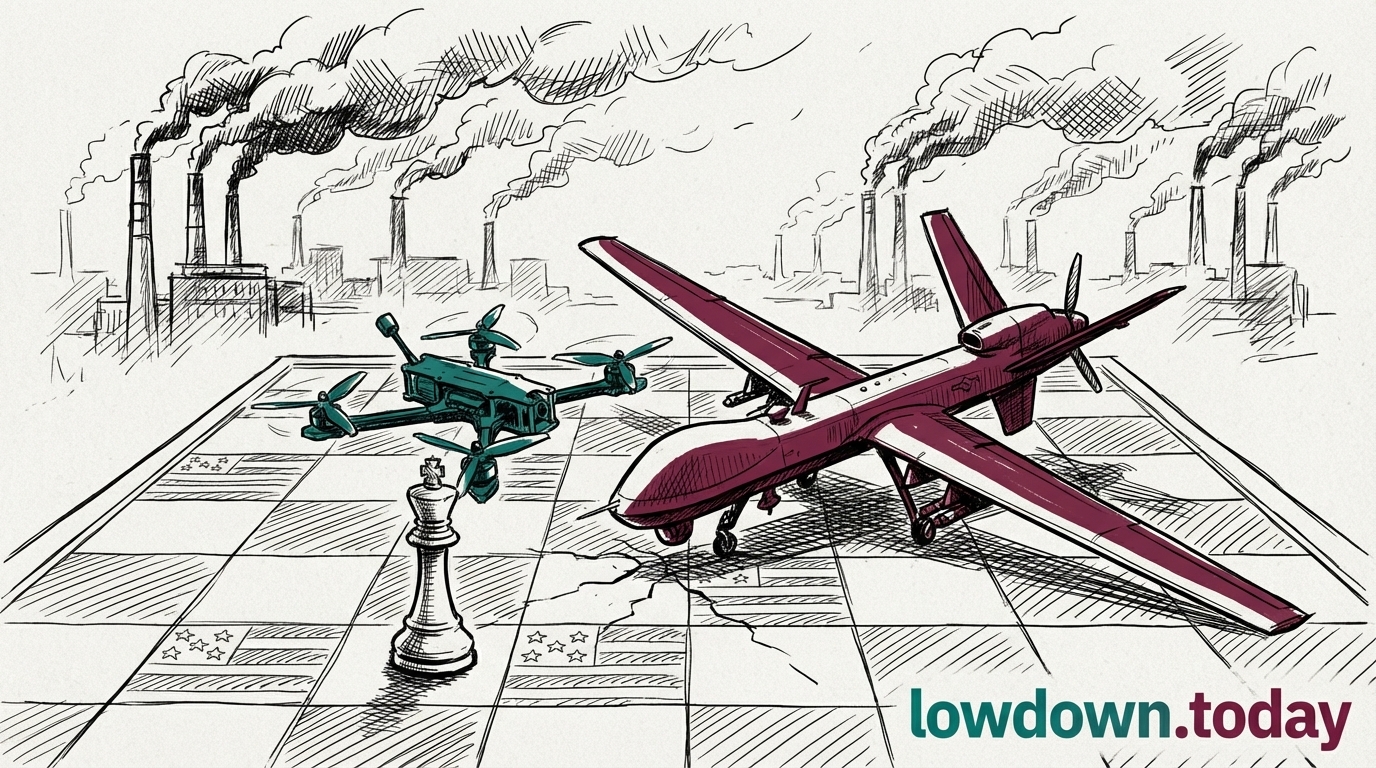
RUSI data shows roughly 90% of drones in massed salvos are intercepted at defended sites — but at current costs, the attacker's economics still work at a 10% success rate.

TechnologyAssessed
Key takeaway

A 10% penetration rate makes massed drone attacks economically rational against high-value infrastructure targets.

Researchers at the Royal United Services Institute found that during massed attacks on well-defended facilities — salvos of 100 to 150 UAVs — approximately 10 drones typically reach the target, a penetration rate of roughly 10% 1. Attack drone costs range from $20,000 to $80,000 per unit 2. At the upper end, a 150-drone salvo costs $12 million to launch; the ten drones that penetrate defences each cost $1.2 million to deliver — less than the replacement value of most military infrastructure.

The defender's cost curve depends entirely on interceptor selection. A Merops unit brings the per-interception cost within an order of magnitude of the attacking drone; a Patriot PAC-3 round at $13.5 million does not. Intercepting a full 150-drone salvo with Merops costs roughly $2 million; the same task with Patriot would exceed $2 billion. The deployment described at follows directly from this maths — volume of cheap interceptors is the only economically sustainable counter to volume of cheap attackers.

Separately, the International Institute for Strategic Studies characterised drone warfare innovation in Ukraine as "constrained" — iterative adaptation within existing military frameworks rather than a transformation of them 3. The IISS assessment pushes back against the narrative that drones have rewritten the rules of conflict. What Ukraine has demonstrated is rapid improvement within established drone categories — FPV attack, ISR, electronic warfare — not the emergence of new operational concepts. The distinction matters commercially: the investment returns are in production scale and incremental cost reduction, not in speculative next-generation platforms.

Taken together, the RUSI penetration data and the IISS framing point toward the same conclusion for the industry. A stable 10% penetration rate means both sides can plan around known parameters. For attackers, the rational response is more drones at lower unit cost — the logic behind the Pentagon's target pricing under Drone Dominance. For defenders, the answer is cheap interceptors manufactured at scale. The competitive advantage accrues to whoever produces faster and cheaper, which makes factory capacity, supply chain control, and unit economics the determining variables — not patent portfolios or platform sophistication.

Deep Analysis

In plain English

Researchers studied real drone attacks and found that when 100–150 drones are launched at a well-defended facility, roughly 10 get through. That sounds like a failure — 90% are stopped. But for the attacker, the maths can still work: if those 10 drones cause millions of dollars of damage to a power station or oil facility, and the entire salvo cost only $2–8 million, the attack is economically rational. The defender, meanwhile, must successfully stop every single incoming drone, every single time, which is enormously expensive to sustain. This cost asymmetry is why cheap, mass-produced drones are reshaping both military planning and commercial insurance calculations for critical infrastructure worldwide.

Deep Analysis
Synthesis

RUSI's 10% penetration figure and IISS's constrained innovation characterisation appear to point in opposite directions but are complementary. RUSI validates massed drone attacks as economically rational at scale — quantity is the effective doctrine. IISS notes this is precision artillery at industrial scale, not a paradigm transformation. Together they imply that the correct strategic response is industrial-scale procurement of cheap interceptors — not investment in more sophisticated individual platforms. The most important variable in the next procurement cycle is not drone capability but interceptor unit cost.

Root Causes

The 10% penetration rate is a product of saturation mathematics rather than drone sophistication — this is the IISS constrained innovation thesis made concrete. Defenders must intercept every drone that breaches the outer perimeter; attackers need only penetrate the final layer once per high-value target. This structural disadvantage of layered defence against swarms is a geometry and economics problem, not a technology problem. No incremental improvement in individual interceptor performance resolves it — only interceptor cost reduction and volume scaling changes the fundamental calculus.

Escalation

The cost-exchange ratio is approaching a critical inflection point. At $14,000–$15,000 per Merops interceptor versus $20,000–$50,000 per Shahed-type attack drone, the exchange ratio is approximately 3:1 in the attacker's favour — historically viable for sustained campaigns. If Merops scales to $3,000–$5,000 as projected, the ratio inverts to roughly 1:5 in the defender's favour for the first time since low-cost drone proliferation began. That inflection — not the current 10% penetration figure — is the variable that will determine whether massed drone attacks remain economically rational for state and non-state actors through the decade.

What could happen next?
  • Consequence

    Defence procurement will shift structurally toward layered, high-volume interceptor stockpiles over single high-cost systems — validating the Merops model over Patriot PAC-3 for saturation-threat environments.

    Short term · Assessed
  • Risk

    A 10% penetration rate against critical infrastructure creates insurable loss scenarios not yet fully priced into Gulf-region commercial coverage — infrastructure operators face potential coverage gaps.

    Medium term · Suggested
  • Opportunity

    Saturation attack economics create sustained, volume-driven demand for low-cost interceptors regardless of conflict tempo — structurally durable demand for Merops-type programmes.

    Short term · Assessed
  • Meaning

    The constrained innovation thesis means existing military logistics, training, and doctrine frameworks remain applicable — industrial scaling, not doctrinal transformation, is the required response.

    Medium term · Assessed
First Reported In

Update #2 · UK startup tops Pentagon's drone gauntlet

The RUSI Journal· 19 Mar 2026
Read original
Different Perspectives
Denmark (host nation)
Denmark accepted Fire Point's Skrydstrup plant after committing to bilateral defence co-production at the B9 Nordic summit in May; the facility sits beside a Danish F-35 base, sharing security perimeters. NATO has published no legal guidance on whether hosting Ukrainian weapons production converts Denmark into a co-belligerent, leaving the host-state obligation unresolved.
Russian Ministry of Defence
Russia's 117% YoY drone-output rise in April, accelerating from a 68% full-year 2025 baseline, validates the FPV mass-production doctrine and hands Moscow a cleaner targeting argument for the Skrydstrup plant than any hidden production line offered; a Ukrainian weapons facility on NATO sovereign territory is a legitimate military target under the laws of armed conflict.
Baltic NATO states (Latvia, Estonia, Lithuania)
Latvia deployed mobile drone-intercept teams on 29 May using domestic Origin Robotics and Eraser interceptors, the first kinetic Baltic border response to Russia's 117% output surge. The Baltic states are the primary target market for Ukraine's ten EU export offices, giving them direct commercial access to combat-tested interceptors their own manufacturers have not yet matched.
Pentagon / Joint Interagency Task Force 401
Two Ukrainian entrants in Drone Dominance Phase 2 and Red Cat's SEC-filed STE partnership bring combat-iterated Ukrainian designs into US procurement without triggering Foreign Military Sale approvals; the programme's performance-scoring methodology does not require US-origin hardware. Northrop holding the Common UAS Payload standard means a heritage prime captures interface revenue regardless of which startup airframe wins.
Ukrainian defence industry (Fire Point / Spetstechnoexport)
Fire Point's Skrydstrup construction start and Spetstechnoexport's Red Cat partnership execute Zelensky's 13 May Bucharest proposal: converting wartime production surplus into a state export apparatus, independent of US approval chains. For Ukraine, embedded manufacturing on NATO soil protects propellant supply from Russian strikes while generating hard currency the war effort needs.
Chinese drone manufacturers (DJI, Autel)
Autel's Ralls Corp Fifth Amendment filing and DJI's Ninth Circuit quantification of USD 1.56 billion in 2026 losses are parallel constitutional attacks on a classified-evidence exclusion mechanism; neither company can contest the intelligence allegations directly, so both are betting on due-process doctrine to reopen the FCC authorisation route.
