Skip to content
You can now search across every topic, entity and event.What's new
Drones: Industry & Defence
20AUG

US drone rules frozen at both ends

2 min read
16:38UTC

The FAA blew past its spring 2026 deadline for the Part 108 BVLOS rule with no new date set, while the Section 232 tariff investigation ran roughly 90 days overdue, leaving US operators unable to plan or price.

TechnologyDeveloping
Key takeaway

A single right-of-way clause is freezing the rule that would unlock routine commercial BVLOS flight.

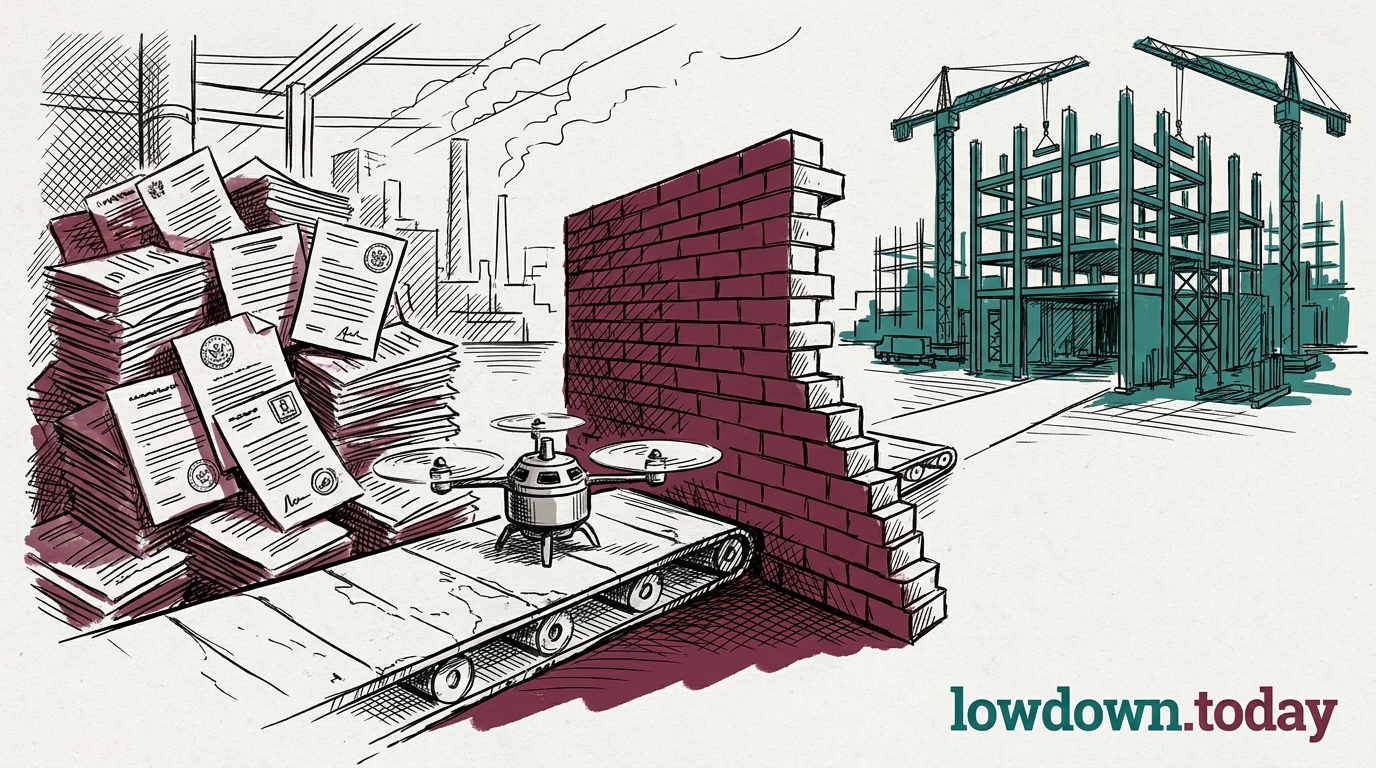
The FAA, the US Federal Aviation Administration, missed its spring 2026 deadline for the Part 108 final rule, confirmed unmet as of 18 June 2026 with no new date set 1. Part 108 would authorise routine beyond-visual-line-of-sight, or BVLOS, flight: drones operating out of the pilot's direct sight, the regime that delivery, inspection and emergency-response operators need to scale. The specific blocker is a contested right-of-way provision under which a crewed aircraft that does not broadcast its electronic position must yield to a BVLOS drone. More than 50% of the 3,100-plus public comments fought over that single point.

Pilots' organisations resist ceding presumptive priority to an unmanned system, so a procedural rule has stalled on one clause about who has precedence in shared airspace. The dispute turns on doctrine, not on any technical safety case. The rule is held up by precedence, not by any safety case against the drones themselves.

The supply side is suspended in parallel. The Section 232 UAS Investigation, the US Commerce Department inquiry into drone imports as a national-security threat, is roughly 90 days past its statutory deadline with no report 2. Importers cannot price the Chinese-drone tariff they have been bracing for, the same unresolved Chinese-import question that has driven Autel's Covered List challenge . A commercial operator cannot plan a BVLOS fleet and an importer cannot price a tariff, both at once, during the period of highest global demand the sector has seen.

Deep Analysis

In plain English

The FAA (Federal Aviation Administration) missed its spring 2026 deadline for rules that would let commercial drones fly beyond the pilot's line of sight. The sticking point is a rule about which aircraft has to yield when a drone and a small aircraft are in the same airspace; general aviation pilots strongly objected to being made to give way to a drone they cannot see. Separately, the US government is investigating whether to add tariffs to imported drones for national security reasons. That investigation is about three months past its legal deadline with no decision published. Both regulatory freezes together leave the US drone industry without certainty on either civilian flight rules or component import costs.

Deep Analysis
Root Causes

The right-of-way provision blocking Part 108 exposes a structural incompatibility between the drone industry's assumption and existing aviation law.

US Federal Aviation Regulations Part 91.113 establishes right-of-way based on aircraft category. Powered aircraft give way to unpowered; less manoeuvrable gives way to more manoeuvrable. BVLOS drones that fly without an on-board pilot have no mechanism to yield to crewed aircraft they cannot see, since the remote pilot is not watching the sky around the drone continuously.

The proposed Part 108 provision reversed this by making unequipped crewed aircraft yield to BVLOS drones, a reversal that general aviation operators , who fly older aircraft without ADS-B transponders , correctly identified as a threat to their right-of-way protections.

The Section 232 overdue status reflects a different structural problem: the statutory 270-day Commerce Department investigation deadline was set in 1962 when investigations concerned steel and aluminium industries with established domestic production alternatives.

A UAS tariff decision requires the Commerce Department to assess supply chains that span 47 component categories across six countries, for which no prior methodology exists. The agency is applying a 1962 procedural framework to a 2026 supply chain problem.

What could happen next?
  • Consequence

    Drone delivery operators including Wing, Amazon Prime Air and Zipline remain on waiver-by-waiver operating authority rather than a standardised certification path, capping their scaling rate in the US market.

  • Risk

    The Section 232 delay beyond 90 days without a statutory extension triggers presidential authority to act unilaterally; a sudden tariff announcement without a transition period would force contract renegotiations across every Pentagon drone procurement programme in progress.

First Reported In

Update #13 · Air Force shuts primes out of drone wingman

The Next Web· 25 Jun 2026
Read original
Causes and effects
This Event
US drone rules frozen at both ends
Suspending both the demand-side flight rule and the supply-side tariff decision at once strands the US commercial sector without a federal framework during its highest-demand period.
Different Perspectives
South Korea's Defense Acquisition Program Administration
DAPA folded drone and roadside-bomb jammers into an 18-year, KRW 3.448 trillion K2 tank upgrade approved 11 August, rather than fund counter-drone kit as its own programme. Seoul is treating the threat as permanent enough to write into a platform's lifecycle, not urgent enough to buy ahead of it.
NATO Support and Procurement Agency
NSPA named five pre-qualified counter-drone suppliers under new framework contracts on 27 July, giving allies a purchasing route with no published budget attached. A framework without committed money is an instrument waiting for a spending decision, not a guarantee one is coming.
Ukraine's Ministry of Defence
Ukraine's forces strike with more than 70 AI and computer-vision systems drawn from over 200 domestic producers, the ministry said on 18 August, a supplier base neither Washington's tariff fight nor Beijing's export licence touches. Kyiv is scaling capability faster than either government is writing rules for it.
A European drone-component manufacturer
A European manufacturer selling components into the United States faces the same 100 per cent tariff and 3 September deadline as any other foreign supplier, with the duty-free onshoring carve-out available only to firms building on American soil. That leaves it to absorb the cost, relocate assembly, or cede the US market rather than shop around a rival supply chain.
Chinese drone component exporters
Exporters now need a case-by-case licence for each US-bound dual-use shipment after MOFCOM's 5 August order, with no published review clock. The same week Shenzhen logged nearly 200,000 domestic logistics-drone sorties and Hunan reported record spraying coverage, a home market large enough to absorb what the licence regime slows from leaving the country.
US drone manufacturers
The onshoring carve-out protects Performance Drone Works' $820 million War Department loan, but the same 3 September deadline hits Red Cat Holdings and Unusual Machines, both filing over 500 per cent revenue growth on 6 August, on Chinese-sourced components with no qualified domestic substitute yet.
