Skip to content
You can now search across every topic, entity and event.What's new
Data Centres: Boom and Backlash
26MAY

Maine passes first US statewide DC freeze

4 min read
11:34UTC

Maine's legislature passed the first US statewide moratorium on large data centre development on 22 April 2026, with twelve further states carrying active bills and a Sanders/AOC federal proposal now in play.

IndustryDeveloping
Key takeaway

Maine is the first US state legislature to pass a data centre moratorium; twelve more are drafting variants.

Maine's legislature passed the first US statewide moratorium on large data centre development on 22 April 2026, with the bill awaiting the signature of Governor Janet Mills. 1 2 Good Jobs First, a Washington-based subsidy-tracking research organisation, counts 12 in-session states with active moratorium bills in the 2026 legislative cycle, including Oklahoma SB 1488 running to November 2029 and Vermont S.205 to July 2030. 3 Senator Bernie Sanders and Representative Alexandria Ocasio-Cortez have introduced a federal proposal covering environmental, energy, labour, and civil-liberties conditions.

Maine's bill is the first state-level data centre moratorium to clear a legislature anywhere in the United States. Prior moratoria have been county-level or executive in nature. Twelve states with active bills in a single session is qualitatively different from the periodic local opposition that has dogged hyperscaler siting since the early 2010s. The pattern points at three converging pressures: residential electricity rates rising faster than wholesale prices, water-stress disclosure under state freedom-of-information frameworks, and zoning friction at the planning-commission level.

Governor Mills now holds a roughly two-week decision window. A signature enacts a freeze on new approvals while the state revisits its grid, water and tax-incentive framework. A veto sends the bill back for an override vote that Maine's split legislature is unlikely to muster. Letting the bill lapse without signature is the third path and historically the governor's preferred tactic when the politics cut both ways. The Sanders-Ocasio-Cortez federal proposal will not pass the current US Congress, but it does establish the template that future legislation can be drafted from when the political climate shifts.

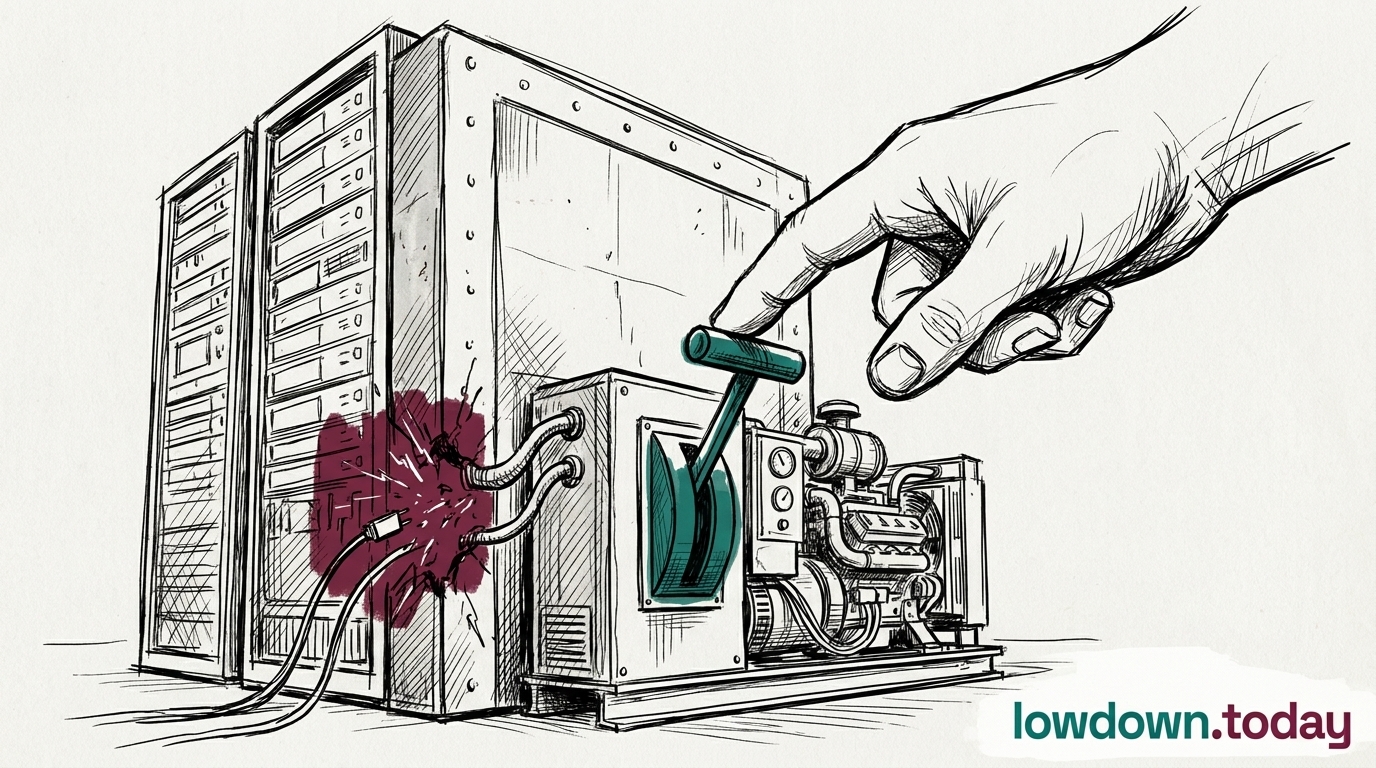
Twelve simultaneous state-level bills make the consent constraint legislatively visible for the first time. The next test is whether Oklahoma SB 1488 or Vermont S.205 clears its respective chamber before the summer recess. The breaks are no longer being applied at zoning hearings alone; they are being drafted as primary legislation in twelve state capitols simultaneously.

Deep Analysis

In plain English

Maine's legislature voted on 22 April 2026 to stop approving new large data centres in the state while a fuller review takes place, the first statewide vote of its kind in the US. The Governor's signature is still needed to make it law. Maine is the first US state to pass a statewide version, but 11 other states have similar proposals moving through their legislatures this year. The pattern suggests coordinated advocacy: many bills share similar language about energy use, water, and jobs. At the federal level, Senators Bernie Sanders and Representative Alexandria Ocasio-Cortez have introduced a bill that would set national conditions for data centre approvals, covering environmental impact, energy sourcing, labour standards, and civil liberties. A federal law would apply everywhere in the US, rather than only in individual states.

Deep Analysis
Root Causes

Three structural conditions explain why 12 state moratorium bills appeared in a single 2026 session. First, data centre tax abatements have grown large enough to feature in state budget debates: Good Jobs First data shows Georgia, Virginia, and Texas each foregoing over $1 billion annually. This scale makes abatements a budget-politics issue, rather than only an economic-development one.

Second, the energy and water costs of large AI-focused data centres are concentrated in the grid districts and watersheds where facilities locate, while the economic benefits (jobs, taxes) accrue largely at state and county level. The mismatch between who bears the cost and who receives the benefit drives local opposition that state legislators respond to.

Third, the Sanders-AOC federal bill provides a political signal that moratorium advocacy is nationally legitimate, reducing the political risk for individual state legislators in states that would not otherwise lead.

What could happen next?
  • Precedent

    Maine's passage establishes a workable legislative template for statewide data centre moratoria, reducing the drafting and lobbying cost for the remaining 11 states in the 2026 cycle.

    Immediate · High
  • Risk

    A federal framework along the lines of the Sanders-AOC bill, if passed, would impose uniform disclosure and compliance costs on operators currently benefiting from state-level tax abatements negotiated without public scrutiny.

    Medium term · Low
  • Meaning

    Twelve concurrent state moratorium bills in a single session marks a phase change in data centre politics: from isolated local opposition to a nationally coordinated posture that operators and investors must now factor into site-selection models.

    Short term · High
First Reported In

Update #1 · Boom hits wall: grid says no, states freeze

Democracy Now· 26 Apr 2026
Read original
Different Perspectives
Global hyperscale operators
Operators are still filing gigawatt-scale campuses and Meta is proceeding with its $10bn Lebanon, Indiana site despite the county-level bans nearby, betting Q2 capex outruns the patchwork of restrictions. Industry framing casts New York's freeze, Oregon's surcharge and Indiana's bans as taxes and levies that push build-out toward faster-permitting jurisdictions such as India and the Gulf.
EirGrid
EirGrid
EirGrid set a 900 MW instantaneous demand-loss ceiling because a single voltage dip can trip many data centres onto backup power at once, risking imbalance above 1,150 MW. It wrote the limit into a standing procedure rather than waiting for an emergency to force one.
US host communities and ratepayers
Prince William residents backed the 8-0 denial of Dulles South over the Occoquan watershed, drinking water for eight million people, while Oregon's approved tariff cuts residential bills 1.3% by charging large loads 29% more. Their position: consent and cost-attribution belong in law, not left to a developer's or a utility's discretion.
Hassan Allam Digital Infrastructure
Hassan Allam Digital Infrastructure, an Egyptian conglomerate rather than a foreign hyperscaler, reportedly secured a domestic hyperscale licence with a $400m first phase, per single-source reporting still to be verified. It reads as home-grown sovereign compute ambition, building national capacity rather than importing a US or Gulf operator's campus.
Damac Digital
Damac Digital
Damac Digital keeps building toward roughly 6,000 megawatts of hyperscale capacity across 13 countries while Virginia taxes power and New York weighs a freeze. Every dollar or month of delay a US state adds is capacity a Gulf developer can site somewhere with faster permitting and no equivalent levy.
Acequia communities, Santa Fe County
Santa Fe County commissioners voted unanimously on 2 July to freeze any data centre over one megawatt, citing the acequia irrigation commons that has shared scarce water since Spanish colonial rule. They expect the low threshold to draw the same Fifth Amendment challenge RCM Hill brought against Hill County, Texas.

