Skip to content
You can now search across every topic, entity and event.What's new
Autonomous Systems: Land & Sea
12AUG

Skycutter scores 99.3/100 at Fort Moore

3 min read
14:17UTC

A British startup fielding Ukrainian combat-tested hardware scored 99.3 out of 100 at Fort Moore, finishing 11.8 points ahead of every US defence contractor in the field.

TechnologyDeveloping
Key takeaway

A UK-Ukrainian partnership outscoring US primes exposes a structural gap between compliance-built and combat-built drones.

Skycutter, a London-based drone company working with Ukrainian firm SkyFall, scored 99.3 out of 100 in the Pentagon's first Drone Dominance Gauntlet at Fort Moore, Georgia — 11.8 points clear of runner-up Neros 1. The winning platform was a modified Shrike 10 Fiber FPV drone, from the same family of systems deployed on the Ukrainian front line. The remaining nine winners were separated by fewer than three points. Ukrainian Defense Drones placed sixth with 72.9 2.

The result inverts the usual direction of defence technology transfer. The Pentagon's own evaluation — designed to identify the best expendable attack drone for American forces — was won by a foreign startup fielding hardware refined through three years of high-intensity combat against Russian electronic warfare and air defences. That operational environment produces something no US test range replicates: thousands of real engagements against a peer adversary adapting countermeasures in real time. Design iterations that take months in a laboratory happen in days when attrition data flows directly to the production line.

Pentagon officials cautioned that "the Gauntlet I leaderboard is not a statement about the best drones in the industry" but reflects mission-specific performance criteria 3. The distinction is accurate — and largely beside the point. Established US contractors with decades of Pentagon relationships and mature production infrastructure finished behind a company whose primary R&D environment is an active war zone. Three further Gauntlet competitions run through 2027, each with larger contract values, and domestic manufacturers now face a clear benchmark: 99.3 is the score to beat.

Deep Analysis

In plain English

The Pentagon ran a competitive test to find the best small attack drone — think of it as a bake-off, but for weapons. A small British startup, working with a Ukrainian company that has been refining its drones in actual warfare, came first by a wide margin, beating large American defence firms. The reason matters: Ukrainian drone designers have had to learn under fire, iterating rapidly because lives depend on getting it right. Traditional US defence contractors design to procurement specifications under controlled conditions. The Gauntlet result suggests the gap between those two approaches is now measurable and decisive.

Deep Analysis
Synthesis

Skycutter's win creates a classification problem for US acquisition policy that the programme's mission-specific caveat does not resolve. As a UK firm using Ukrainian hardware, it clears allied-sourcing thresholds but directly challenges domestic industry protections. The Pentagon must now decide whether Drone Dominance means best-performing drone or best-performing American drone — a distinction with multi-billion-dollar implications across the programme's 2027 horizon.

Root Causes

Two structural factors explain the performance gap. Pentagon procurement rewards compliance, documentation, and programme management — not lethality per dollar — selecting for firms optimised to the acquisition process rather than the battlefield. Ukrainian FPV development has simultaneously been compressed by survival pressure into a continuous rapid-iteration cycle that peacetime R&D budgets and procurement timelines structurally cannot match.

Escalation

Competitive pressure on US primes is intensifying. The 11.8-point gap is not marginal — it signals a structural disadvantage that incremental design improvement alone cannot close. Lobbying for domestic-content requirements in Gauntlet II–IV is the predictable institutional response, which would reshape the competitive field before performance gaps widen further.

What could happen next?
  • Precedent

    Allied non-US firms can now compete as prime contractors — not subcontractors — in Pentagon attack drone programmes, structurally altering the established defence industrial base.

    Immediate · Reported
  • Risk

    Congressional Buy American pressure in subsequent Gauntlet phases may introduce domestic-content requirements that override performance-based competition, degrading programme quality.

    Short term · Assessed
  • Opportunity

    Ukrainian-partnered firms have a replicable formula for allied defence procurement across NATO markets, where combat-proven performance is increasingly the decisive procurement criterion.

    Medium term · Assessed
First Reported In

Update #2 · UK startup tops Pentagon's drone gauntlet

Defense One· 19 Mar 2026
Read original
Causes and effects
This Event
Skycutter scores 99.3/100 at Fort Moore
A UK firm partnered with a Ukrainian drone company outscored established US defence contractors on the Pentagon's own evaluation range, demonstrating that three years of frontline combat experience have produced measurable performance advantages over laboratory-developed systems.
Different Perspectives
Conservative opposition
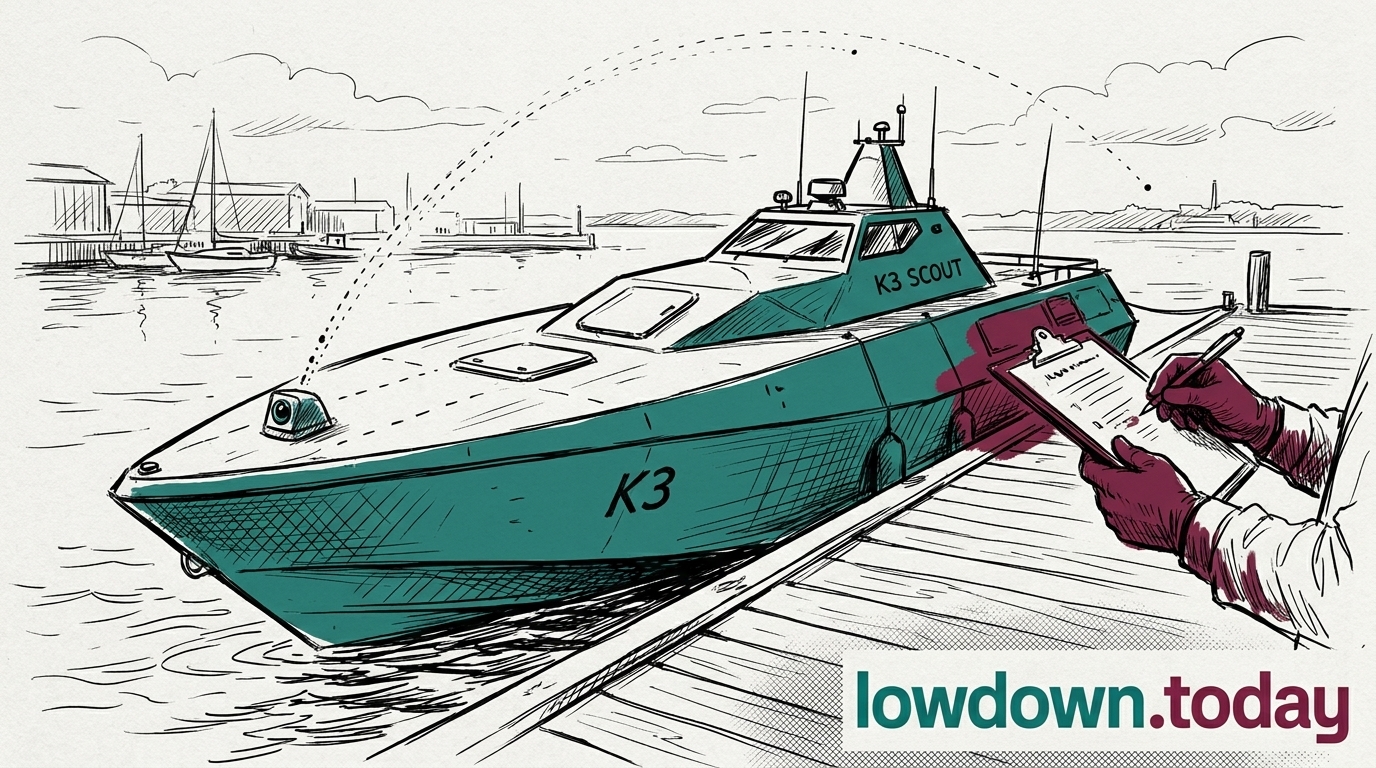
The Conservative opposition called on the Government on 9 August to 'urgently audit' equipment for hidden Chinese components, after the Telegraph's K3 SCOUT report. No named MP has been quoted on the record; the call came at party level, alongside the Ministry of Defence's own 10 August statement that no data had been compromised.
Netherlands Ministry of Defence
The Netherlands Ministry of Defence authorised Dutch Naval Design on 4 August to design 12-metre anti-submarine warfare uncrewed vessels for the Dutch-Belgian frigate programme, and to buy an adapted Compact FLASH dipping sonar from Thales Underwater Systems France. The order commits money and a named supplier while Britain's own certification body remains at the market-engagement stage.
Kraken Technology Group
Kraken Technology Group is a UK maritime-defence company based in Portsmouth that builds the K3 SCOUT, and crossed a $1bn valuation in July on a single-sourced $175m raise. The camera components reached the fleet under a third party's written security assurance, which the Platform Authority, which does not yet exist, was never positioned to check.
Navy Commercial
Navy Commercial
Navy Commercial at Whale Island published two notices on 5 August: 074032-2026, asking industry how to build a Platform Authority to certify uncrewed vessels, and 074351-2026, a GBP10m multi-role USV testbed for the Defence Chief Technology Officer. Responses on the Platform Authority close 19 August, ten days after the cameras were found transmitting to China.
Ministry of Defence
Ministry of Defence
The Ministry of Defence said on 10 August that a routine cyber vulnerability assessment found the camera fault, and a thorough investigation found no evidence that MoD data or systems had been accessed, compromised or transmitted externally. It stripped the cameras of internet connectivity but did not say whether it acted against the supplier.
Thales
Thales
Thales converted its 6 July engaging accord with Exail into a definitive combination agreement on 30-31 July, but the tender offer for Exail's remaining shares now closes by early 2028, later than July's timetable implied. Thales integrates its new undersea prime while still bidding against Kongsberg and DRASS's 2027 target for the AUKUS Pillar II contest.
