Skip to content
Briefings are running a touch slower this week while we rebuild the foundations.See roadmap
AI: Jobs, Power & Money
23APR

Oracle cuts 30,000 to fund AI

3 min read
14:51UTC

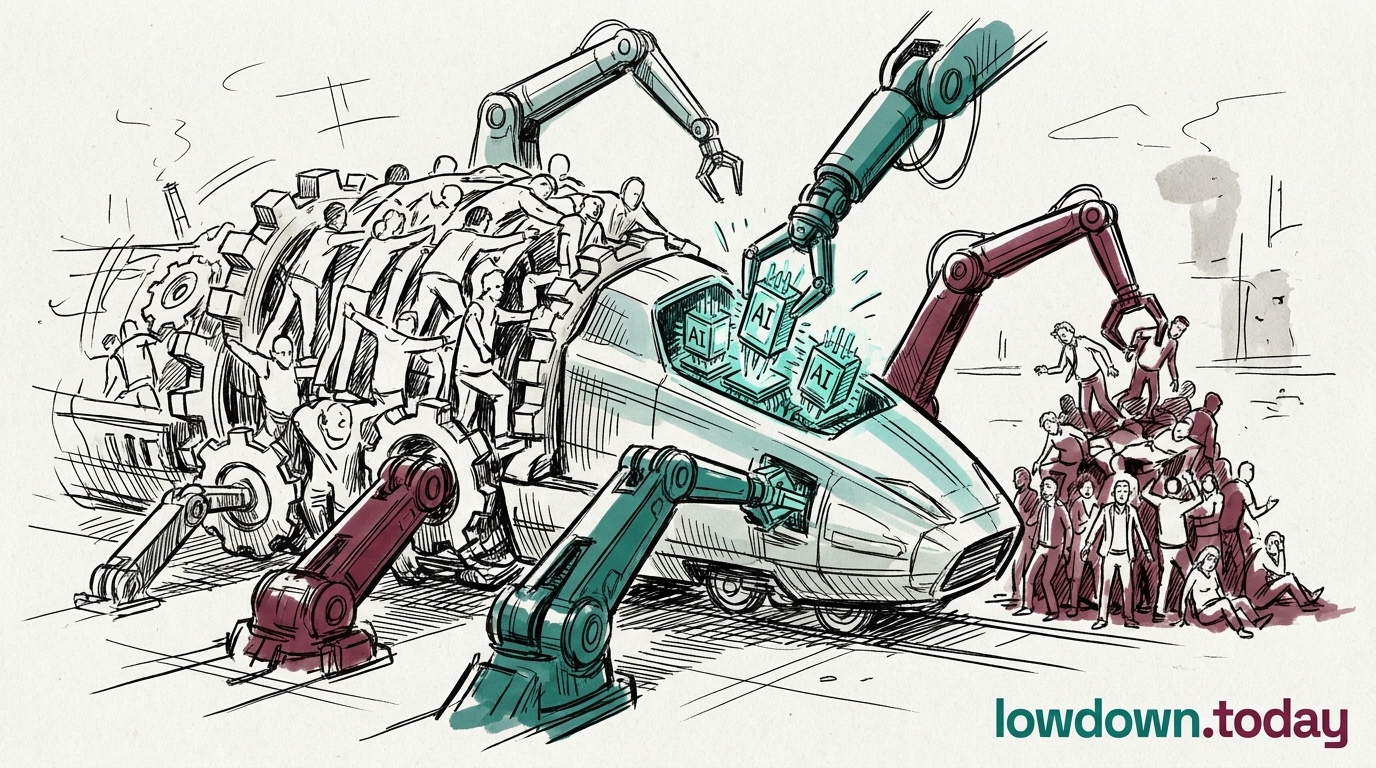
The largest single AI-attributed corporate reduction on record turned a workforce into a line item that funds data centres.

EconomicAssessed
Key takeaway

Oracle cut up to 30,000 jobs to free $8-10 billion annually for AI data centres.

Oracle began cutting 20,000 to 30,000 jobs on 31 March, roughly 18% of its 162,000 global workforce 1. The move freed $8 to $10 billion annually in salary costs. TD Cowen estimates the company has committed $156 billion to AI data centre infrastructure, adding to the $650-690 billion capital expenditure commitment from the five largest US tech companies .

Worker Adjustment and Retraining Notification (WARN) Act filings surfaced in Washington state (491 positions) and Missouri (539), but no Massachusetts filing has appeared despite Oracle's Burlington offices. Oracle has joined the pattern the 55% regret rate documented earlier this quarter : cutting on projected capability, not demonstrated return.

At 30,000 positions, Oracle's action is the largest single AI-attributed corporate reduction on record. Its workforce is now a funding mechanism.

Deep Analysis

In plain English

Oracle is a large American technology company. On 31 March it announced it was cutting between 20,000 and 30,000 jobs, roughly 18% of its total workforce worldwide. That is one of the biggest single job cuts any company has ever announced. The reason given was to free up money for building AI data centres. The jobs cost Oracle around $8-10 billion per year in salaries. That money will now go towards buying and building computer infrastructure instead. Most of the affected workers were in India, where about 12,000 people found out by email at 6am with no prior warning from their manager. Those workers will not appear in any American statistics.

Deep Analysis
Root Causes

Oracle's $156 billion AI data centre commitment, estimated by TD Cowen, requires capital that its current margins cannot generate organically. Workforce reduction is the fastest available mechanism to free $8-10 billion annually without new debt issuance or equity dilution. The displacement is therefore a financing instrument as much as an operational one.

The competitive pressure from hyperscale cloud providers (AWS, Azure, Google Cloud) has eroded Oracle's traditional enterprise software margins. AI data centre infrastructure represents Oracle's most credible route to market relevance in the next technology cycle. The workforce cost of that bet is being paid by the existing employee base.

India's regulatory environment offers a third factor. Indian labour law provides fewer formal protections and lower severance obligations than US or EU equivalents, making large-scale rapid reductions structurally easier to execute there. The 40% contraction of Oracle India in a single action reflects both concentration of operational roles and the lower disclosure cost of cuts outside US jurisdiction.

What could happen next?
  • Oracle's template of mass workforce reduction to fund AI capex will be replicated by other legacy enterprise technology firms (SAP, IBM, Dell, Hewlett Packard Enterprise) facing similar margin pressure and AI infrastructure competition.

  • The gap between WARN Act filings (below 1,100) and stated total cuts (20,000-30,000) will drive legislative pressure to extend WARN Act coverage to non-US jurisdictions or require disclosure of global headcount reductions in US SEC filings.

First Reported In

Update #4 · AI leads US layoffs as cuts go uncounted

CNBC· 4 Apr 2026
Read original
Different Perspectives
UK financial regulators (BoE FPC / FCA)
The Bank of England's April FPC directive on agentic AI in payments was scoped around one frontier model; AISI confirmed a second model cleared the same 32-step threshold on 1 May. The supervisory architecture is one model behind the capability it was built to contain.
Indian IT sector workers (TCS, Infosys, Wipro)
TCS posted its first annual revenue decline in the modern era, Infosys shed 8,400 workers in a quarter, and Wipro hit its zero-fresher target. Western Big Tech's AI automation is cannibalising the offshored-services model that employs roughly five million Indian IT workers.
Chinese workers (Hangzhou and Beijing plaintiffs)
Workers Zhou and Liu won cases that established a two-court doctrinal chain: AI adoption is the employer's deliberate strategy, placing the cost of displacement on the employer rather than the worker. Any Chinese employee facing AI-driven dismissal now has a citable legal route that American, British, and European counterparts do not.
Chinese government, courts, and domestic employers
The Hangzhou rulings were released on Workers' Day eve alongside the Ministry of Human Resources' recognition of 42 new AI occupations. Domestic firms now face mandatory retraining obligations; the Orgvue estimate of 8-14 months added to displacement timelines will feature in employer compliance briefings throughout 2026.
EU regulators and European Parliament
The second Digital Omnibus trilogue collapsed without agreement on 28 April; the third is scheduled for 13 May with the binding employer AI-literacy obligation still contested. Brussels is arguing over a non-binding encouragement clause while Beijing's courts have already bound employers.
US legislators (Warner, Rounds, Hawley, Sanders)
Warner and Rounds produced the Economy of the Future Commission Act, the most concrete federal vehicle still moving, endorsed by the companies it would notionally regulate. The Sanders-AOC moratorium was killed by Democratic senators; the Hawley-Warner disclosure bill remains in committee with no floor date.
