Skip to content
Welcome, thoughtbot's Giant Robots listeners!Start here
AI: Jobs, Power & Money
23APR

GitLab rewrites engineering around AI agents

4 min read
14:51UTC

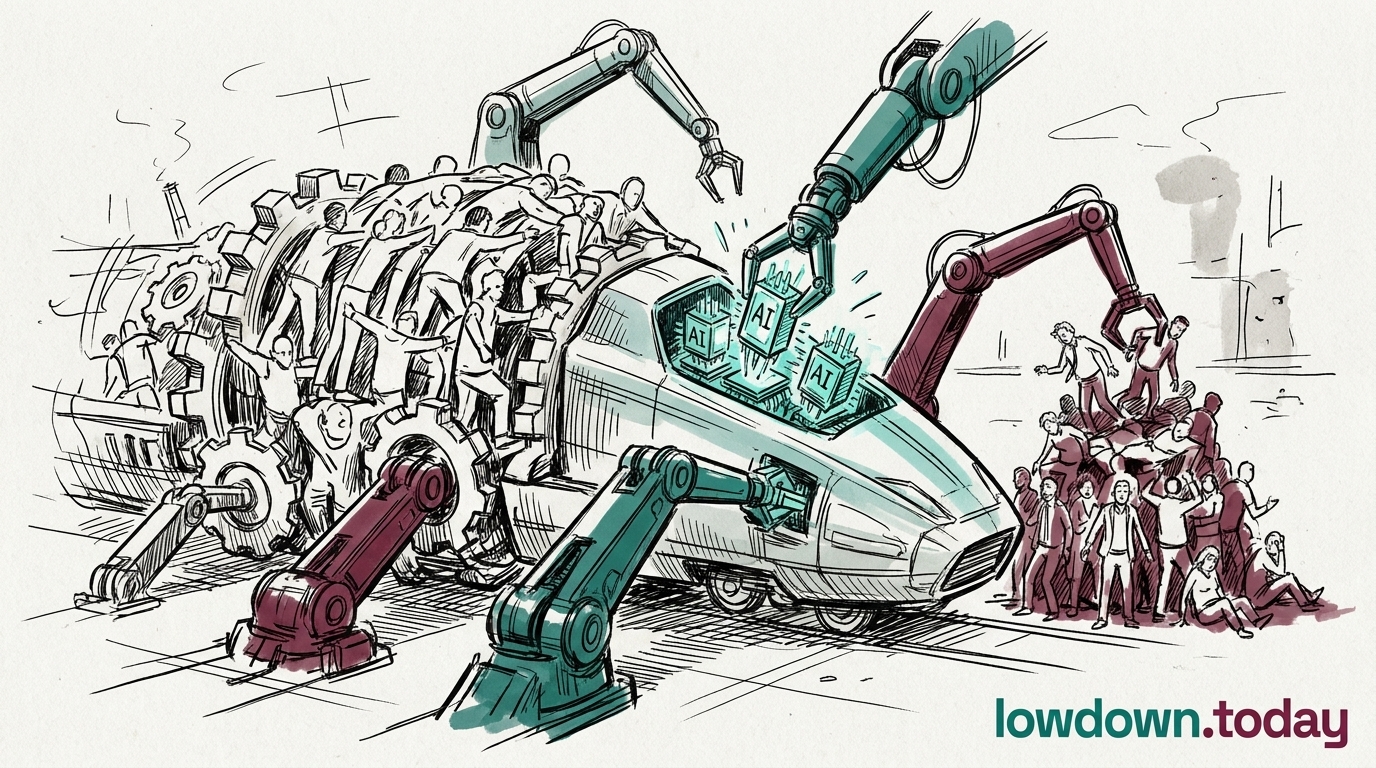
GitLab CEO Bill Staples published 'GitLab Act 2' on 11 May 2026, cutting the company's country footprint by up to 30% and breaking R&D into approximately 60 smaller teams on the explicit premise that AI agents will plan, code, review, deploy, and repair software.

EconomicDeveloping
Key takeaway

GitLab's Act 2 makes the CEO-signed case that AI agents replace engineering co-ordination, dissolving the management layer that connected them.

GitLab CEO Bill Staples published "GitLab Act 2" on Monday 11 May 2026, announcing a restructuring that cuts the company's country footprint by up to 30%, removes up to three management layers from some functions, and breaks R&D into approximately 60 smaller teams, nearly doubling the number of independent teams. The explicit justification in Staples's own words: "Software will be built by machines, directed by people. Agents will plan, code, review, deploy, and repair."

The 60-team structure concentrates individual-contributor output while stripping out the managers who previously co-ordinated across functions. In practice, individual engineers report into smaller pods with no manager between them and the AI tools they use to build product. A voluntary separation window closes 18 May; full restructuring completes by 1 June 2026. Financial impact lands on the 2 June earnings call, making it the first public headcount figure for the new structure.

GitLab did not arrive at this thesis alone. Salesforce CEO Marc Benioff applied the same structural argument to customer support: AI agents replaced roughly half the team, and no new engineers were hired in its fiscal year ending January 2026. Meta applied it to engineering titles in April, replacing conventional engineering roles with AI-native designations. GitLab has now applied the thesis to engineering structure itself: not which roles exist, but how many engineers it takes to ship product. That progression from support functions to engineering titles to engineering organisation is what makes the May cluster a pattern rather than separate decisions by unrelated companies.

The voluntary separation window that closes 18 May avoids the immediate WARN Act filing that a simultaneous termination event would trigger. GitLab operates across dozens of countries with no single US site large enough to meet the WARN threshold in any single jurisdiction. Both structural facts sit alongside the public manifesto, which is arguably the most candid CEO-signed statement on AI displacement to appear from a major DevOps company in 2026.


Deep Analysis

In plain English

GitLab makes software that other software companies use to build their products. Think of it as the tool companies use to organise engineers, review code, and push updates. On 11 May 2026, GitLab's chief executive published a document saying the company itself would restructure around the assumption that AI would do most of the engineering work going forward. His argument: AI agents can now plan what to build, write the code, check it, push it to production, and fix problems. Humans direct the process rather than perform it. So GitLab is cutting the number of countries it employs engineers in, removing manager layers, and splitting its engineering organisation into roughly 60 small, autonomous teams. Why this matters beyond GitLab: GitLab is not a frontier AI lab predicting the future. It is a practical software tools company declaring that the future is already here in its own operations. When the company that makes the tools other engineers use restructures itself around AI-built software, it is saying something about where the whole software industry is heading.

Deep Analysis
Root Causes

GitLab's restructuring has two structural drivers that the fact does not name.

First, the GitLab product roadmap and the GitLab engineering structure have converged onto the same thesis. GitLab sells DevOps tooling including CI/CD pipelines, code review, and deployment orchestration. Its Act 2 document argues that AI agents will perform these functions.

If that thesis is correct for GitLab's customers, it must also be correct for GitLab's own engineering. The restructuring is therefore not a cost response to a revenue miss; it is the company applying its own product roadmap to itself.

Second, capital market pressure from the Harvard Business Review finding that only 2% of organisations announcing AI-related cuts have implemented AI that actually accounts for them creates a verification problem for companies that claim AI productivity gains.

GitLab, as a software tool company, has unusually direct access to internal metrics that can demonstrate AI productivity gains to investors. The 2 June earnings call is the first public test of whether those metrics materialise as disclosed.

What could happen next?
  • Precedent

    GitLab's 60-team R&D structure becomes the reference architecture investors ask other mid-cap DevOps companies to justify not adopting.

    Short term · 0.75
  • Consequence

    The 2 June earnings call is the first public test of whether declared AI productivity gains translate to financial disclosure; a miss would undermine the entire CEO manifesto genre.

    Immediate · 0.8
  • Risk

    Removing co-ordination layers without a proven AI substitute creates integration risk that surfaces only after the voluntary separation window closes 18 May.

    Short term · 0.7
First Reported In

Update #9 · GitLab signs the manifesto, Brussels backs out

GitLab (Bill Staples, CEO)· 15 May 2026
Read original →
Causes and effects
This Event
GitLab rewrites engineering around AI agents
GitLab's restructuring applies the AI-replacement thesis directly to engineering structure, rather than headcount alone, making it the most operationally specific CEO manifesto in the 2026 tech restructuring cycle.
Different Perspectives
Competition and Consumer Commission of Singapore
The regulator found on 27 November that businesses can still choose and switch between cloud providers and AI models. It named dominant firms blocking rival AI agents as a risk, but answered with eight voluntary principles rather than rules.
La Poste
La Poste
France's state-owned postal group signed its first AI accord with four union confederations on 19 November, setting up a joint committee to oversee AI use. The announcement gives the unions a say, but no job security and no training hours for its 227,000 staff.
Nascent Information Technology Employees Senate (NITES)
The IT workers' union asked India's central government on 26 November for a mandatory national policy on AI layoffs, with every automated job cut logged in public. It expects to meet Labour Ministry officials; no government response has been reported.
China State Council
China State Council
Beijing's cabinet told local governments to pace AI in labour-intensive industries and to screen large AI projects for job losses. It keeps backing AI but wants the replacement of workers slowed, and it set no numeric targets.
SAP
SAP
SAP answered Bloomberg's report of at least 10,000 planned job cuts by telling CNBC that nothing is settled. In Germany a cut on that scale goes through works councils, and its 2024 round of about 10,000 ended mostly in voluntary departures.
Nvidia's board of directors
The board reinstated Jensen Huang on 22 November after input from senior levels of the US government, while its committee of independent directors keeps investigating. Its confidence rests, by its own account, on Washington's input, and the company says it will keep cooperating with government inquiries.

Written with AI from Lowdown's published reporting. Not individually reviewed by an editor. Editorial standards.
