Skip to content
Welcome, thoughtbot's Giant Robots listeners!Start here
AI: Jobs, Power & Money
16APR

TCS shed 19,271 while its profit grew

2 min read
13:29UTC

India's largest private employer closed June with 593,798 staff, down 19,271 on the year, and posted net profit up 4.6% on revenue up 13.9%.

EconomicAssessed
Key takeaway

TCS earned 13.9% more revenue from 19,271 fewer people and explained nothing.

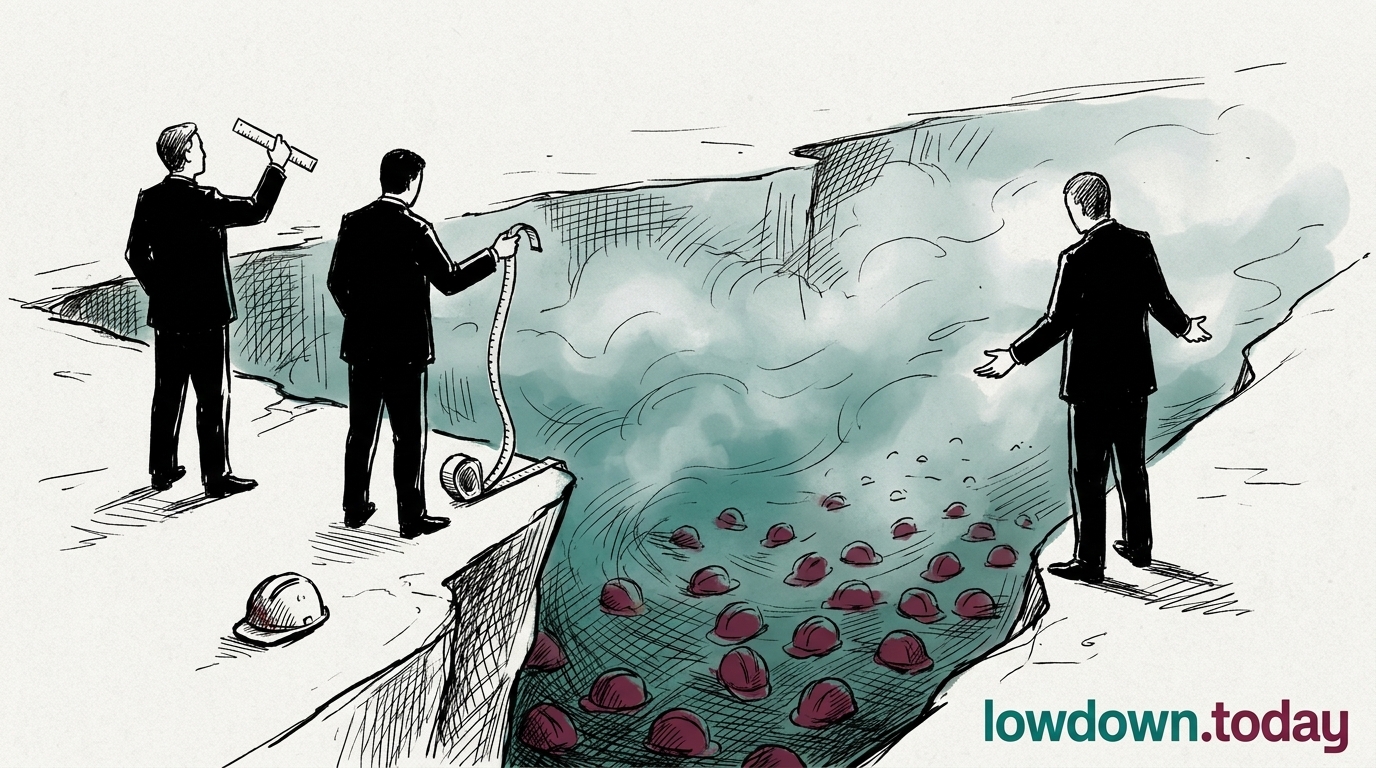
Tata Consultancy Services reported 593,798 staff at the end of June, down 19,271 across twelve months, in results published on Thursday 9 July.⁠1 Net profit rose 4.6% to Rs 13,349 crore, on revenue up 13.9%. A crore is ten million rupees, so The Firm cleared roughly 133bn rupees for the quarter, and it did so with a workforce smaller than a year ago by the population of a decent-sized market town.

For thirty years this sector ran on a straightforward proportion: more contracts meant more engineers, so revenue and headcount climbed together and investors read one off the other. Nearly 14% more revenue from 19,271 fewer people breaks that arithmetic, and TCS offered no reason for it. Its results release attributes the decline to nothing in particular.

How a firm this size shrinks matters more than the total. TCS announced no redundancy programme: 19,271 is what a year of ordinary attrition looks like when a company stops backfilling, and Indian IT attrition runs high enough to deliver that without a single redundancy notice. Stanford's estimate that AI now suppresses roughly a million US hires a year describes the same mechanism on another continent: the job that vanishes is the one never advertised. A vacancy nobody posts leaves no trace in any dataset, which is why a firm can shed a market town's worth of staff and file it as an unremarkable quarter.

Caution is warranted about how much of this belongs to AI. TCS is the world's largest IT services employer, and a firm of nearly 600,000 people moves its headcount for reasons that include contract renewals, delivery-model changes and plain cost pressure from clients. What can be said without stretching: The Firm got materially more productive per head, said nothing about why, and reported it as an ordinary quarter.


Deep Analysis

In plain English

Tata Consultancy Services, India's biggest IT services firm, employed 593,798 people at the end of June, 19,271 fewer than a year before, while its profit grew 4.6%. Proportionally, that is the steepest headcount fall of the three big Indian IT firms reporting this week, even though TCS is the largest and most established of them.

Deep Analysis
Root Causes

TCS's 19,271 year-on-year decline is roughly 3.1% of its post-cut headcount of about 613,000, the largest proportional fall among the three Indian majors reporting this week. HCLTech's 3,292 is about 1.4% of its base; Wipro added 0.4%.

That TCS, the largest and most process-mature of the three, shows the steepest relative decline suggests its scale allows faster reduction of the deployed-but-unbilled bench capacity Indian IT has historically carried between projects, rather than scale simply cushioning attrition.

What could happen next?
  • Meaning

    TCS's -3.1% year-on-year headcount change is proportionally the steepest among the three Indian IT majors reporting this week, ahead of HCLTech's -1.4% and Wipro's +0.4%.

First Reported In

Update #17 · Fed hedges as four banks cut headcount

Business Standard· 17 Jul 2026
Read original →
Different Perspectives
Competition and Consumer Commission of Singapore
The regulator found on 27 November that businesses can still choose and switch between cloud providers and AI models. It named dominant firms blocking rival AI agents as a risk, but answered with eight voluntary principles rather than rules.
La Poste
La Poste
France's state-owned postal group signed its first AI accord with four union confederations on 19 November, setting up a joint committee to oversee AI use. The announcement gives the unions a say, but no job security and no training hours for its 227,000 staff.
Nascent Information Technology Employees Senate (NITES)
The IT workers' union asked India's central government on 26 November for a mandatory national policy on AI layoffs, with every automated job cut logged in public. It expects to meet Labour Ministry officials; no government response has been reported.
China State Council
China State Council
Beijing's cabinet told local governments to pace AI in labour-intensive industries and to screen large AI projects for job losses. It keeps backing AI but wants the replacement of workers slowed, and it set no numeric targets.
SAP
SAP
SAP answered Bloomberg's report of at least 10,000 planned job cuts by telling CNBC that nothing is settled. In Germany a cut on that scale goes through works councils, and its 2024 round of about 10,000 ended mostly in voluntary departures.
Nvidia's board of directors
The board reinstated Jensen Huang on 22 November after input from senior levels of the US government, while its committee of independent directors keeps investigating. Its confidence rests, by its own account, on Washington's input, and the company says it will keep cooperating with government inquiries.

Written with AI from Lowdown's published reporting. Not individually reviewed by an editor. Editorial standards.
