Skip to content
Briefings are running a touch slower this week while we rebuild the foundations.See roadmap
AI: Jobs, Power & Money
17MAR

Claude Cowork wipes $24bn from India IT

4 min read
13:50UTC

Anthropic released an enterprise coding product whose market ripple effects — a $24 billion Indian IT sell-off, 12,000 TCS job cuts, and a hiring freeze across India's Big Four — exposed the structural fragility of the labour-arbitrage model.

EconomicAssessed
Key takeaway

Claude Cowork is the first AI product launch to produce a measurable, single-session market verdict on an entire national industry's business model.

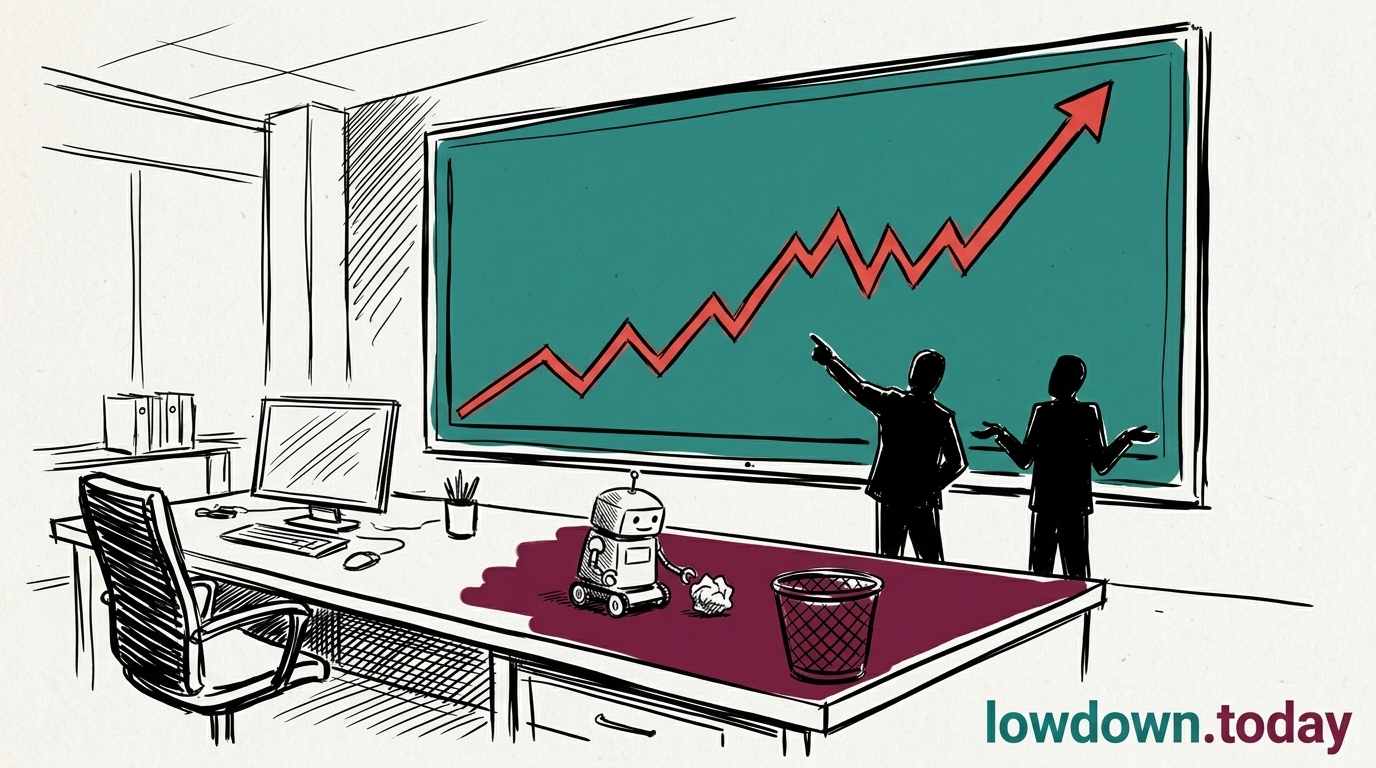
Anthropic announced Claude Cowork on 30 January 2026, a product designed for enterprise coding workflows. Within a week, India's Nifty IT index fell approximately 6%, erasing roughly ₹2 lakh crore ($24 billion) in market value in a single session 3. TCS, Infosys, Wipro, HCLTech, and Tech Mahindra each dropped 5–8%.

Claude Cowork enters a crowded field — GitHub Copilot, Amazon CodeWhisperer, and Google's Gemini Code Assist already compete for developers. What distinguished Anthropic's offering is its enterprise positioning. An AI tool that helps an individual developer autocomplete functions is a productivity booster. A tool marketed for integration into organisational coding workflows is a potential substitute for the outsourced development teams that Indian IT firms bill by the hour. The market placed Claude Cowork closer to the latter.

India's IT services sector employs roughly 5.4 million people and generates over $200 billion in annual export revenue. The growth model rests on labour arbitrage: large engineering teams at a fraction of Western salary costs, billed by the hour. Every AI tool that reduces billable hours attacks this model's unit economics. Systematix Group analyst Ambrish Shah warned: "As Indian enterprises integrate Claude for critical coding workflows, dependency on large vendor teams may decline, squeezing billable hours and margins."

India's Big Four have "essentially stopped hiring," according to The Register 4. TCS announced 12,000 planned job cuts — though industry sources place actual departures closer to 30,000 5. TCS CEO K. Krithivasan attributed the reductions to "skill mismatch" rather than AI — a framing the "AI washing" research would treat with scepticism 6.

Three decades of building India's IT economy produced a model that depended on human developers being cheaper than the alternative. AI has changed what the alternative is.

Anthropic CEO Dario Amodei had, weeks before the launch, called on AI companies to "steer customers away from firing workers" 2. The gap between that rhetoric and the market's reading of Claude Cowork is one every AI lab now faces.

Deep Analysis

In plain English

Anthropic — the AI safety company — announced Claude Cowork for enterprise deployment on 30 January. The product allows companies to integrate Claude AI into collaborative knowledge work: coding, data analysis, business process management. These are exactly the tasks currently handled by large outsourced teams, primarily in India. The timing is significant: Anthropic CEO Dario Amodei had weeks earlier published a lengthy essay urging companies not to fire workers and calling on governments to tax AI wealth. Claude Cowork's launch is therefore both a commercial product and an immediate test of whether Anthropic's stated ethics hold under competitive pressure.

Deep Analysis
Synthesis

The gap between Anthropic's stated ethics — Amodei explicitly urged companies not to fire workers — and the immediate market effect of its product launch (a $24 billion Indian IT sector wipeout) is the sharpest example in this briefing of the structural contradiction between AI companies' public positioning and their commercial incentives. This gap may become a regulatory and reputational liability as AI governance frameworks mature.

Root Causes

Anthropic faces competitive pressure from Microsoft Copilot and Google Gemini for Workspace — both better capitalised with existing enterprise distribution. The Claude Cowork launch reflects a need to establish enterprise revenue before rivals capture market share, partially decoupling the product's timing from technical or ethical readiness considerations.

Escalation

Escalation is likely but paced by enterprise procurement inertia. Regulated sectors — banking, insurance, healthcare — require compliance review periods of 12–24 months before deploying third-party AI tools. The displacement signal is credible, but the timeline is materially slower than the $24 billion Nifty IT market reaction implied.

What could happen next?
  • Consequence

    Anthropic's simultaneous ethical advocacy and market-disrupting product launch may trigger regulatory scrutiny of whether AI safety companies' stated commitments constitute enforceable representations.

    Medium term · Suggested
  • Risk

    If enterprise adoption accelerates faster than the 12–18 month baseline, Indian IT firms' April earnings guidance will materially understate the structural revenue impact.

    Short term · Suggested
  • Opportunity

    Indian IT firms that pivot to Claude Cowork implementation and integration services could recapture billable hours as AI deployers rather than displaced engineers.

    Medium term · Suggested
  • Precedent

    Claude Cowork establishes agentic AI as an enterprise-ready product category, likely accelerating competitive launches from Microsoft and Google within six months.

    Short term · Assessed
First Reported In

Update #1 · Meta cuts 20% while Big Tech spends $650bn

Fortune· 17 Mar 2026
Read original
Different Perspectives
European workers and regulators
NBER working paper w34995 found European workers use generative AI at 32% versus 43% of US workers, a gap driven by management practice rather than regulation. The EU AI Act's high-risk employment deadline stays at December 2027, leaving European workers facing the same displacement curve two to four years behind the US.
AI industry (Leading the Future PAC, OpenAI, Andreessen Horowitz)
Leading the Future committed over $100 million to the 2026 midterms and targeted regulation-minded candidates in the 2 June primaries; its counter-fund Public First formed at $50 million. The PAC runs advertising on healthcare and jobs without naming AI, mirroring the 1994 insurance industry campaign that defeated the Clinton health plan.
UK youth entering the labour market
UK youth unemployment reached 14.7% in January-March 2026, the highest since 2014, with 22.7% of young jobseekers out of work more than a year. The ONS publishes no AI-exposure breakdown, so policy is being set blind to the channel doing the damage.
US displaced workers (tech and finance)
Tech workers face median reemployment times of 4.7 months, up 47% from 2024, with a hiring pool contracting faster than AI-specialist openings can absorb them. Finance operations workers are the next cohort: 52% of their employers now run agentic AI in the exact functions where most of them work.
TSMC and Taiwan chip supply chain
Nvidia's 17% headcount growth to 42,000 on $81.6 billion in quarterly revenue depends on TSMC's CoWoS advanced packaging capacity constraining H100 and B200 supply, sustaining margins above 70%. The AI build-out's sole headcount-growth story runs through a Taiwan supply chain that has no parallel in downstream software.
Displaced tech workers globally
CrowdStrike's SEC disclosure puts AI attribution on a material regulatory record for the first time, but Oracle's Massachusetts WARN clock expired unfiled after up to 14 workers were logged as remote despite office proximity. The legal apparatus cannot enforce what it cannot see: hybrid reclassification, GCC transfers, and hires never made.