Skip to content
You can now search across every topic, entity and event.What's new
2026 FIFA World Cup
4JUL

Plan Kukulkan deploys 100,000 troops

4 min read
10:34UTC

President Sheinbaum stakes personal credibility on World Cup security with the largest peacetime military deployment in Mexican history, weeks after cartel retaliatory violence killed at least 70 people across the country.

SportAssessed
Key takeaway

Mexico's cartel crisis forces the largest World Cup security deployment in tournament history.

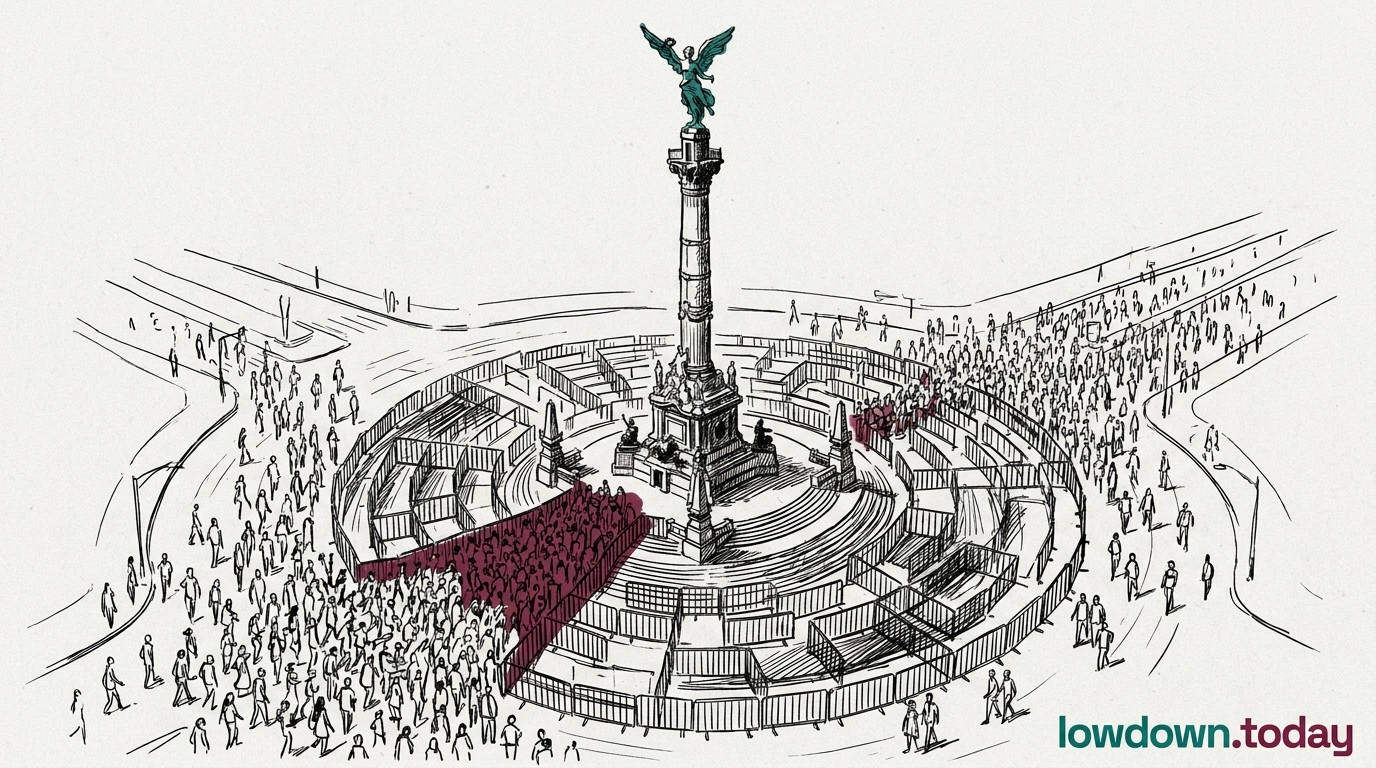
President Claudia Sheinbaum announced "Plan Kukulkan" on 6 March, committing up to 100,000 security forces, 2,500 vehicles, 24 aircraft, anti-drone systems and explosives-detection dogs to secure World Cup venues across Mexico 1. She travelled to Jalisco personally — the state where four group-stage matches will be played in Guadalajara, and the epicentre of retaliatory violence following the military's killing of Jalisco New Generation Cartel leader Nemesio "El Mencho" Oseguera Cervantes on 22 February 2.

The deployment's scale reflects what followed El Mencho's death. At least 70 people were killed in retaliatory violence across at least a dozen Mexican states, with armed clashes and road blockades reported in up to 20 3. Cartel members burned buses and blocked highways in and around Guadalajara itself. The CJNG has been Mexico's most territorially aggressive criminal organisation since the Sinaloa Cartel's internal fracture in 2023, and El Mencho's removal does not dissolve its command structure. Decapitation strikes against Mexican cartels have historically produced succession violence lasting months, not weeks — the 2009 killing of Arturo Beltrán Leyva triggered a prolonged war between his lieutenants, and the Zetas' fragmentation after their leadership was dismantled in 2012-2015 generated years of localised conflict.

Plan Kukulkan's name — referencing the feathered serpent deity of Mesoamerican civilisation — is deliberate political branding. Sheinbaum is staking personal authority on tournament security; a president visiting a violence-wracked state to announce a military operation is a signal directed simultaneously at FIFA, at European governments pressing for safety guarantees, and at domestic audiences. The 100,000-troop figure, if fully realised, would represent a force larger than Mexico deployed for any single security operation in recent memory. Whether the government can sustain that posture across three host cities for five weeks while managing ongoing cartel fragmentation is the operational question FIFA has not publicly addressed. Infantino stated he was "confident" Mexico could co-host safely 4, but that assessment preceded the full scale of post-El Mencho violence.

The practical test arrives in Guadalajara. Four group-stage matches at Estadio Akron will require secure corridors for tens of thousands of international fans in a city where, weeks earlier, cartel operatives were burning public transport on arterial roads. Sheinbaum's government has the military resources; the gap is between a security perimeter around stadiums and the threat environment across entire metropolitan areas. Mexican security forces have experience protecting high-value fixed sites — the 2012 G20 summit in Los Cabos, the 2018 presidential inauguration — but sustaining that protection over a month-long tournament with multiple simultaneous venues is a different operational problem.


Deep Analysis

In plain English

When the Mexican military killed one of the country's most powerful cartel bosses in February, his organisation retaliated with violence across at least a dozen states. In response, Mexico's president mobilised up to 100,000 soldiers, federal police, and special units, along with aircraft and bomb-detection dogs. The operation's name — Kukulkan — references a Mesoamerican feathered-serpent deity, signalling a deliberate nationalist framing intended to project state authority. The scale is historically unprecedented for a World Cup host. The critical unknown is whether this force can sustain high readiness across the full six weeks of the tournament rather than peaking reactively around the opening matches.

Deep Analysis
Synthesis

Plan Kukulkan's reactive scale reveals that Mexico was not adequately prepared for the post-El Mencho security environment when its World Cup hosting role was confirmed. The operation also raises a question the body does not address: whether sustained military presence in Guadalajara could itself become a symbolic target, with cartel factions seeking to demonstrate capability precisely because the World Cup's global profile amplifies the reputational damage of any incident.

Root Causes

CJNG had acquired military-grade weaponry and multi-state territorial control before El Mencho's death, making it qualitatively different from prior Mexican criminal organisations in its capacity for asymmetric retaliation against state forces. This structural factor — not merely the killing itself — explains why a 100,000-strong deployment is deemed necessary rather than a conventional policing operation.

Escalation

CJNG is almost certainly now in a succession struggle, and leadership transitions in major cartels historically produce a period of intensified, less-disciplined violence as factions compete for territorial control.

This makes the pre-tournament window from now through June potentially more dangerous than the immediate post-killing period. Plan Kukulkan is therefore a reactive posture deployed into a threat environment that may be deteriorating rather than stabilising — a structural vulnerability the body does not address.

What could happen next?
  • Risk

    CJNG succession violence may intensify before June, with cartel factions targeting the tournament's symbolic profile to demonstrate continued operational capacity.

    Short term · Assessed
  • Consequence

    If Plan Kukulkan holds, the Mexican government will cite it as a model for future major public events, normalising large-scale military deployment in civilian spaces.

    Medium term · Suggested
  • Precedent

    A World Cup secured by 100,000 troops sets a new baseline security requirement that future host nations, particularly in the Global South, will struggle to finance or replicate.

    Long term · Suggested
  • Risk

    Violence spreading to Mexico City — also a host city — would extend the required security perimeter far beyond Kukulkan's current Jalisco-focused posture.

    Immediate · Suggested
First Reported In

Update #1 · Iran splits on World Cup boycott

Al Jazeera· 22 Mar 2026
Read original
Different Perspectives
French Football Federation
The FFF called an 11:00 CEST press conference for 28 July, at its Paris headquarters, following an extraordinary executive committee meeting, at which Zinedine Zidane is expected to be presented as head coach succeeding Didier Deschamps. As of this writing no communique confirms the appointment, contract length or start date.
Morocco
Morocco
Morocco is pushing for the 2030 final at its Grand Stade Hassan II in Casablanca, a planned 115,000-seat venue that would be the world's largest football stadium on completion. The venue is contested by a Spanish petition for the Santiago Bernabeu, and FIFA has fixed neither the venue nor the tournament's proposed 64-team format.
FIFA
FIFA
FIFA's first tournament report, published 27 July, itemises nearly 300,000 accredited personnel, 73,700 security staff and 300,000 square metres of custom-grown turf, with no revenue or cost figure attached. As a Swiss association answering to its own Congress rather than a treasury, FIFA has followed the same operational-before-financial sequence it used after Qatar 2022.
Javier Tebas / La Liga
La Liga president Javier Tebas said on 21 July that FIFA's system is rotten from the root and that Gianni Infantino's time as president has, in his words, concluded. Tebas has no vote in FIFA's process, so days after the IOC declined jurisdiction over a separate ethics complaint, he used the only instrument he has.
Mexico City government
Head of government Clara Brugada presented a closing report on 22 July crediting the tournament with 44 billion pesos of economic activity, 2,000-plus accelerated public works and 100,000 formal jobs in June alone. The city has not published the method behind that figure, and three other Mexican bodies count the same five weeks differently.
Town of Foxborough
Town of Foxborough
Foxborough answered Kraft Group's June lawsuit on 7 July with a 61-page counterclaim, calling the stadium's owners 'a collection of multibillion-dollar corporations' trying to shift its $7.8 million security bill onto taxpayers. The town says its licensing power and its billing power run through the same board, and it wants the court to award its own costs too.


