Skip to content
You can now search across every topic, entity and event.What's new
2026 FIFA World Cup
4JUL

Four die in Mexico World Cup crush

2 min read
10:34UTC

Four people died in a crush on Paseo de la Reforma after Mexico beat Ecuador to reach the last 16, as Mayor Clara Brugada put the celebrating crowd near 1.4 million.

SportDeveloping
Key takeaway

Four fans died celebrating Mexico's win, in a street crush outside the federal stadium-security operation's remit.

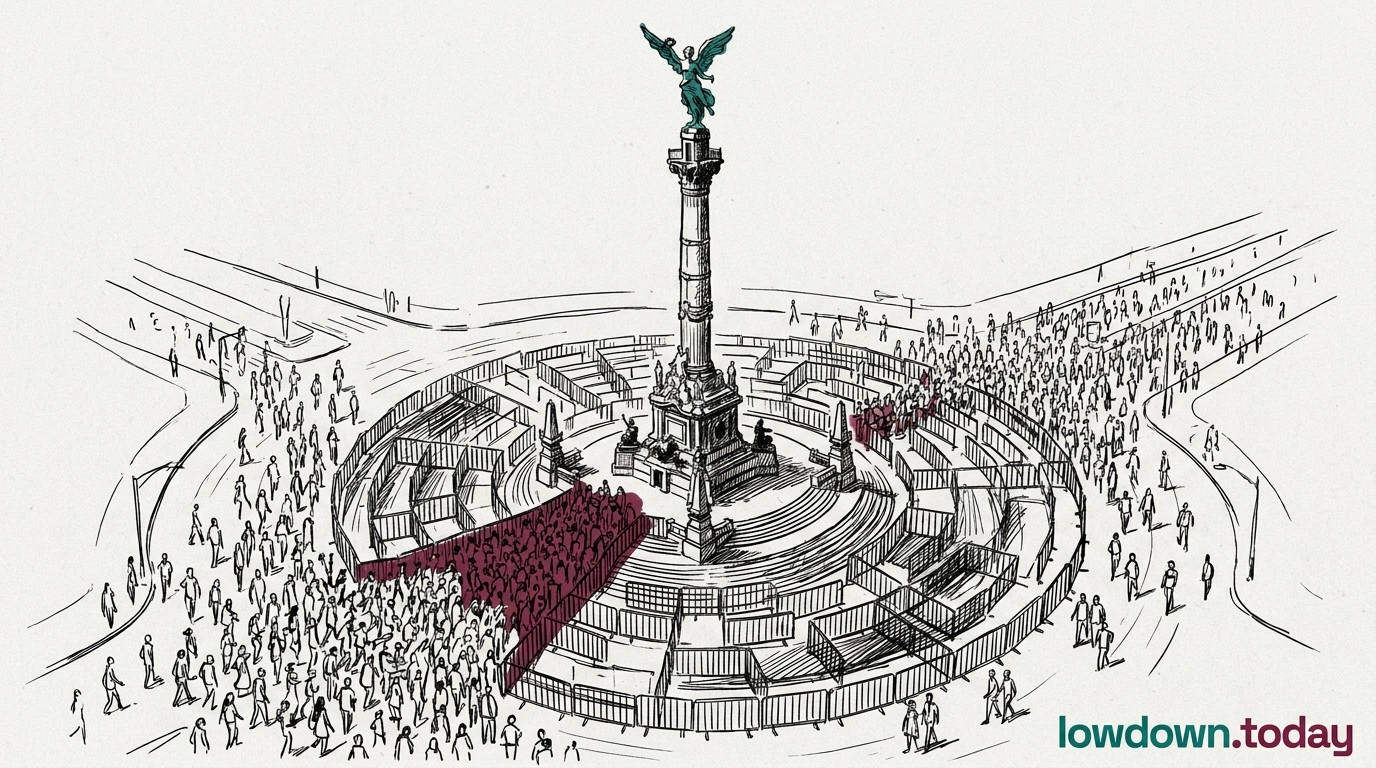
Four people died in a crowd crush on Paseo de la Reforma in Mexico City late on 30 June, hours after Mexico beat Ecuador at the Azteca to reach the round of 16 1. Three of them, two women aged 48 and 44 and a 19-year-old man, were asphyxiated in the surge around the Angel of Independence; a fourth man in his thirties later died in hospital of cardiac arrest after a seizure 2.

Mayor Clara Brugada put the crowd near 1.4 million and said the city attorney-general had opened an investigation 3. Paseo de la Reforma is central Mexico City's main ceremonial boulevard, and the Angel of Independence its traditional point for victory celebrations. The result was Mexico's first World Cup knockout victory in 40 years, and the deaths the tournament's first.

Mexico's federal security operation, Plan Kukulkan , was built to keep cartel violence and drones away from stadiums; on 18 June it downed a drone over a closed South Korea training session. The four deaths came from none of that. They came from an unpoliced street celebration, in the seam between what a federal venue-security plan was designed to guard and where the crowd actually gathered. Street and fan-zone crowd control in Mexico City falls to city authorities, not the federal operation.

Mexico host England at the Azteca on 5 July, the first host-city test of whether the crowd plan changes after four celebration deaths. No Mexican side has passed the round of 16 since 1986.


Deep Analysis

In plain English

Paseo de la Reforma is Mexico City's grandest boulevard, a wide avenue that runs past the Angel of Independence, a tall gold monument that has long been the spot where fans gather after a big win. After Mexico beat Ecuador to reach the World Cup's knockout stage, huge numbers of supporters headed there to celebrate. A crowd crush happens when so many people pack into one space that nobody can move freely and the pressure of bodies against bodies becomes dangerous, even without anyone panicking or running. That is what investigators believe happened here: four people died not because of violence, but because the crowd around the monument grew too dense for anyone caught inside it to escape. Mexico's huge World Cup security plan, built mainly to protect stadiums from threats like drones and cartel violence, was not designed to manage a street party of well over a million people.

Deep Analysis
Root Causes

Plan Kukulkan, Mexico's federal security operation for the tournament, deployed roughly 100,000 personnel, 24 aircraft and anti-drone countermeasures across the three host stadiums in Mexico City, Guadalajara and Monterrey. Its brief was perimeter security against cartel and drone threats inside ticketed venues, not density management on public streets.

The Angel of Independence has been Mexico City's default post-match gathering point for decades, but the pedestrian approaches onto the monument's traffic island narrow sharply compared with Reforma's twelve traffic lanes. An estimated 1.4 million people converging on that single node, with no capacity limit, ticketing or phased exit plan, created the compression that killed four people regardless of how wide the boulevard itself is.

What could happen next?
  • Consequence

    Mexico City's investigation is likely to examine whether celebration hotspots like the Angel of Independence need formal capacity limits or crowd barriers for the remainder of the tournament.

  • Precedent

    If further deep Mexican runs produce comparable crowds, city authorities will face pressure to extend Plan Kukulkan's remit beyond stadium perimeters to street celebration zones.

First Reported In

Update #32 · Four dead in Mexico's World Cup crush

Associated Press· 2 Jul 2026
Read original
Different Perspectives
French Football Federation
The FFF called an 11:00 CEST press conference for 28 July, at its Paris headquarters, following an extraordinary executive committee meeting, at which Zinedine Zidane is expected to be presented as head coach succeeding Didier Deschamps. As of this writing no communique confirms the appointment, contract length or start date.
Morocco
Morocco
Morocco is pushing for the 2030 final at its Grand Stade Hassan II in Casablanca, a planned 115,000-seat venue that would be the world's largest football stadium on completion. The venue is contested by a Spanish petition for the Santiago Bernabeu, and FIFA has fixed neither the venue nor the tournament's proposed 64-team format.
FIFA
FIFA
FIFA's first tournament report, published 27 July, itemises nearly 300,000 accredited personnel, 73,700 security staff and 300,000 square metres of custom-grown turf, with no revenue or cost figure attached. As a Swiss association answering to its own Congress rather than a treasury, FIFA has followed the same operational-before-financial sequence it used after Qatar 2022.
Javier Tebas / La Liga
La Liga president Javier Tebas said on 21 July that FIFA's system is rotten from the root and that Gianni Infantino's time as president has, in his words, concluded. Tebas has no vote in FIFA's process, so days after the IOC declined jurisdiction over a separate ethics complaint, he used the only instrument he has.
Mexico City government
Head of government Clara Brugada presented a closing report on 22 July crediting the tournament with 44 billion pesos of economic activity, 2,000-plus accelerated public works and 100,000 formal jobs in June alone. The city has not published the method behind that figure, and three other Mexican bodies count the same five weeks differently.
Town of Foxborough
Town of Foxborough
Foxborough answered Kraft Group's June lawsuit on 7 July with a 61-page counterclaim, calling the stadium's owners 'a collection of multibillion-dollar corporations' trying to shift its $7.8 million security bill onto taxpayers. The town says its licensing power and its billing power run through the same board, and it wants the court to award its own costs too.


