Skip to content
Briefings are running a touch slower this week while we rebuild the foundations.See roadmap
2026 FIFA World Cup
11JUN

Teachers and the missing take the Zocalo

3 min read
09:02UTC

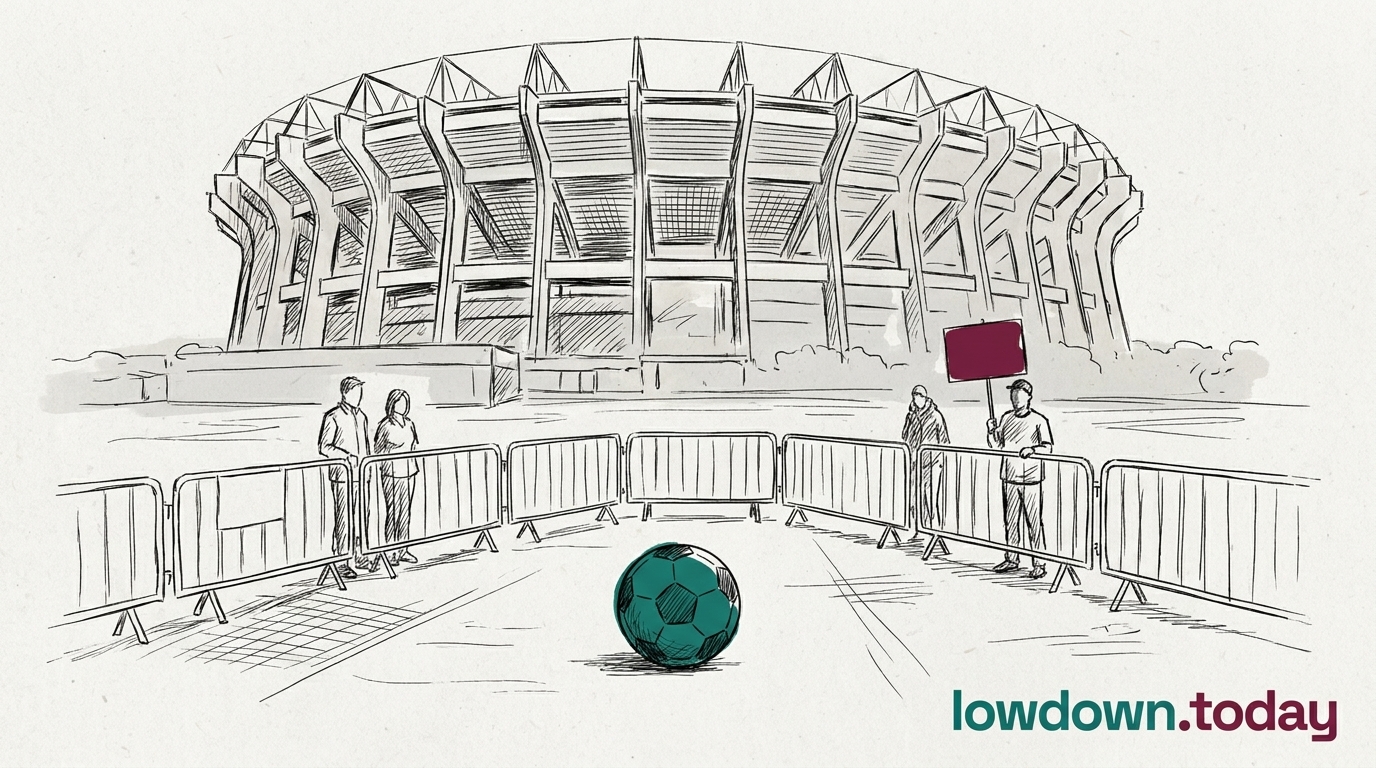
On kickoff morning, Mexico's dissident teachers' union and families of the country's disappeared occupied the central square that was meant to be the official FIFA fan zone.

SportDeveloping
Key takeaway

Mexico's teachers and the families of its disappeared turned the official fan zone into a protest on opening morning.

CNTE, Mexico's dissident teachers' union, erected a tent encampment on the Zocalo, Mexico City's central square and the planned official FIFA fan zone, on opening morning, 11 June. The union, formally the Coordinadora Nacional de Trabajadores de la Educacion and independent of the official SNTE, demanded restored pensions under the 2007 ISSSTE programme and higher wages. 1

Alongside the teachers, families of Mexico's more than 130,000 disappeared hung flyers of missing relatives across the site, turning the fan zone into a protest against the spectacle itself. President Claudia Sheinbaum confirmed 18 alternative free-viewing venues and said only, "Let's see how things develop with the teachers," stopping short of any commitment to clear the square. Nineteen social movements had planned demonstrations during the opening week.

The protest sits inside a heavy security frame. Roughly 100,000 military, police and National Guard personnel are deployed across the three Mexican host cities under Plan Kukulkan, the state's response to a threat picture that US authorities themselves rate as severe: the Department of Homeland Security called the tournament threat level extremely high and FEMA deployed $1.47bn, including $221m for counter-drone systems . On opening day, the host's domestic dissent and its security apparatus arrive in the same frame as the football.


Deep Analysis

In plain English

On the morning the World Cup started, teachers from a union called CNTE set up a tent camp in Mexico City's main square, the Zocalo, exactly where the official FIFA fan zone was supposed to be. CNTE, Mexico's dissident teachers' union, occupied the Zocalo because the World Cup brought global cameras. They want the government to restore defined-benefit pensions stripped by a 2007 reform, and they knew that international visibility was their only remaining lever. Alongside them, families of Mexico's more than 130,000 missing and disappeared people hung photos and flyers of their relatives. Over 130,000 people in Mexico have disappeared, mostly in connection with organised crime and drug-related violence, with little accountability. Mexico's president, Claudia Sheinbaum, offered to set up 18 alternative places for fans to watch matches, but did not order the protesters to leave. She faces a difficult choice: remove the protesters and generate worse international headlines, or let them stay and effectively cede the symbolic centre of the capital.

Deep Analysis
Root Causes

Two structural causes, independent but reinforcing.

The pension dispute traces to the 2007 ISSSTE reform, which applies to roughly 250,000 teachers hired since that year. Teachers' union CNTE has never had a direct negotiating channel with the presidency; their demands go through the Education Ministry (SEP), which has never had the budget authority to restore defined-benefit pensions. The structural deadlock is 19 years old.

The disappeared persons dimension traces to the 2014 Ayotzinapa disappearance of 43 student teachers; a CNTE-affiliated group; and the subsequent expansion of official disappeared-persons tracking to 130,000+ entries. Families using the World Cup platform to hang flyers reflects the same logic CNTE uses: international visibility at a critical moment is their only remaining leverage instrument, because domestic institutional channels have produced nothing.

What could happen next?
  • Risk

    If CNTE's occupation persists past the round-of-16 stage, FIFA will face pressure from broadcast partners over ongoing replacement of its flagship Mexico City fan-zone content with protest imagery.

  • Precedent

    Sheinbaum's tolerance model; alternative venues rather than enforcement; may establish a template other host nations adopt in 2030 and 2034 when political dissent at fan zones arises.

First Reported In

Update #18 · 0 Days to Go: the football finally starts

ESPN· 11 Jun 2026
Read original
Different Perspectives
FIFA
FIFA
FIFA's 48-team format, projecting $13.1 billion in 2026-cycle revenue against $7.5 billion for 2019-2022, opened on 11 June despite simultaneous legal, labour and security crises. Expanding to 48 sides structurally reduced the stakes of individual group results, which is both its commercial logic and the mechanism that let the build-up machinery run without cancellation.
Brazil
Brazil
Brazil open Group C against Morocco on 13 June missing Neymar, Rodrygo, Estevao and Militao; Ancelotti expressed no regrets carrying an injured Neymar and targets the Haiti fixture on 20 June for his return. Morocco's full-strength XI is rated higher by performance index than Brazil's depleted opener lineup, making this the most awkward first fixture any pre-tournament favourite has drawn.
United States
United States
The co-host avoided its most damaging opening image when UNITE HERE Local 11 reached a tentative deal with Legends on 9 June, pulling a threatened strike off the table days before Pochettino's 4-3-3 faces Paraguay. The agreement requires a ratification vote this week; rejection returns the threat before the first US match.
South Africa
South Africa
Bafana Bafana returned to the World Cup after a 16-year absence in Hugo Broos's final tournament before retirement, arriving at the Azteca opener with a counter-attacking shape to exploit possession-heavy hosts at altitude. Broos told his players to silence the Mexican crowd; his pace through Appollis and Mofokeng sets the tone for Group A.
Mexico
Mexico
Mexico opened the tournament at home on 11 June carrying a 0W-5L-2D opener record and a sold-out Azteca, while the official Zocalo fan zone was occupied by teachers and families of the disappeared on the same morning. Sheinbaum's offer of 18 alternative venues rather than a clearance order reflects her calculation that force produces worse headlines than co-existence.
Norwegian Football Federation
NFF president Lise Klaveness sent a letter of support backing FairSquare's Article 15 ethics complaint against Infantino, explicitly noting Norway was acting alone as a deliberate signal. The filing converted an external NGO campaign into the first internal federation action against the FIFA president, arriving in the same fortnight as Platini's Paris criminal complaint.


