Skip to content
Foundations rebuilt, and the first new thing is here: search across every topic, entity, and event.Try search
2026 FIFA World Cup
11JUN

Six hundred rolls of grass and a Dutch grow light

4 min read
09:02UTC

MetLife Stadium began installing 600 rolls of Tahoma 31 bermudagrass on 6 May; NRG Stadium is shipping refrigerated grass from Colorado with Dutch grow lights; Estadio Banorte's upper sections are still incomplete 31 days before kickoff.

SportDeveloping
Key takeaway

Three venues are running compressed installation windows with no tested fallback before the 11 June opener.

MetLife Stadium in East Rutherford began installing the pitch for the 19 July final on 6 May. 600 rolls of Tahoma 31 bermudagrass, grown for ten months at Carolina Green Turf Farm outside Charlotte, were trucked north in 20 refrigerated loads. The sub-base, in order of depth, is 18 to 24 inches of sand, Permavoid permeable cloth, a vacuum-and-ventilation layer, more sand, then the grass. NJ Transit's MetLife mobility plan and FIFA's hybrid-grass mandate sit on top of an operation the venue had ten weeks to assemble. If the Tahoma 31 fails to root in time, the 19 July final is played on a contingency surface nobody has tested at scale. 1

The technical challenge has no tournament precedent at scale. NRG Stadium in Houston, which is domed, is shipping refrigerated grass from Colorado and using LED grow lights from the Netherlands to maintain the pitch between matches; 8 of the 16 venues are converting artificial surfaces to hybrid grass in a single window. The mechanism is straightforward and unfamiliar to most US sports operators: bermudagrass goes dormant under twelve hours of natural light a day, which is exactly what an indoor venue offers. NRG's Dutch grow lights keep the pitch alive between the 14 June first match and the venue's last.

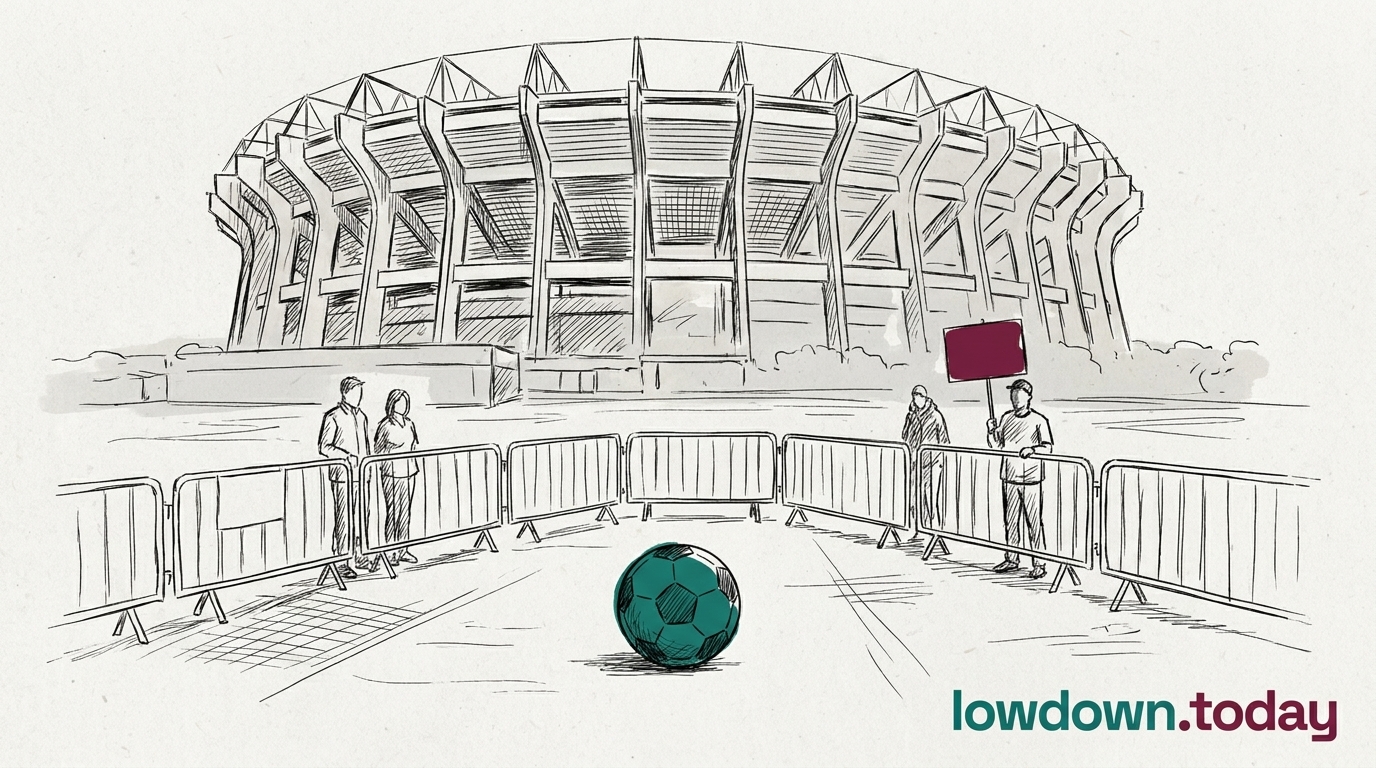
At Estadio Banorte in Mexico City, renamed from Estadio Azteca after Banorte purchased the naming rights in March 2025 , photographs taken near publication date show seat installation still incomplete in the upper sections and new red membrane structures that were not in the original renovation specification . Mexican officials acknowledged to The Athletic that "renovation progress has not matched early projections". 2 Banorte hosts the 11 June opener for an expected 87,000 attendance, and FIFA has still not been given full possession of a stadium that takes the tournament's first kick.


Deep Analysis

In plain English

Most American football stadiums use artificial turf, but FIFA requires real grass for World Cup matches. Eight US venues have to rip out their artificial turf and lay natural grass in a matter of weeks before the tournament starts. MetLife Stadium in New Jersey, where the final is on 19 July, started laying 600 rolls of specially grown grass on 6 May. In Houston, which has a dome, the stadium is using special LED lights imported from the Netherlands to stop the grass dying between matches. Meanwhile, in Mexico City, photographs show some seats still being installed at the stadium hosting the very first match on 11 June.

Deep Analysis
Root Causes

Eight of sixteen World Cup venues use artificial turf as their primary NFL or MLS surface, which FIFA's hybrid-grass mandate requires them to convert for the tournament. The mandate arose directly from the Copa América 2024 pitch failures, where players publicly criticised surface quality. FIFA's mandate requires a 90-95% natural grass content; indoor venues cannot maintain that standard between matches without supplemental lighting and climate control.

Banorte's incomplete upper sections reflect a different root cause: the stadium renovation was contracted in 2023 with a 28 March 2026 reopening target, which was met for the Mexico-Portugal friendly.

The post-March renovation works, adding seating in sections that were not included in the original renovation scope, were added to the specification after the naming-rights deal with Banorte in March 2025 expanded the commercial footprint of the venue. FIFA's possession transfer in early May occurred with those works still incomplete.

What could happen next?
  • Risk

    If Tahoma 31 fails to establish at MetLife by early June, FIFA has no tested contingency surface for the 19 July final; no alternative US venue has the capacity to host a final-level match at short notice.

    Short term · 0.45
  • Risk

    Banorte's incomplete upper sections, if not remediated by 11 June, reduce the stadium's declared capacity of 87,000 for the opener, potentially affecting FIFA's commercial obligations to broadcast partners and Category 1 ticket holders.

    Immediate · 0.6
  • Consequence

    The Copa América 2024 pitch failures that drove the hybrid-grass mandate are now generating $200-280m in one-time infrastructure costs; future US World Cup bids will need to include permanent hybrid-grass stadium conversions to avoid this cost cycle.

    Long term · 0.7
First Reported In

Update #10 · Tehran names the players

AFP via Geo TV· 11 May 2026
Read original
Different Perspectives
FIFA
FIFA
FIFA's 48-team format, projecting $13.1 billion in 2026-cycle revenue against $7.5 billion for 2019-2022, opened on 11 June despite simultaneous legal, labour and security crises. Expanding to 48 sides structurally reduced the stakes of individual group results, which is both its commercial logic and the mechanism that let the build-up machinery run without cancellation.
Brazil
Brazil
Brazil open Group C against Morocco on 13 June missing Neymar, Rodrygo, Estevao and Militao; Ancelotti expressed no regrets carrying an injured Neymar and targets the Haiti fixture on 20 June for his return. Morocco's full-strength XI is rated higher by performance index than Brazil's depleted opener lineup, making this the most awkward first fixture any pre-tournament favourite has drawn.
United States
United States
The co-host avoided its most damaging opening image when UNITE HERE Local 11 reached a tentative deal with Legends on 9 June, pulling a threatened strike off the table days before Pochettino's 4-3-3 faces Paraguay. The agreement requires a ratification vote this week; rejection returns the threat before the first US match.
South Africa
South Africa
Bafana Bafana returned to the World Cup after a 16-year absence in Hugo Broos's final tournament before retirement, arriving at the Azteca opener with a counter-attacking shape to exploit possession-heavy hosts at altitude. Broos told his players to silence the Mexican crowd; his pace through Appollis and Mofokeng sets the tone for Group A.
Mexico
Mexico
Mexico opened the tournament at home on 11 June carrying a 0W-5L-2D opener record and a sold-out Azteca, while the official Zocalo fan zone was occupied by teachers and families of the disappeared on the same morning. Sheinbaum's offer of 18 alternative venues rather than a clearance order reflects her calculation that force produces worse headlines than co-existence.
Norwegian Football Federation
NFF president Lise Klaveness sent a letter of support backing FairSquare's Article 15 ethics complaint against Infantino, explicitly noting Norway was acting alone as a deliberate signal. The filing converted an external NGO campaign into the first internal federation action against the FIFA president, arriving in the same fortnight as Platini's Paris criminal complaint.


