Skip to content
Briefings are running a touch slower this week while we rebuild the foundations.See roadmap
2026 FIFA World Cup
6JUN

Democrats move to ban ICE at World Cup

4 min read
12:17UTC

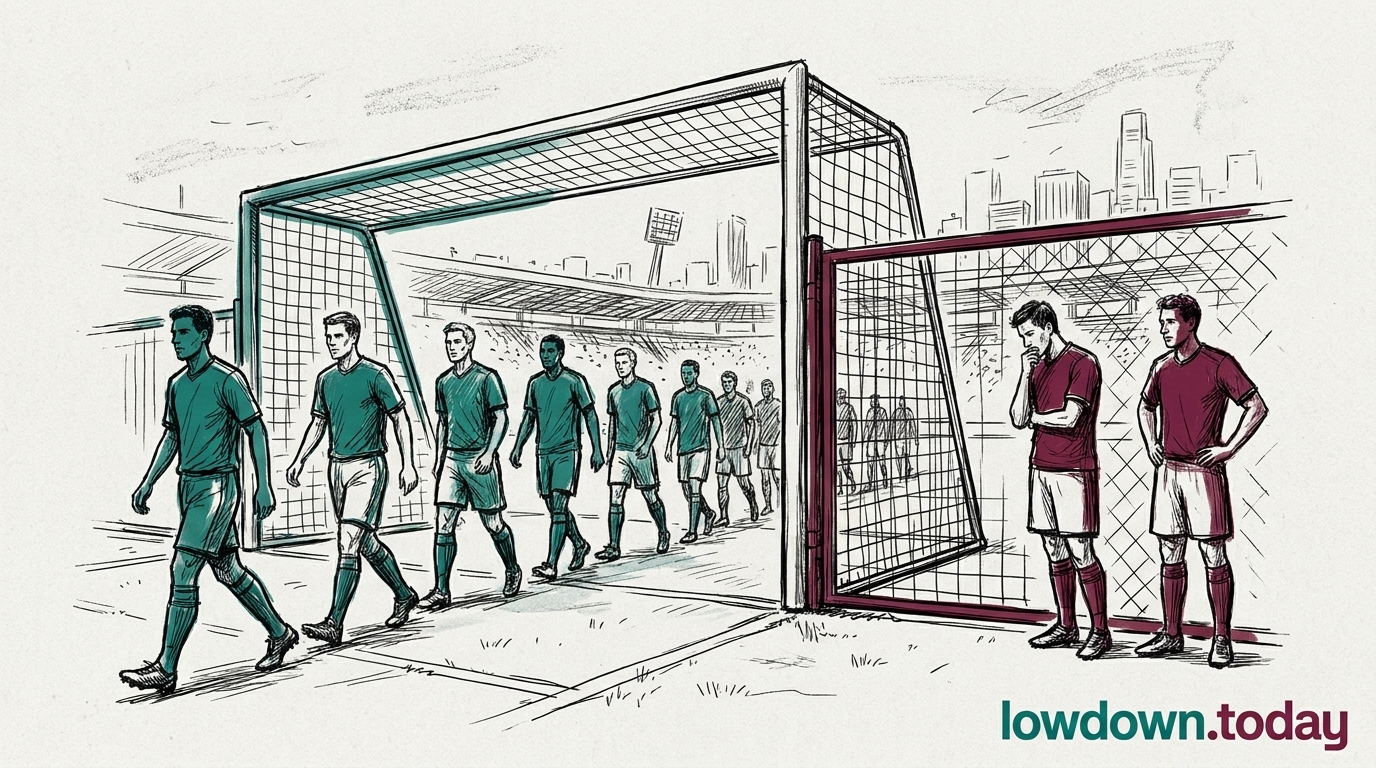
Three House bills would prohibit immigration enforcement near stadiums, fan zones and public transit during the tournament — but all face near-certain defeat in the Republican-controlled chamber.

SportAssessed
Key takeaway

Three separate Democratic bills reveal a fractured legislative strategy driven by political positioning over law-making.

Three House Democrats introduced separate bills in March to prohibit Immigration and Customs Enforcement operations near World Cup venues during the tournament window of 11 June to 19 July. Rep. Eric Swalwell's 'Safe Passage to the World Cup Act' targets enforcement on public transit routes serving stadiums 1. Rep. Nellie Pou's 'Save the World Cup Act' covers stadiums and designated fan zones 2. Rep. LaMonica McIver's bill would block federal agencies from activating Section 287(g) agreements — which deputise local police to enforce immigration law — during match days 3.

None will pass. No Republican co-sponsor has signed on to any of the three bills, and without bipartisan support in the House, none will reach a floor vote. The Trump administration, which has made immigration enforcement a central domestic priority, has given no indication it would accept carve-outs for sporting events.

The bills address a practical concern rather than an abstract one. The tournament will funnel millions of spectators through public transit, urban fan zones and stadium perimeters across 16 US host cities. Section 287(g), the programme McIver's bill targets, is already active in jurisdictions that include host-city metropolitan areas — it allows local officers to check immigration status during routine encounters. The fear among immigrant communities, articulated by the American Immigration Council and immigration advocacy organisations, is that enforcement activity near venues will deter attendance not only by undocumented residents but by legal immigrants and naturalised citizens wary of profiling 4.

That three representatives introduced three separate bills rather than one unified measure suggests these are as much political messaging as legislation — each tailored to a different constituency and a different slice of the enforcement apparatus. Their practical effect, if they remain stalled, is to place on the Congressional record a position that the administration's immigration posture is incompatible with hosting an event built on international movement. Whether ICE conducts visible operations near stadiums during the tournament will be a decision made by the executive branch, not one settled by legislation.


Deep Analysis

In plain English

Three separate Democratic members of Congress have each introduced their own bill to stop immigration enforcement agents from operating near World Cup stadiums, fan zones, and public transport routes during the tournament. The bills will almost certainly fail because Republicans control the House. Their real purpose is political: they force Republican opponents to publicly vote against protecting World Cup fans from immigration enforcement, generating news coverage and constituent pressure. The fact that there are three separate bills covering different locations — rather than one unified measure — suggests either poor co-ordination between the sponsors or a deliberate strategy to maximise media attention across multiple news cycles, at the cost of appearing fractured to potential allies.

Deep Analysis
Synthesis

Three separate bills rather than one unified Democratic proposal reveal a legislative strategy optimised for political positioning rather than law-making. Each bill's distinct venue scope — transit, stadiums, fan zones — reflects individual sponsors' constituent priorities rather than co-ordinated legislative design. This fragmentation weakens the collective political signal and makes it easier for Republicans to dismiss each bill individually. The pattern mirrors Democratic immigration-enforcement responses in prior Congresses, where similar fragmentation produced sustained media coverage but minimal legislative output.

Root Causes

Section 287(g) agreements — targeted specifically by Rep. McIver's bill — deputise local law enforcement as federal immigration agents, creating enforcement capacity inside host cities without requiring ICE to deploy its own officers directly. Democratic advisers appear to have identified 287(g) as the most operationally likely enforcement mechanism near venues. Critically, 287(g) agreements are contractual between DHS and local governments and can be activated or expanded without Congressional approval, meaning the McIver bill addresses a vulnerability that only executive action can fully close.

Escalation

The bills' near-certain defeat does not resolve the political dynamic — it may intensify it. A single publicly documented ICE enforcement action near a World Cup venue would generate international media coverage disproportionate to the individual incident.

The political logic could incentivise enforcement rather than restraint: the administration may view visible ICE presence near World Cup venues as a signal to its political base, treating the diplomatic cost as acceptable. This makes the chilling effect on Latino attendance a near-certainty regardless of whether any formal enforcement occurs.

What could happen next?
  • Risk

    A single documented ICE enforcement action near a World Cup venue triggers disproportionate international condemnation and potential boycott threats from affected nations and fan groups.

    Immediate · Suggested
  • Consequence

    A chilling effect on Latino fan attendance in major US host cities depresses commercial revenues for FIFA sponsors and local hospitality and retail businesses.

    Short term · Assessed
  • Precedent

    Failure of all three bills establishes that US immigration enforcement has no sporting-event carve-out, regardless of diplomatic implications for future hosted tournaments.

    Long term · Assessed
  • Opportunity

    Republican co-sponsorship of any bill would represent a rare bipartisan limit on immigration enforcement and significantly shift the political calculus around tournament-period enforcement.

    Short term · Suggested
First Reported In

Update #1 · Iran splits on World Cup boycott

Newsweek· 22 Mar 2026
Read original
Causes and effects
This Event
Democrats move to ban ICE at World Cup
The bills are legislatively doomed but force a public debate over whether US immigration enforcement is compatible with hosting an event that depends on the free movement of millions of international visitors.
Different Perspectives
FIFA
FIFA
FIFA remains publicly silent on every open dispute touching the tournament: no response to the UNITE HERE ICE-moratorium demand since April, no on-record comment on the Iran visa reversal, no intervention on the FIGC election. Its governance architecture, which routes bilateral matters to governments and domestic federation matters to national bodies, structurally precludes a direct answer on all three.
Andrea Abodi / Italian Sports Ministry
Abodi's ANAC referral is the first formal institutional step in his challenge to Malagò, converting a legal argument into a timed procedural clock, with both bodies reportedly receiving the request with "considerable frustration". The 15 June deadline means Italy's federation crisis will peak mid-tournament regardless of the ruling's direction.
Mauricio Pochettino / USMNT
Pochettino confirmed the 4-3-3 with Reyna and Pulisic starting against Germany, resolving the formation question at the cost of a 3-1 defeat that exposed the defensive axis. His public frustration over Richards's fitness, "I got a little annoyed", frames the 11 June deadline as an emotional as well as a tactical decision.
FFIRI / Mehdi Taj
FFIRI / Mehdi Taj
FFIRI confirmed the squad's clearance but stated five federation staffers were blocked under a "false pretences" finding, and denied separately reported player rejections, insisting the playing group travels intact. Taj's 5 June deadline expired; the approval arrived the same day, meeting the form of the demand while leaving the delegation short.
US State Department / UNITE HERE Local 11
Unnamed US officials approved Iran's squad visas via Ankara without a formal State Department statement, leaving Taremi's individual file unconfirmed; at the same venue system, UNITE HERE Local 11's 96% strike mandate among 2,000 SoFi workers, following FIFA's silence since 7 April, means US immigration enforcement runs as two parallel pressure tracks through the opener.
France (FFF)
France (FFF)
Manager Didier Deschamps confirmed William Saliba will play, reversing the 'very doubtful' briefing from earlier in the week and deferring any surgery until after the tournament. France recovers its first-choice central defender for the group stage at a point when rivals were adjusting their tactical assessments.


