Skip to content
Briefings are running a touch slower this week while we rebuild the foundations.See roadmap
2026 FIFA World Cup
29MAY

24 MEPs name Digital Fairness Act

3 min read
15:10UTC

Brando Benifei's E-001336/2026 asks the Commission a deliberate three-part question: is this Article 102, is it a 2005 directive breach, and should primary legislation close it.

SportDeveloping
Key takeaway

Benifei's question opens a legislative route through the Digital Fairness Act alongside the competition complaint track.

Twenty-four Members of the European Parliament led by Brando Benifei, the Socialists and Democrats (S&D) group coordinator on the internal market committee, submitted written question E-001336/2026 to the European Commission on 31 March, last updated 13 April 1. Benifei's question is the first time a Commission-level legislative instrument has been proposed as a remedy for World Cup ticketing.

Benifei's question is structured in three parts. First, whether FIFA's dynamic pricing and dark patterns breach Article 102 TFEU, the abuse-of-dominant-position provision, and the 2005 Unfair Commercial Practices Directive. Second, whether the Commission will prioritise enforcement before the 11 June opener. Third, whether the upcoming Digital Fairness Act, primary legislation still in draft, should include a ban on dynamic pricing for live events. DG COMP, the Commission's competition directorate, has not answered as of 19 April.

Article 102 cases against sports governing bodies sit in an unsettled area of EU law, which is why the Football Supporters Europe (FSE) and Euroconsumers complaint filed on 24 March carries uncertain legal weight. The Digital Fairness Act runs on a different track: binding future tournaments by statute rather than by case law , . The 24 co-signatories give the file a visible European political constituency FIFA cannot dismiss as a single-country campaign, and Benifei's question enters the EP record for the next Digital Fairness Act debate whether DG COMP answers or not.


Deep Analysis

In plain English

Twenty-four members of the European Parliament (MEPs : the elected representatives who make EU law) have asked the European Commission (the EU's executive body, similar to a government) a formal question about FIFA's ticket pricing. They want to know whether FIFA's approach : where prices can rise with no cap after you've bought a ticket, and where the seats you're allocated turn out to be different from what the original maps showed : breaks European consumer and competition law. They also asked whether the new Digital Fairness Act, a piece of EU legislation being drafted right now, should include a permanent ban on this kind of variable pricing for live events. The Commission has not yet replied. The deadline for a response is not fixed by law, but a question from 24 MEPs typically receives a response within six to eight weeks.

Deep Analysis
Root Causes

Article 102 TFEU prohibits abuse of a dominant market position. The structural difficulty the Commission faces is that FIFA's ticketing monopoly was never challenged under competition law before 2026, partly because major sports governing bodies have historically received informal exemptions under EU sport policy (Article 165 TFEU).

FSE and Euroconsumers' complaint therefore requires the Commission to make a market-definition argument it has never made: that FIFA constitutes a dominant undertaking in the market for access to World Cup tickets.

Benifei's E-001336/2026 opens a second route that avoids the market-definition problem entirely. The Unfair Commercial Practices Directive 2005/29/EC applies to any trader regardless of dominance, and FIFA's retroactive reassignment of seat locations after purchase : acknowledged via its 'maps were indicative' statement : is a straightforward bait-and-switch under Article 6 of the Directive.

The MEPs are signalling that the Commission has an existing legal instrument that does not require the untested dominance argument.

First Reported In

Update #8 · Three clocks running against kickoff

European Parliament· 19 Apr 2026
Read original
Different Perspectives
Argentina / Lionel Scaloni
Scaloni confirmed Messi for a record sixth World Cup on 28 May, choosing the 38-year-old captain's institutional authority over 18-year-old Franco Mastantuono's development potential. Commercial as well as sporting considerations weigh on any Messi decision, and Argentina's AFA was never likely to backstop an exclusion on pure sporting logic.
DFB / Rudi Völler
DFB / Rudi Völler
Völler issued informal guidance to Germany's squad on around 27 May to keep politics and sport separate, stopping short of the formal ban that produced Qatar 2022's OneLove armband collision. The approach gives the federation documented deniability while preserving each player's legal freedom to act independently.
England Football Association / Thomas Tuchel
Tuchel cut Alexander-Arnold, Foden and Palmer on system grounds, the clearest signal yet that the FA has genuinely ceded selection authority to the coaching staff. England travel without Palmer, one of the Premier League's sharpest creators, accepting a narrower build-up vocabulary against low-block opponents in exchange for off-ball discipline.
Football Supporters Europe / Euroconsumers
The fan coalition's Article 102 TFEU complaint, filed in March and unacknowledged past the April deadline, was confirmed for assessment by the European Commission on 28 May. Brussels logging the file gives the complainants a live regulatory record FIFA must preserve, building on the European Super League judgment that exposed FIFA and UEFA rules to EU competition scrutiny.
New York and New Jersey Attorneys General / UNITE HERE Local 11
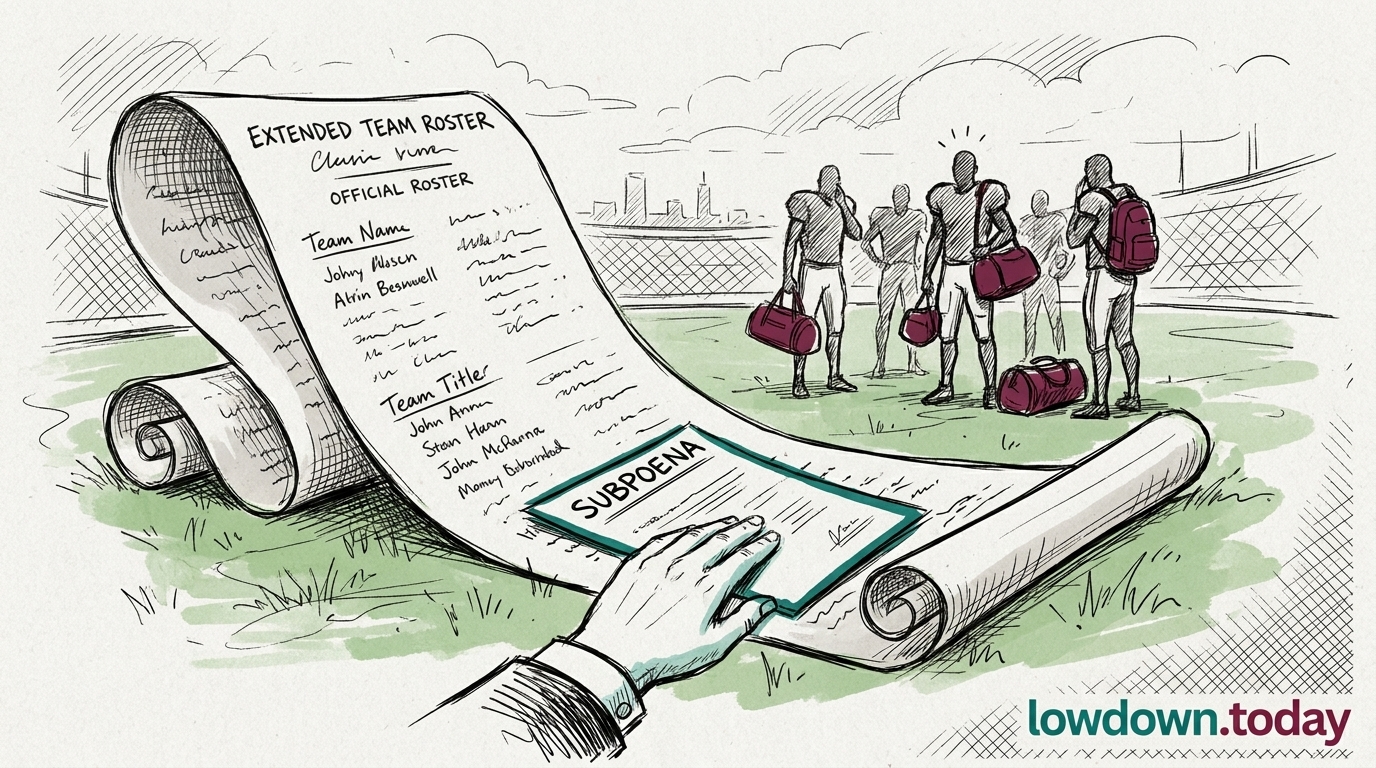
On 28 May, Letitia James and Jennifer Davenport subpoenaed FIFA under their broad state authority to pursue an entity trading in their states, regardless of FIFA's Swiss registration; that same week UNITE HERE Local 11 moved its campaign to California privacy law, filing with the CPPA over FIFA accreditation data shared with DHS and ICE without worker consent.
FFIRI / Mehdi Taj
FFIRI / Mehdi Taj
Taj framed Tijuana as resolving entry friction while simultaneously demanding multiple-entry US visas, because single-entry papers would strand the squad in Mexico after the first match-day crossing. Both are needed: the camp solves accommodation, the visa solves the border crossings Iran's three group matches require, the first before 15 June.


