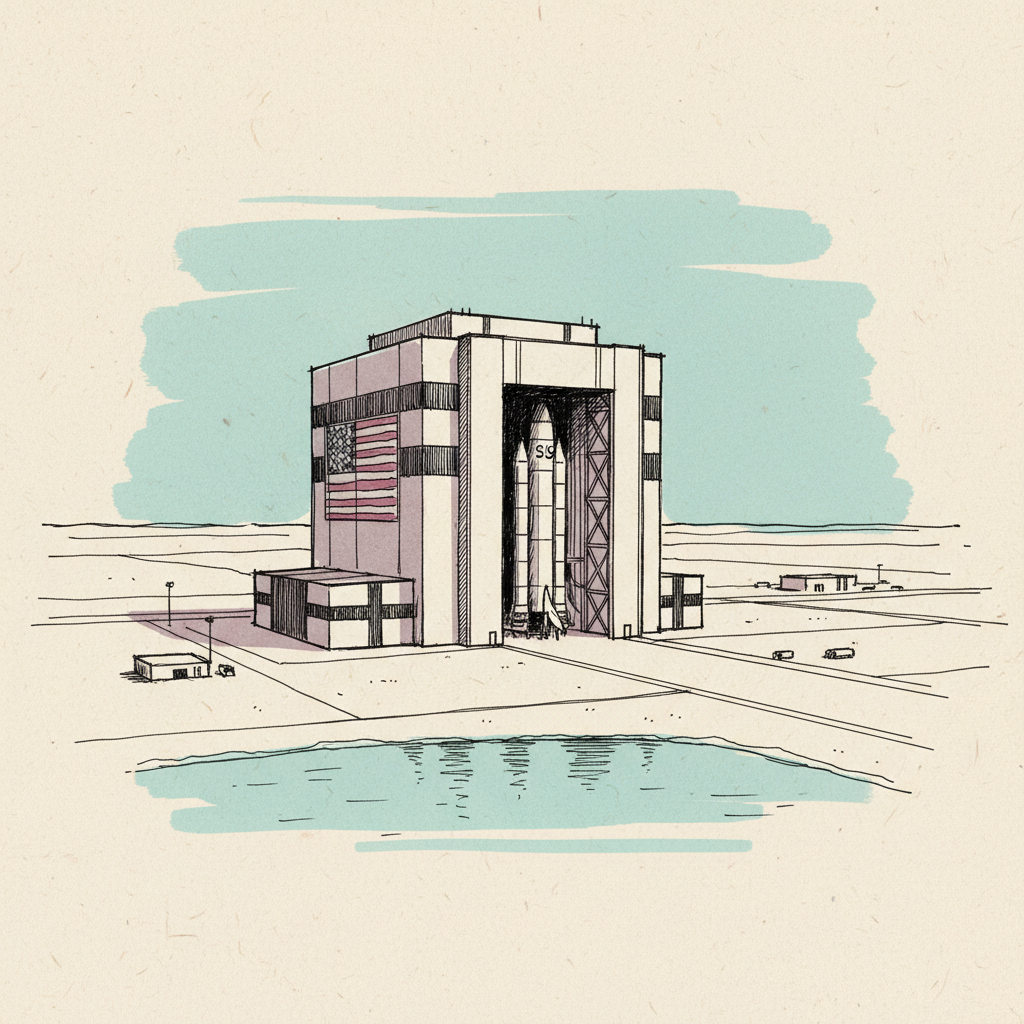
Why does NASA need a building so large it creates its own clouds inside?
Timeline for Vehicle Assembly Building
Five open Orion items, no fix dates
Artemis II Moon MissionMentioned in: Launcher rolls back from Pad 39B
Artemis II Moon MissionBackground
Mobile Launcher 1 began its transit from Launch Pad 39B to the Vehicle Assembly Building at 08:11 EDT on 16 April 2026 for Artemis III repair and stacking. Once repairs to ML-1's flame hole panels, elevators, pneumatic panels, and umbilicals are complete, the arriving Artemis III SLS core stage will be vertically integrated inside the VAB before rollout to Pad 39B.
The Vehicle Assembly Building is one of the largest structures in the world by enclosed volume. At 526 feet tall and covering 8 acres of floor space, it was built in the 1960s to stack Saturn V rockets and has been used for every major NASA launch vehicle since. the Building has its own internal weather: on humid days, clouds can form near the ceiling.
The VAB is a single-point constraint on Kennedy Space Center's launch cadence. Only one vehicle can be stacked at a time. With the Artemis III core stage arriving by barge in the coming weeks, the VAB's availability and the ML-1 repair timeline will determine when the Artemis III stack is ready for rollout and when a 2027 launch date becomes credible.
