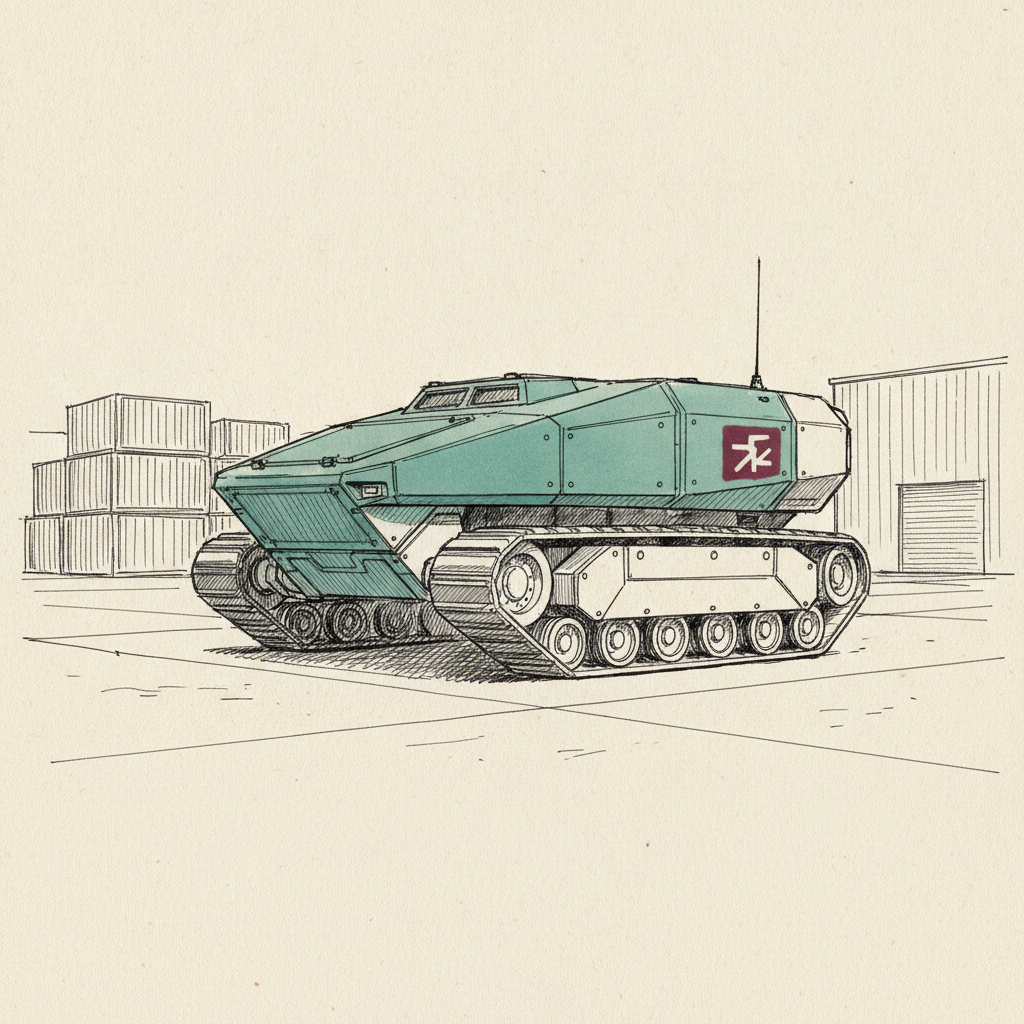
TRACKX
Finnish-Swedish heavy autonomous tracked vehicle (Patria); RENK drivetrain, 2027 serial production target.
Finland and Sweden signed a bilateral procurement arrangement for the Patria TRACKX heavy autonomous vehicle at Eurosatory on 15 June 2026, the same week RENK won a pre-series contract for its transmission, targeting 2027 serial production.
Last refreshed: 3 August 2026
Can TRACKX become NATO's standard autonomous heavy vehicle for Arctic and northern operations?
Timeline for TRACKX
Mentioned in: US Army buys the robot resupply job
Autonomous Systems: Land & SeaNordics put a heavy UGV on the line
Autonomous Systems: Land & SeaBackground
TRACKX is a heavy autonomous tracked vehicle developed by Finland's Patria Group under the EU-funded FAMOUS programme, which involves close to 20 European industrial partners and has attracted nearly €100 million in European Defence Fund and EDIDP support. It is designed to combine the high-speed mobility of wheeled platforms with the terrain-handling and protection of tracked armour, reaching 80 km/h with an operational range of up to 500 km.
Serial production is targeted for 2027, with Germany's RENK Group supplying the HSWL 076 transmission under a pre-series contract.
The vehicle's dual manned and unmanned capability, operating with a crew when required and autonomously in contested environments, makes it a flagship for EU defence-industrial cooperation on the Alliance's northern flank.
TRACKX secures its first supply contract
TRACKX, Patria's heavy autonomous tracked vehicle developed under the EU-backed FAMOUS programme, reached its first binding industrial milestone in June 2026 when RENK won a pre-series contract to supply the HSWL 076 transmission for the 10 to 20 tonne vehicle class. The same week, Finland and Sweden signed the Implementation Arrangement for Common Arctic Mobility at Eurosatory in Paris, opening formal technical exchange ahead of a 2027 serial-production target.
Capable of 80 km/h with a 500 km range, TRACKX combines wheeled-platform speed with tracked-vehicle protection, addressing a gap no existing Western platform fills for Arctic-grade autonomous operation.
What is the Patria TRACKX vehicle?
What makes TRACKX different from other armoured vehicles?
Which countries are buying the TRACKX vehicle?
