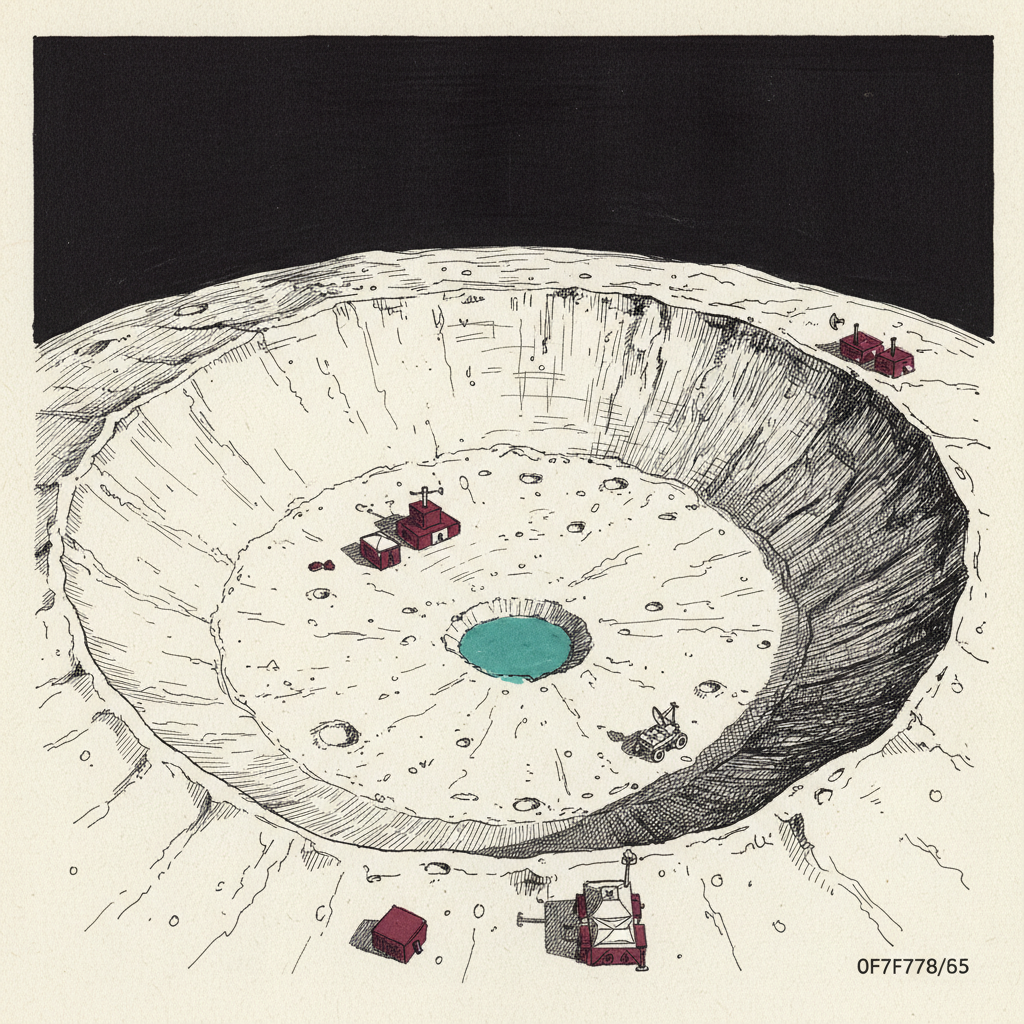
Is the Moon's most valuable real estate about to have two competing national flags planted on it?
Timeline for Shackleton crater
Chang'e 7 lands Russian payload at Shackleton
Artemis II Moon MissionDesignated as Chang'e 7 target zone for rover operations and water-ice prospecting
Artemis II Moon Mission: Chang'e 7 arrives at Wenchang for launchBackground
Shackleton crater, at the Lunar South Pole, is the primary landing target for both Chang'e 7 and NASA's Artemis crewed programme, placing it at the centre of the most direct competition in the history of space exploration. The crater rim receives near-continuous sunlight, making it viable for sustained solar-powered operations, while its permanently shadowed interior floor is where water ice is inferred to exist. Chang'e 7 arrived at Wenchang for a H2 2026 launch and will use a mini-hopper probe to explore those shadowed regions.
Shackleton is 21 kilometres in diameter and 4.2 kilometres deep. Evidence for water ice comes from the Lunar Reconnaissance Orbiter (LRO) and the LCROSS mission, which impacted a different south-pole crater in 2009 and detected hydroxyl signatures consistent with ice. Shackleton's rim sits at approximately 89.9 degrees south Latitude. ESA's Lunar South Pole Atlas (2022) identified the crater rim as offering the longest illumination periods of any south-pole candidate, averaging more than 80 per cent solar access over a lunar year.
The National Academies study DEPS-SSB-24-06, sponsored by NASA and reporting H2 2026, is specifically assessing whether there are viable Artemis IV and V landing sites away from the polar cluster. The outcome of that study will determine whether the US programme can avoid placing astronauts in physical proximity to Chinese and Russian robotic missions on the same terrain.
Why does everyone want to land on Shackleton crater on the Moon?
Is there actually water ice in Shackleton crater?
Will Chinese and American astronauts land at the same place on the Moon?
Written with AI from Lowdown's published reporting. Not individually reviewed by an editor. Updated 14 April 2026. Editorial standards.