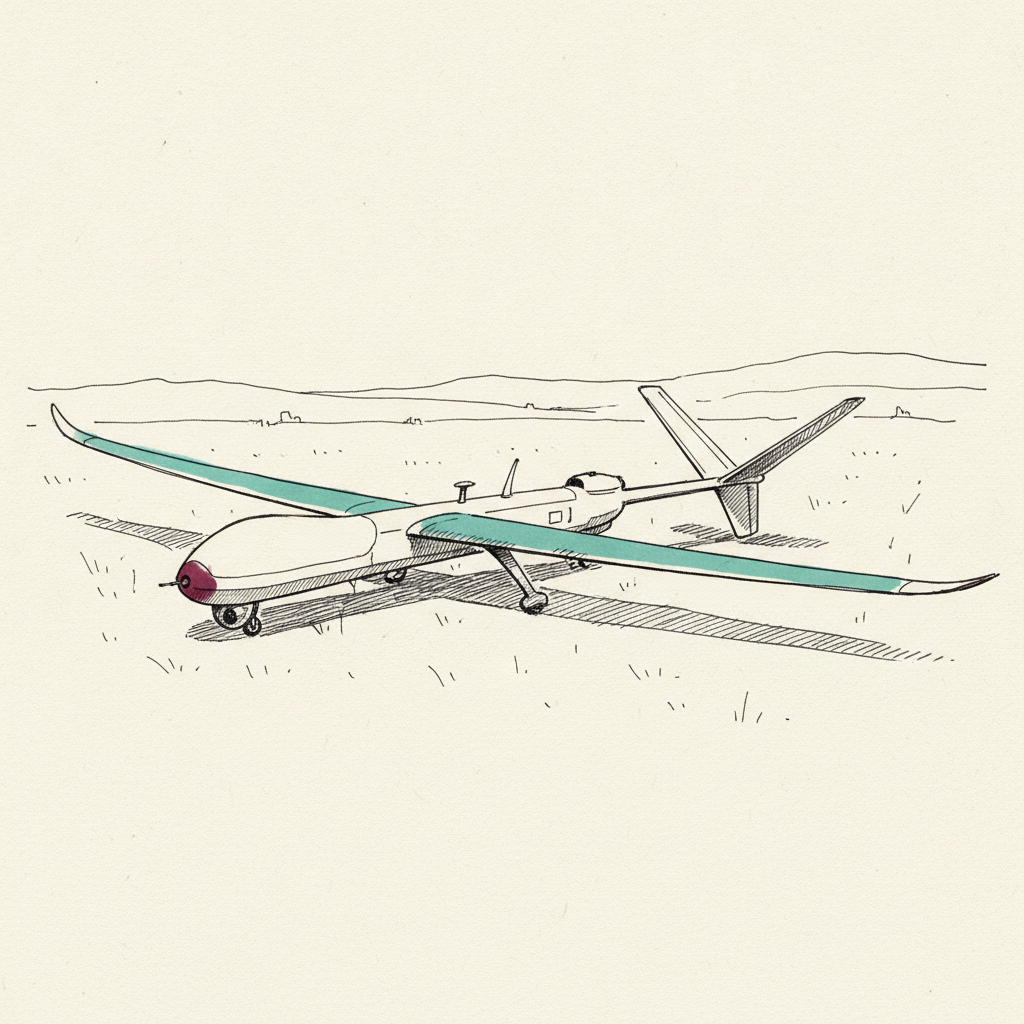
Raybird
Ukrainian-designed fixed-wing drone manufactured by Skyeton/Prevail, bidding for the UK's Project Corvus Watchkeeper replacement contract.
Last refreshed: 25 June 2026 · Appears in 1 active topic
Can a 23 kg Ukrainian combat drone do what a £1 billion British programme could not?
Background
The Raybird (also designated ACS-3 or Raybird-3) is a fixed-wing long-endurance uncrewed aerial system developed by Ukrainian manufacturer Skyeton, and the platform proposed for the British Army's Project Corvus requirement. With more than 350,000 combat flight hours logged by Ukrainian Armed Forces since 2016, it is among the most operationally validated ISR drones in NATO-compatible inventory. In September 2025 the system participated in the British Army's Iron Titan exercise; a Plymouth production line has been proposed for UK manufacture if the Corvus contract is won.
The Raybird is a NATO Class I platform weighing 23 kg at maximum takeoff weight, with a 2.96m wingspan and endurance exceeding 28 hours. It is catapult-launched and parachute-recovered, deployable from austere sites within 25 minutes. Propulsion is a single-cylinder four-stroke GF40 injector gasoline engine producing 3.8 hp. Service ceiling is 5,500m; the control link reaches 240km with an offline autonomous range of 2,500km. Integrated payloads include gimballed electro-optical/infrared cameras, laser designators, synthetic aperture radar, ELINT sensors, and first-person-view quadcopters. The ACS-3M variant, introduced in October 2020, added an improved injector engine and SAR capability. The system is resistant to electronic warfare jamming through wideband frequency-agile communications.
The Raybird's significance to Project Corvus is its combination of combat proof and price point: where the Watchkeeper Mk1 cost over £1 billion and suffered persistent airworthiness failures, the Raybird has operated continuously in one of the most contested electronic environments in modern warfare. A Plymouth production line would satisfy UK industrial-participation requirements while accelerating the sovereign manufacturing base the MoD has sought since the Watchkeeper programme collapsed.
What are the specifications of the Raybird drone?
How has the Raybird drone performed in Ukraine?
Why is the Raybird being considered to replace the Watchkeeper?
What payloads can the Raybird carry?







Written with AI from Lowdown's published reporting. Not individually reviewed by an editor. Updated 25 June 2026. Editorial standards.