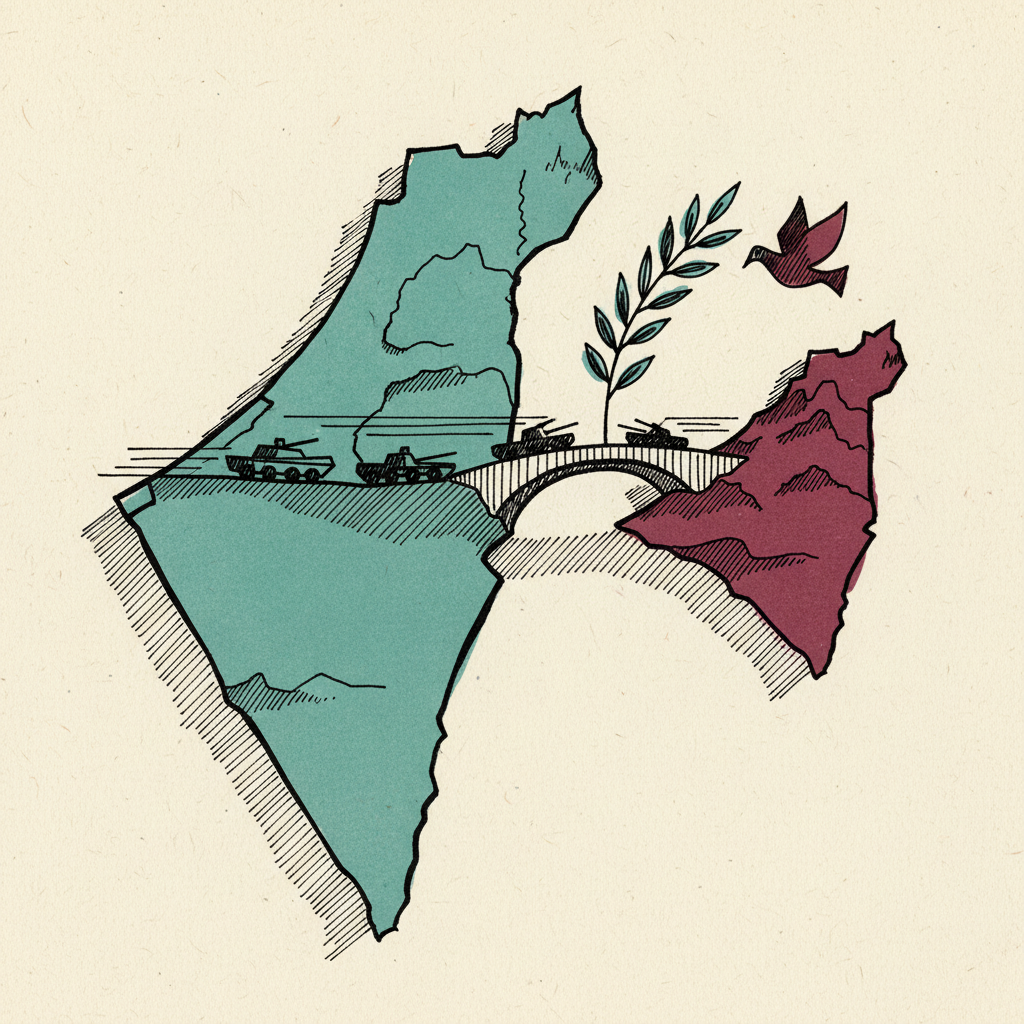
How does 1982's Operation Peace for Galilee explain Israel's 2026 Lebanon advance?
Timeline for Operation Peace for Galilee
Mentioned in: Israel takes Beaufort Castle above the Litani
Iran Conflict 2026Mentioned in: Israel evacuates seven southern Lebanon towns
Iran Conflict 2026Mentioned in: 36th Division doubles Lebanon force
Iran Conflict 2026Mentioned in: 91st Division crosses into Lebanon
Iran Conflict 2026Mentioned in: Israel pushes 91st Division into Lebanon
Iran Conflict 2026Background
Operation Peace for Galilee was the Israeli invasion of Lebanon launched on 6 June 1982, ordered by Prime Minister Menachem Begin and directed by Defence Minister Ariel Sharon. The stated objective was to push PLO forces 40 km north of the Israeli border, ending rocket attacks on the Galilee. In practice the operation extended to Beirut, where Israeli forces besieged the western half of the city for ten weeks, compelling the PLO to evacuate to Tunisia in August 1982. Israel occupied southern Lebanon until the phased withdrawal of 2000. The war killed an estimated 17,000-20,000 people, the majority Lebanese civilians, and triggered the Sabra and Shatila massacre in which Lebanese Phalangist militias, operating in an Israeli-controlled area, killed between 700 and 3,500 Palestinian civilians. The Israeli state commission of inquiry — the Kahan Commission — found Sharon bore personal responsibility and forced his resignation as Defence Minister.
The operation was also the crucible of Hezbollah. Iranian Revolutionary Guard advisers deployed to the Bekaa Valley in response to the invasion, helping build the movement that would come to fill the power vacuum created by the PLO's expulsion. In that sense Operation Peace for Galilee produced the very threat Israel now fights: the 1982 invasion is the reason Hezbollah exists. The operation established the pattern of IDF use of the 91st Galilee Division, the Beaufort Castle fortress on the Litani as a symbolic and tactical objective, and the Litani River line as the default limit of operations — all elements that recurred directly in 2026.
In the 2026 war, Operation Peace for Galilee functions as the explicit historical template. Israeli forces captured Beaufort Castle on 1-2 June 2026, holding it for the first time since the 2000 withdrawal and retracing the 1982 advance. The IDF 91st Galilee Division that entered eastern southern Lebanon in March 2026 is the same formation that crossed the border in 1982. The political and strategic debate in 2026 — whether to stop at the Litani or push further, whether to accept a diplomatic settlement or hold territory — directly mirrors the decisions that turned a stated 40 km buffer into an 18-year occupation.
What was Israel's Operation Peace for Galilee in 1982?
How did the 1982 Lebanon invasion create Hezbollah?
What is the connection between the 1982 Lebanon war and the 2026 Israeli advance?
What was the Sabra and Shatila massacre?


Written with AI from Lowdown's published reporting. Not individually reviewed by an editor. Updated 3 June 2026. Editorial standards.