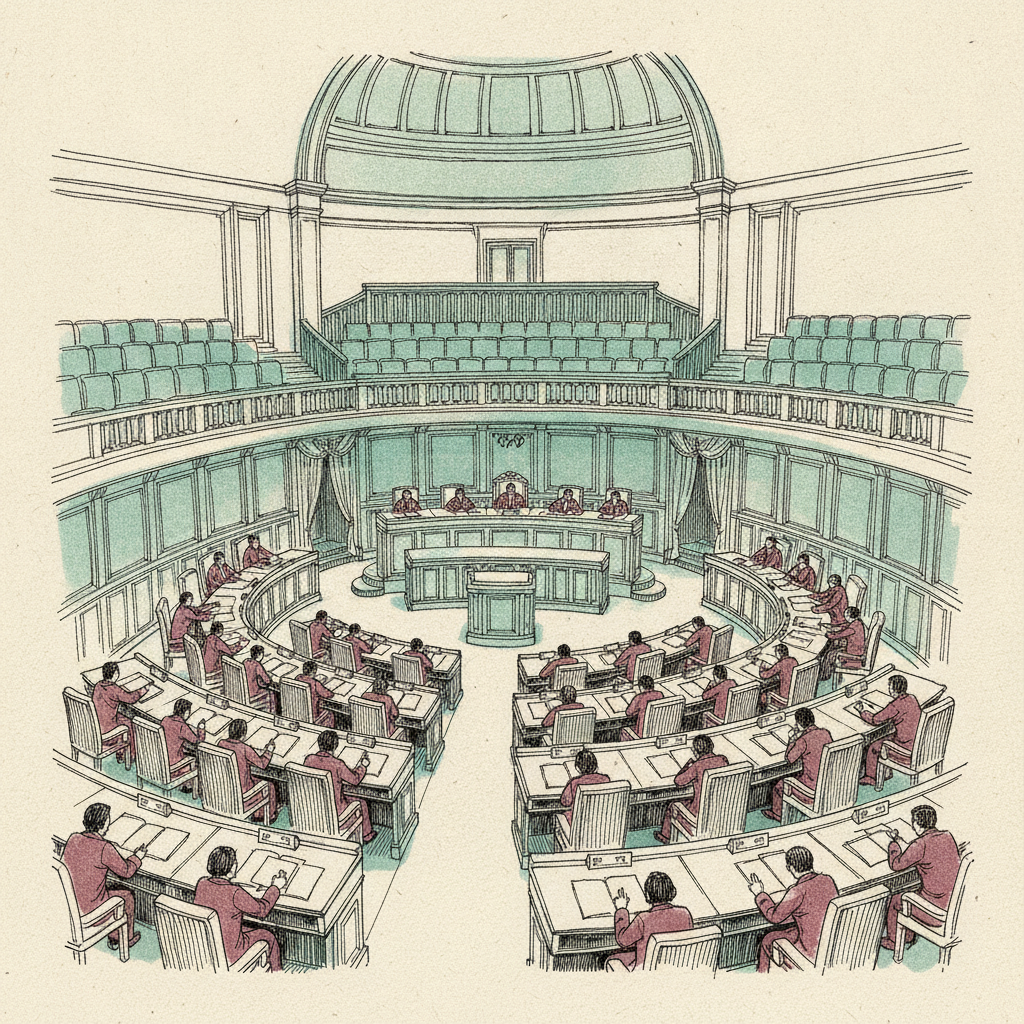
National Assembly of People's Power
Cuba's unicameral national legislature, which passed the June 2026 reform package.
Last refreshed: 19 June 2026 · Appears in 1 active topic
Did Cuba's legislature actually debate the 176-measure reform package, or rubber-stamp it?
Timeline for National Assembly of People's Power
Mentioned in: Cuba lets foreign firms hire directly
Cuba DispatchMentioned in: Sharif attends; the West sends no one
Iran Conflict 2026Cuba opens its market in 176 steps
Cuba DispatchBackground
The National Assembly of People's Power (Asamblea Nacional del Poder Popular) is Cuba's unicameral national legislature, established under the 1976 constitution and retained in the revised 2019 constitution. It comprises 474 deputies elected every five years from a single-party slate, with candidates selected through a process controlled by the Communist Party of Cuba. The Assembly meets in full session only twice per year, with legislative work conducted between sessions by a 31-member Council of state, whose president is also Cuba's head of state.
On 18 June 2026, the Assembly passed a 176-measure economic reform package in a special session, the deepest market opening in Cuba since the 1960s nationalisations . The package had been pre-approved by a Communist Party plenum on 17 June before reaching the Assembly, following the established pattern in which the Assembly ratifies decisions made within the party structure rather than independently deliberating them. President Miguel Diaz-Canel announced the package on 12 June, and the plenum-to-Parliament sequence was completed within 24 hours.
The legislative process for the June 2026 reforms illustrated the Assembly's role as a ratification body rather than a deliberative one. The 176 measures covered private banking, dollar accounts, Cryptocurrency, non-state fuel imports, SME deregulation, ministry consolidation, and subsidy reform, all presented as a composite package. The European Parliament's June 2026 resolution calling for Magnitsky-style sanctions cited the Assembly's structural relationship with the Communist Party as evidence of Cuba's non-democratic governance, while the Cuban government used the Assembly's unanimous passage as evidence of legitimacy and national consensus .