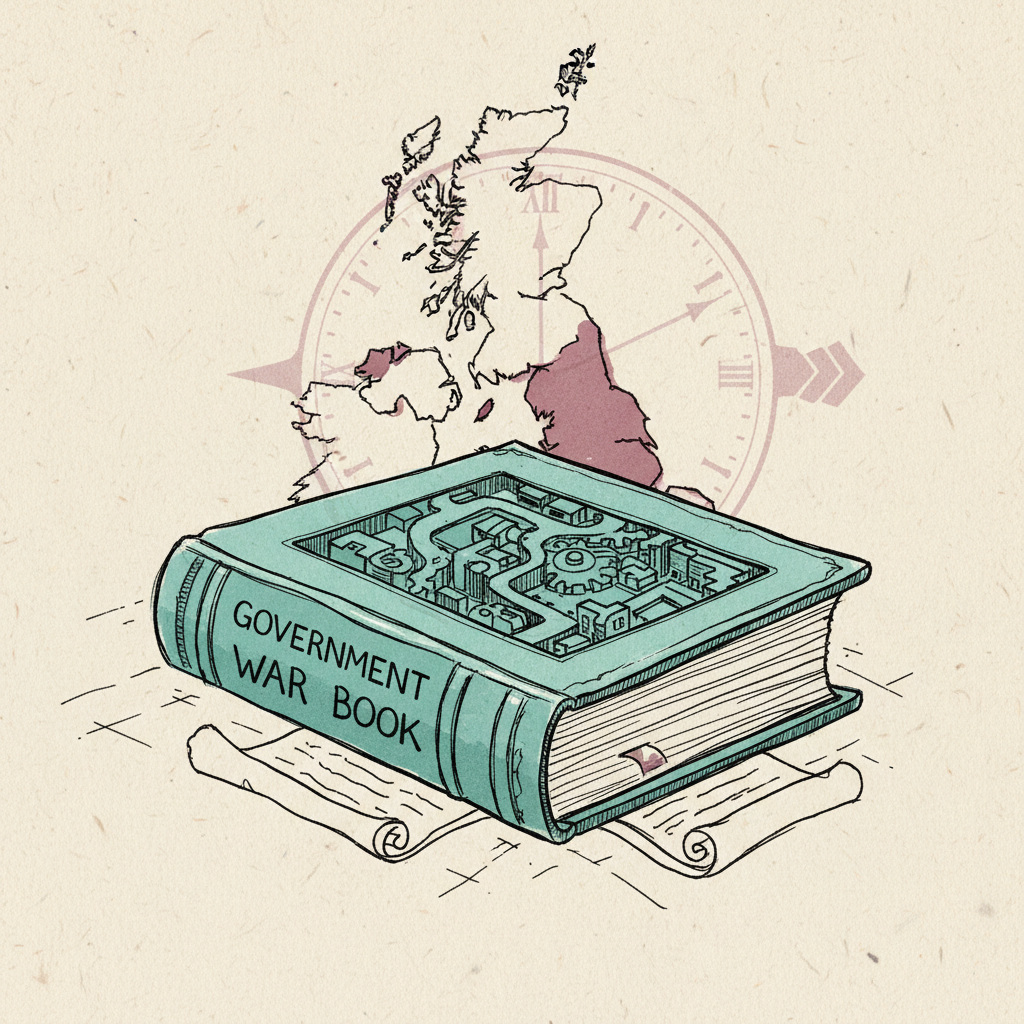
Government War Book
UK civil-mobilisation doctrine from WWI, scrapped in 2004, revival announced April 2026 by the CDS.
Last refreshed: 24 April 2026 · Appears in 1 active topic
What is the Government War Book and why did the UK revive it in 2026?
Timeline for Government War Book
Announced as being rebuilt by CDS Knighton, citing Iran-Ukraine dual-conflict drivers
Russia-Ukraine War 2026: UK reopens War Book, hosts 30-nation Hormuz meetBackground
The Government War Book is the United Kingdom's framework for coordinating civil and military mobilisation in a national emergency. First developed during the First World War, it sets out how Cabinet Office-led planning integrates military commands, police, industrial capacity, and the National Health Service in a crisis. It was maintained through the Cold War and the early POST-Cold War period, then allowed to lapse in the early 2000s as the threat environment was deemed to have diminished.
On 10 April 2026, Air Chief Marshal Sir Richard Knighton, the Chief of the Defence Staff, told Sky News at the London Defence Conference that Whitehall is building a "modern version" of the War Book. He cited both Ukraine and the Iran conflict as drivers: "in a modern context, with a modern society, with modern infrastructure". The announcement confirmed that the UK's operational planning community no longer regards the POST-Cold War assumptions of the early 2000s as adequate.
The War Book revival sits in a UK defence context that critics characterise as under-resourced. Lord Robertson, commissioned by the Prime Minister to Conduct a review of the armed forces, accused the government of "corrosive complacency" on defence during the same period. A £28 billion decade-long funding shortfall is cited in parliamentary and media reporting. The War Book is an institutional planning mechanism, not a budget line; its revival can proceed independently of procurement funding, which is why its announcement preceded any corresponding spending commitment.

