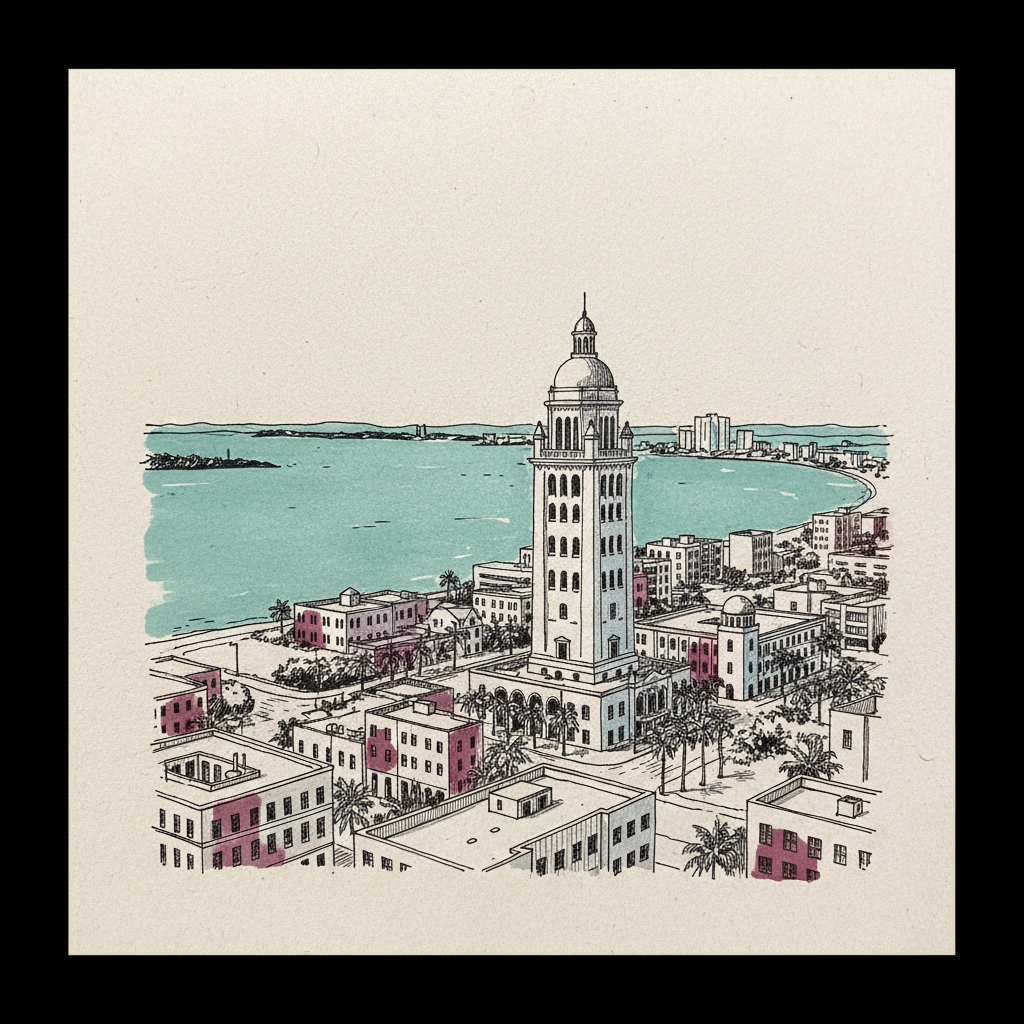
Freedom Tower
Historic Miami building that processed Cuban refugees during the 1960s–1970s; now a symbol of the Cuban-American exile community.
Last refreshed: 28 May 2026 · Appears in 1 active topic
Why did the DOJ unseal the Raul Castro indictment at Miami's Freedom Tower?
Timeline for Freedom Tower
Raul Castro charged over 1996 shoot-down
Cuba DispatchBackground
Freedom Tower became the site of a deliberate political act on 20 May 2026 when the Department of Justice chose it to unseal the superseding grand jury indictment charging Raul Castro with conspiracy to murder four Cuban-American aviators. The date was Cuban Independence Day. A prosecutor does not select that venue by accident: the choice converted a legal filing into an address to the exile community.
the Building at 600 Biscayne Boulevard, Miami, was constructed in 1925 as the home of the Miami News and later the Miami Daily News. Its distinctive Baroque tower is modelled loosely on the Giralda in Seville. When the Miami News closed in 1957, the federal government leased it as a processing and aid centre for Cuban refugees fleeing the Castro revolution; between roughly 1962 and 1974 more than 650,000 Cubans passed through its doors for medical screening, job placement, and resettlement assistance. That function gave it the name Freedom Tower, a deliberate echo of Ellis Island. It was designated a National Historic Landmark in 2008 and is now owned by Miami Dade College, which uses it as a cultural and exhibition centre.
the Building is the pre-eminent symbol of the Cuban exile experience in the United States. Choosing it to unseal a criminal charge against a living Cuban leader on the anniversary of Cuban independence signals the intended audience as clearly as the legal text. Miami's Cuban-American community, which has pressed successive administrations on accountability for the 1996 shoot-down, received the indictment at the landmark most associated with that community's founding trauma.
Why is Freedom Tower important to Cuban Americans?
Where is Miami's Freedom Tower?
Why was the Raul Castro indictment unsealed at Freedom Tower?
