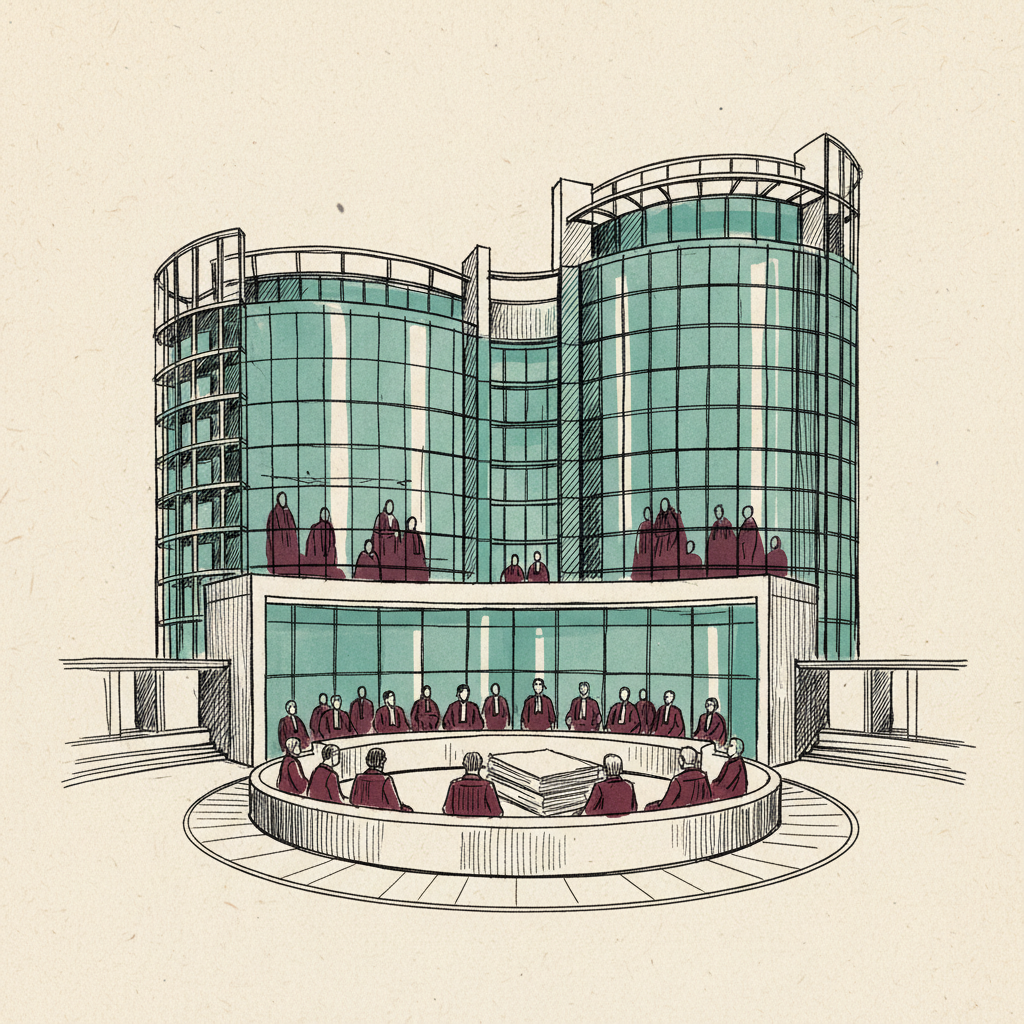
CJEU
EU's Supreme Court, seated in Luxembourg; rules on EU law and member state compliance.
Slovakia is now the sole Challenger to the EU's Russian pipeline gas ban after Hungary's Tisza government dropped its case in May 2026. The CJEU refused Slovakia an interim stay, and the ban bound on 17 June 2026.
Last refreshed: 4 August 2026 · Appears in 3 active topics
Can Hungary and Slovakia's CJEU challenge actually halt the EU Russian gas ban before winter 2026?
Timeline for CJEU
Mentioned in: Google files no appeal to its €890m DMA fine
European Tech SovereigntyAI Act fines land on a stale register
European Tech SovereigntyMentioned in: Slovakia says Brussels signed on gas
European Energy MarketsDismissed Google's final appeal, confirming the €4.1bn fine
European Tech Sovereignty: Google loses €4.1bn EU Android appealMentioned in: The ban's own text makes it porous
European Energy MarketsBackground
the Court of Justice of the European Union is the EU's highest judicial body, seated in Luxembourg. It operates in two tiers: the Court of Justice, with 27 judges, one per member state, and the General Court, with 54 judges, which handles first-instance competition, state-aid and trade cases. It traces its origin to 1952, as the Court of Justice of the European Coal and Steel Community.
Its core functions are to ensure uniform application of EU law through preliminary rulings under Article 267 TFEU, infringement actions brought by the Commission, and challenges to the validity of EU acts. It grants interim relief, suspending an EU act pending full annulment proceedings, only where an applicant demonstrates urgency and a real risk of serious and irreparable harm; that threshold is deliberately high, and most suspension bids fail at the interim stage.
That structure makes the Court an active enforcement lever across the full landscape of EU law, from sanctions and trade disputes to competition rulings and constitutional questions about voting thresholds in the Council, rather than a body confined to any single policy area.
Slovakia stands alone against the ban
Viktor Orban's government filed the original February 2026 challenge to Regulation 2026/261, arguing the Russian pipeline gas ban needed unanimous Council approval as a sanction rather than a majority-vote trade act. Peter Magyar's Tisza government took office in May 2026 and withdrew the interim relief application, ending the dual-state pressure Budapest and Bratislava had built.
Robert Fico's government pressed on with Slovakia's own annulment claim after Hungary's withdrawal, but the Court refused it an interim stay on 17-18 June 2026, and the ban bound on 17 June with no judicial relief granted. Fico's annulment case now proceeds on the merits alone, a track that runs for years while the ban already applies.
Court dismisses an eight-year appeal
the Court of Justice dismissed a final appeal on 2 July 2026, confirming a €4.1bn fine imposed over Android licensing practices dating to 2018. The ruling closes an eight-year case that tested how far a dominant platform's contractual bundling can go under EU competition law.
The dismissal lands as Brussels weighs a separate, more recent fine against the same company under newer EU digital-platform rules, illustrating how the Court's competition docket and its digital-markets docket can run in parallel against the same defendant on different legal grounds.
What is the CJEU and how does it differ from the European Court of Human Rights?
Can Hungary's CJEU challenge stop the EU Russian gas ban?
How long does a CJEU infringement case take?
Which EU member states face CJEU referral for missing energy law deadlines?
Did the CJEU block the EU gas ban before it took effect?
Why is it hard to get an emergency suspension from the CJEU?
Written with AI from Lowdown's published reporting. Not individually reviewed by an editor. Updated 4 August 2026. Editorial standards.