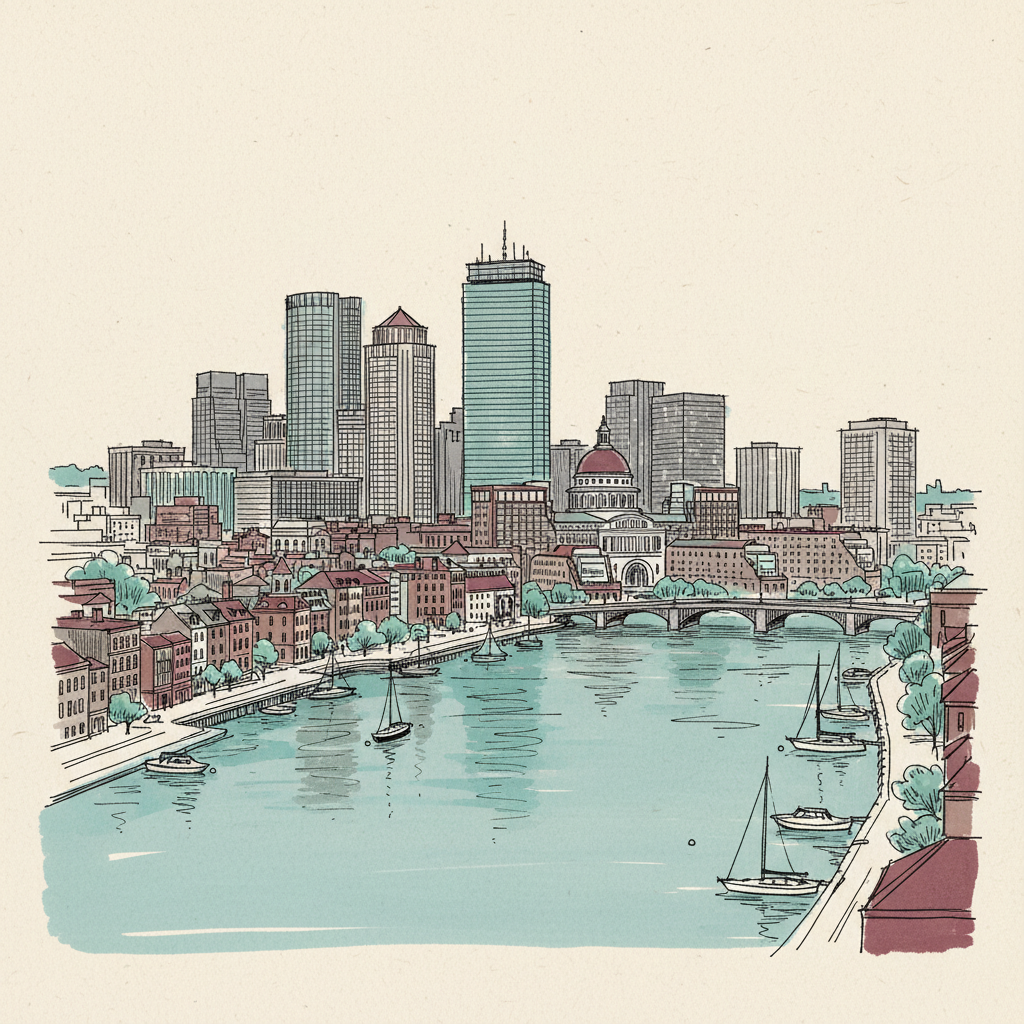
Boston
Massachusetts capital; one of America's oldest cities; 2026 World Cup host at Gillette Stadium.
On 9 July, Boston's World Cup hosting reached the quarter-finals when France beat Morocco 2-0 at Gillette Stadium, sending France into the last four.
Last refreshed: 22 September 2026 · Appears in 2 active topics
Why hasn't Boston published a human rights plan 31 days before the World Cup?
Timeline for Boston
Mentioned in: Mindgard's $30m leads a spinout week
UK Startups and InnovationMentioned in: Wells Fargo cuts, and names the machine
AI: Jobs, Power & MoneyMentioned in: France meet Spain in first semi-final
2026 FIFA World CupHosted the France-Morocco quarter-final
2026 FIFA World Cup: Africa's last team out as France winMentioned in: Morocco knock Canada out of home Cup
2026 FIFA World CupBackground
Boston is the capital of Massachusetts and was founded in 1630. It sits at the centre of a metropolitan area of about 4.9 million people. Higher education, medical research, finance and technology shape its economy, with Harvard University, the Massachusetts Institute of Technology and major teaching hospitals forming a large part of its institutional identity.
The 2026 World Cup gave Boston a regional host role through Gillette Stadium in Foxborough, about 40km south of the city centre. The venue staged tournament matches including the France-Morocco quarter-final on 9 July. Federal World Cup security spending reached $875m in March 2026, showing the scale of security support attached to host areas across the United States.
Boston hosted a knockout match
On 9 July, Boston's World Cup role centred on the quarter-final at Gillette Stadium in Foxborough, where France beat Morocco 2-0. The result sent France to the semi-finals and ended Morocco's run as the last remaining side from the tournament's ten-nation African contingent.
Boston hosted the area's highest-profile knockout fixture. The pairing had been set on 4 July as a repeat of France's 2022 semi-final win over Morocco, placing the regional host venue on the tournament's decisive route rather than only its group-stage schedule.
Boston lacked a public rights plan
On 11 May, Boston was among 12 of 16 World Cup host-city committees that had not published a public Human Rights Action Plan. Fans connected to the Boston host area therefore had no public framework explaining how organisers would address rights risks during the tournament.
Football's governing body said every host city had submitted a plan privately. Its 2017 framework treated private submission as compliance, so Boston faced no stated procedural penalty despite the absence of a public document before matches began at Gillette Stadium.
What happened when France played Morocco in Boston?
Has Boston published a World Cup human rights plan?
What is Boston known for besides sport?
How far is Gillette Stadium from Boston city centre?
Where is the World Cup stadium in Boston?
Who paid for World Cup security in Foxborough?
How much World Cup security funding did Massachusetts get?


